


A new voters’ survey has challenged the long-held assumption that Nigerian voters are largely unwilling to elect women, youth and persons with disabilities, saying the bigger problem may lie in the limited opportunities given to these groups to emerge as candidates and gain visibility. The survey, conducted by Invictus Africa, found that substantial numbers of voters are willing to support candidates from the three underrepresented groups ahead of the 2027 General Elections, but many said they had never voted for them because they were unaware that such candidates were on the ballot.
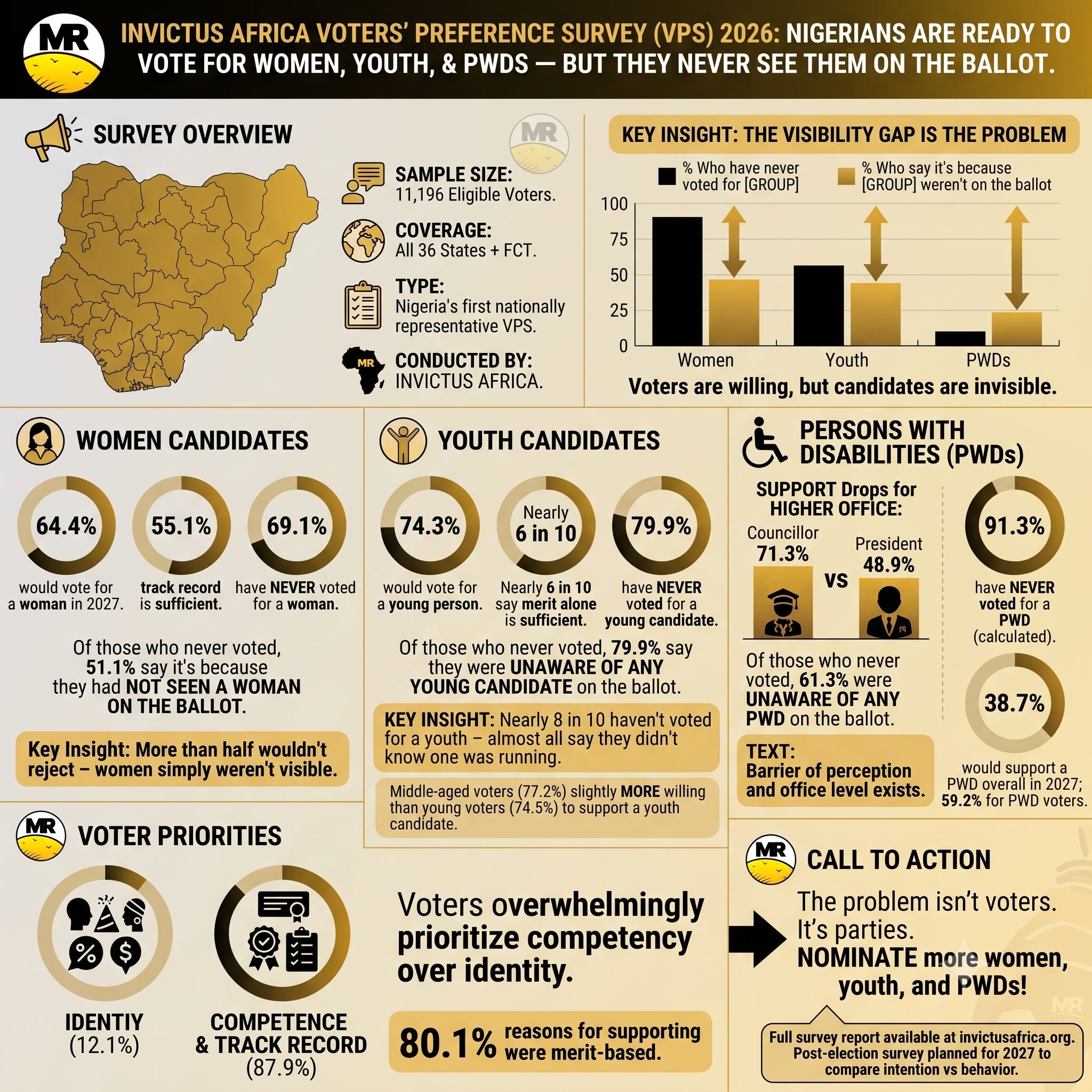
The nationally representative survey covered 11,196 eligible voters across Nigeria’s 36 states and the Federal Capital Territory. The Executive Director of Invictus Africa, Bukky Shonibare, said the findings point to a need to move the national conversation away from simply asking why Nigerians are not voting for women, young people and persons with disabilities, to examining whether political parties are providing them with a fair opportunity to contest elections.
The survey found that 69.1 per cent of respondents had never voted for a woman in an election. However, 51.1 per cent of those who had never done so said the reason was that they had not seen a woman on the ballot. The finding contrasts with voters’ stated willingness to support women in future elections. According to the survey, 64.4 per cent of respondents said they would vote for a woman in the 2027 elections. The same pattern emerged in the findings on youth. The survey showed that 79.9 per cent of respondents who had never voted for a young candidate said they were unaware of any young candidate on the ballot. Yet, 74.3 per cent of respondents said they would support a young candidate.
The survey suggests that the absence of women, youth and persons with disabilities in elected positions cannot be explained solely by voters’ attitudes. “The conversation must go beyond whether Nigerians are willing to vote for candidates from underrepresented groups. We must also ask whether these candidates are being given a fair opportunity to emerge,” Shonibare said.
The winners: women, youth and persons with disabilities, who now have data to challenge the narrative that voters reject them; and Nigerian democracy, which may benefit from greater inclusion. The losers: political parties, which must now answer uncomfortable questions about their nomination processes; and the Nigerian public, who must demand more inclusive ballots.
Bottom Line: Nigerians are willing to vote for women and youth. The real obstacle is that they rarely appear on the ballot. The barrier is not the electorate. It is the political establishment.