


A woman in Ikeja buys a tube of body lotion for her baby. A man in Kano buys malaria tablets from a chemist he has used for years. A family in Onitsha opens a bottle of wine at a birthday party. Each of them is taking a gamble. The gamble is not about price. It is about whether the product is real. Between January and August 2026, the National Agency for Food and Drug Administration and Control (NAFDAC) destroyed unsafe, banned and falsified products worth ₦22.73 billion. The figure is enormous. It is also reassuring only in the way that a body count is reassuring. It tells you how many were caught. It does not tell you how many were missed.
The numbers
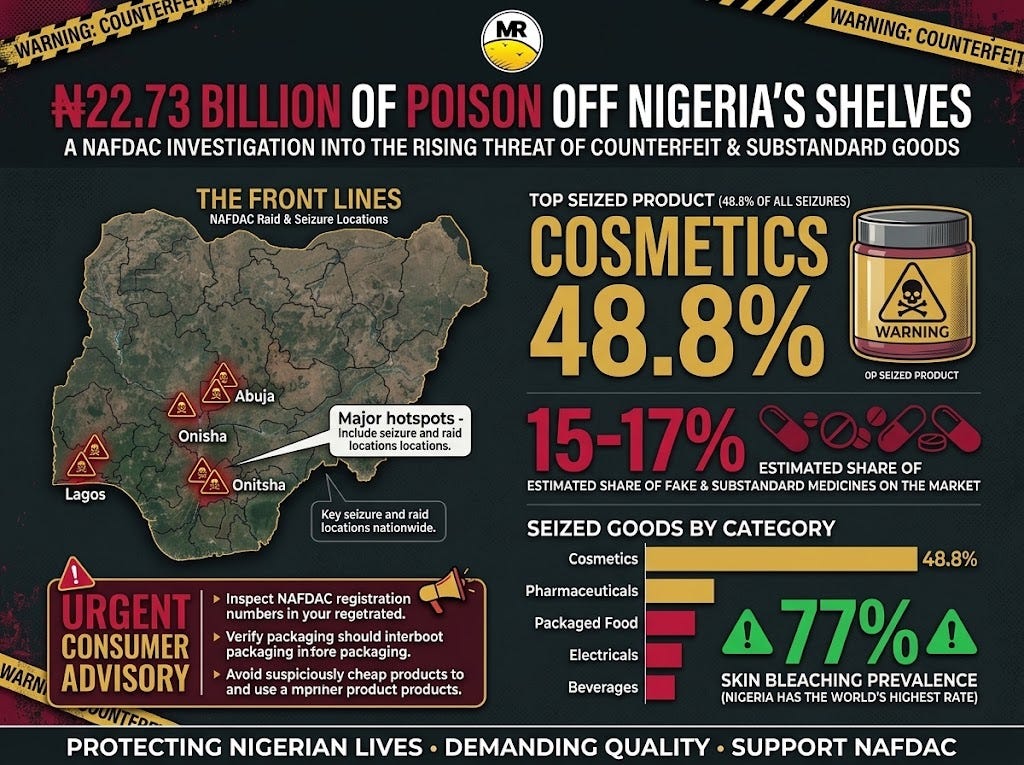
NAFDAC’s enforcement data for the eight-month period is stark. The agency conducted 213 targeted raids. It opened 474 new investigative cases. It sealed 179 non-compliant establishments. It arrested 52 primary suspects. Across 821 recorded seizure entries, the pattern of attack becomes clear. Cosmetics topped the list with 401 entries. Drinks and beverages followed with 215. Pharmaceutical drugs and medical products accounted for 112. The rest were food items, chemicals and assorted goods.
The cosmetics figures tell their own story. Nigeria’s skin-bleaching market is vast. It is also deadly. Banned substances like mercury and hydroquinone remain in circulation. They cause kidney damage, skin cancer and permanent disfigurement. The drinks figures reflect something else. Social consumption creates demand for familiar brands. Counterfeiters exploit that demand. They refill branded bottles with industrial alcohol. They dilute spirits. They revalidate expired stock.
The pharmaceutical figures are the most alarming. Fake antimalarials. Substandard antibiotics. Adulterated cough syrup. Expired lifestyle drugs repackaged with new expiry dates. These products do not just fail to treat illness. They kill. They also breed drug resistance. A patient who takes a sub-therapeutic dose of an antimalarial does not just remain sick. The parasite learns. It adapts. The next treatment becomes harder.
The historical anchor
This is not Nigeria’s first war against fake products. It is not even the second. In the 1990s and early 2000s, counterfeit medicines flooded Nigerian markets. An estimated 70% of drugs in circulation were fake. Patients died from fake paracetamol. Children died from contaminated syrup. The crisis was so severe that the World Health Organization flagged Nigeria as a global hotspot for falsified pharmaceuticals.
The turning point came with Dora Akunyili. She led NAFDAC from 2001 to 2008. She raided markets. She burned fake drugs. She prosecuted traffickers. She survived an assassination attempt. By the time she left, the share of counterfeit drugs had fallen significantly. But the victory was never complete. The counterfeiters adapted. They moved to cosmetics. They moved to drinks. They moved to food imports. They exploited weak borders and porous markets.
Two decades later, the pattern repeats. Under Professor Mojisola Adeyeye, NAFDAC has resumed aggressive enforcement. Adeyeye has said repeatedly that protecting public health is the agency’s non-negotiable mandate. She has warned that regulatory oversight must evolve as fast as the counterfeiters. The 2026 data suggests she means it. But the data also suggests the counterfeiters remain several steps ahead in reach, if not in sophistication.
Raid one: the Trade Fair alcohol syndicate
In October 2026, NAFDAC operatives stormed a two-storey building at Zamfara Plaza in the Balogun Business Association section of the Lagos Trade Fair Complex. The location was chosen for scale. The complex handles millions of goods daily. A counterfeiting operation inside it could move product across the country within days.
Inside, operatives found an industrial-scale operation. Suspects were blending and diluting popular alcoholic brands. They were revalidating expired drinks for resale. They were stockpiling banned imported spirits. NAFDAC evacuated drums, filtration equipment, heating devices and packaging materials. It seized products worth over ₦2 billion. It arrested two suspects, Chibuzor Okafor and William John.
Okafor offered a defence that captured the moral emptiness of the trade. “I deal in drinks. I change the bottle of the drink. It’s not that the bottle is not good. It’s the drink in there, because the other one is already damaged. So that’s why we are putting it in the next bottle.” He spoke as though he were recycling soft drinks. He was not. He was putting expired alcohol and industrial chemicals into circulation.
Raid two: the falsified pharmaceutical network
Earlier in the year, NAFDAC intercepted over 10 million doses of fake malaria medicine at the Lagos Trade Fair Market. The operation was intelligence-led. It targeted major distribution hubs. Subsequent raids uncovered substandard antibiotics, adulterated cough syrups and expired drugs with fresh expiry dates.
The scale is hard to grasp. Ten million doses is not a warehouse accident. It is a supply chain. It requires manufacturing, packaging, distribution and market penetration. It means that at some point, a patient somewhere received chalk instead of medicine. It means that at some point, a child died of a treatable illness because the treatment was fake.
The consequence is not just death. It is distrust. Patients now cross-check hologram seals. They scan barcodes with verification apps. They demand imported brands out of fear that domestic alternatives are fake. The healthcare system suffers when trust collapses. Doctors prescribe. Patients hesitate. Pharmacists stock products they cannot verify.
The human cost
Mrs Abimbola Thomas is a 34-year-old accountant and mother of two in Ikeja. She described the feeling that follows every NAFDAC announcement. “When you hear that NAFDAC has seized billions of Naira worth of fake goods, you are supposed to feel relieved. Instead, you feel terrified. It makes you look at every tube of body lotion you bought for your baby, every bottle of wine you opened at a family birthday, and every packet of malaria tablets in your medicine cabinet with suspicion. You begin to wonder: was my family part of the unlucky ones who consumed poison before the raid happened?”
Mallam Sani Danlami, a retired civil servant in Kano, described an ordeal that nearly killed him. “Last year, I bought malaria medication from a regular chemist, and after taking the full course, my condition worsened until I collapsed and had to be rushed to a teaching hospital. The doctors later told me the drugs were completely fake. When you read in the news about NAFDAC seizing warehouses full of fake tablets, you realize how many people are dying silently because criminals want to make fast money off our sickness.”
Dr Zainab Ahmed is a public health physician and clinical researcher in Abuja. She framed the pharmaceutical raids in clinical terms. “When a patient suffering from severe malaria takes a fake antimalarial drug containing mere chalk or sub-therapeutic doses of active ingredients, the parasite builds resistance while the patient deteriorates. These counterfeiters are not just committing economic sabotage. They are actively sabotaging Nigeria’s clinical survival. NAFDAC’s seizure of millions of doses of fake drugs is a monumental victory, but it also exposes how deeply penetration has gone into our supply chains.”
Mr Emeka Nduka, a Lagos-based hospitality vendor, reacted to the Trade Fair raid with anger. “Listen to the suspect’s excuse. He talks about changing bottles like he is recycling soft drinks, not realizing he is putting industrial chemicals and expired alcohol into circulation that can cause kidney failure or permanent blindness. Men like this are murderers operating in daylight. The courts must ensure that a ₦2 billion seizure is matched with a prison sentence that sends a clear warning to every other criminal in our markets.”
Raid three: banned imports and toxic consumables
Beyond alcohol and drugs, NAFDAC has targeted food imports and chemical safety. In October alone, the agency intercepted ₦300 million worth of banned alcoholic drinks in Lagos. Separate nationwide operations seized hundreds of millions of Naira worth of food items contaminated with excessive pesticide residues and banned chemical preservatives.
The economic logic is simple. As inflation compresses household budgets, consumers search for cheaper alternatives. Unscrupulous traders exploit that vulnerability. They flood the market with cheap, expired or chemically altered products. The consumer saves a few hundred naira. The consumer pays with their health.
The enforcement gap
Comrade Wale Adebayo is executive director of a Lagos-based consumer rights advocacy initiative. He argued that regulatory enforcement must be treated as a matter of national security. “NAFDAC cannot be everywhere at once. With 213 raids and 474 new cases in just eight months, the agency is stretching its personnel to the absolute limit. But raids and seizures are only firefighting measures. To truly defeat this syndicate network, we need coordinated intelligence sharing between community leaders, market associations and the judiciary. If the cost of getting caught is merely losing inventory while walking free on administrative bail, the trade will continue. Counterfeiting food and medicine is an act of biological warfare against the Nigerian people, and our laws must treat it with the ultimate severity it deserves.”
His point is precise. NAFDAC’s enforcement is necessary. It is also insufficient. The agency has 213 raids to its credit. It also has 179 sealed establishments and 52 arrests. But the counterfeiters are not deterred by seizures. They are deterred by prison. If traffickers face administrative bail and return to business, the raids become a cost of doing business. Inventory is lost. Profits continue.
The structural problem
Nigeria’s counterfeit trade survives because three conditions persist. First, demand exceeds supply. Poverty drives consumers toward cheap goods. Second, enforcement is thin. NAFDAC cannot inspect every market, warehouse and pharmacy. Third, prosecution is weak. Cases drag. Convictions are rare. Traffickers calculate risk. They accept the risk because the penalties are low.
The solutions are known. They require stronger penalties. They require faster courts. They require coordination between NAFDAC, the police, Customs and the judiciary. They require consumer education. They require community vigilance. NAFDAC has a consumer hotline, 0800-1-NAFDAC. It has public awareness campaigns. It has empowered citizens to report suspicious activity. Those tools matter. They cannot replace enforcement. They can only supplement it.
Winners: NAFDAC, which demonstrates capacity. Consumers who verify products and survive. Legitimate manufacturers, who face less unfair competition. Public health advocates, who gain evidence. Communities that report suspicious activity. Courts that convict, if they do. Losers: Counterfeiters, who lose inventory and face arrest. Their financiers, who face prosecution if cases hold. Patients who consumed fake medicine before the raids. Families of those who died from fake products. Nigerians who cannot afford verified brands and must gamble. The healthcare system, which loses trust with every fake tablet. The economy, which loses revenue to an underground trade. Taxpayers, who fund enforcement that cannot keep pace.
Bottom Line
NAFDAC destroyed ₦22.73 billion in fake products in eight months. That is a serious number. It is also a fraction of the trade. The counterfeiters operate across borders, markets and supply chains. They adapt faster than regulators can legislate. The agency is fighting hard. It is not winning yet. Nigerians should use the hotline. They should verify products. They should report suspicious activity. But the burden of safety should not rest on the consumer. It should rest on the state. Until penalties match the crime, the shelves will stay poisoned.