


A Kenya Airways flight from Nairobi to Lagos descended into chaos on Tuesday night. About 20 minutes before landing, a male passenger became restless and aggressive. He tried to enter the cockpit. He then attempted to open the rear door of the aircraft. Other passengers and crew restrained him. They tied his hands behind his back. The plane landed safely at Murtala Muhammed International Airport at 9:41 pm. Medical personnel boarded. They confirmed the man had died. The airline called it a medical emergency. The police have begun an investigation.
In-flight deaths are rare but not unknown. In April 2025, an elderly passenger died on a Kenya Airways flight from New York to Nairobi after collapsing mid-air. The crew diverted to Entebbe. The passenger was pronounced dead before landing. The airline followed international protocols for onboard medical emergencies. Those protocols include administering first aid, communicating with ground medical staff, and diverting if necessary. They do not typically involve restraining a passenger. That detail makes this case unusual. The deceased was reportedly an “inadmissible traveller” who had been denied entry into Madagascar. He was being returned to Nigeria by Kenya Airways. The airline had a legal obligation to transport him back. What happened during that return flight is now the subject of a police inquiry.
The Nigeria Civil Aviation Authority (NCAA) confirmed the details. Its Director of Public Affairs and Consumer Protection, Michael Achimugu, said the passenger became restless and aggressive after boarding. “When he got into the aircraft, he became restless and aggressive inside the aircraft, wanted to enter the cockpit and later wanted to open the rear door, but was later tied down,” Achimugu said. “His hands were tied to his back to ensure that he stopped the troubles.” The passenger later became unresponsive. The crew administered first aid. Emergency procedures were followed. But by the time the aircraft landed, he was dead.
The Airport Command of the Nigeria Police Force confirmed the death. Its spokesperson, Adeola Muhammed, said the deceased’s body had been deposited at a morgue in Ikeja. Police have taken statements from the flight crew, including the captain. “Yes, it’s true, and investigations have commenced,” Muhammed said. “It’s an issue of an inadmissible passenger, and the said complications arose on their way back. He was unable to breathe, and medical officers were alerted before the aircraft landed. However, upon landing, he was confirmed to have died.”
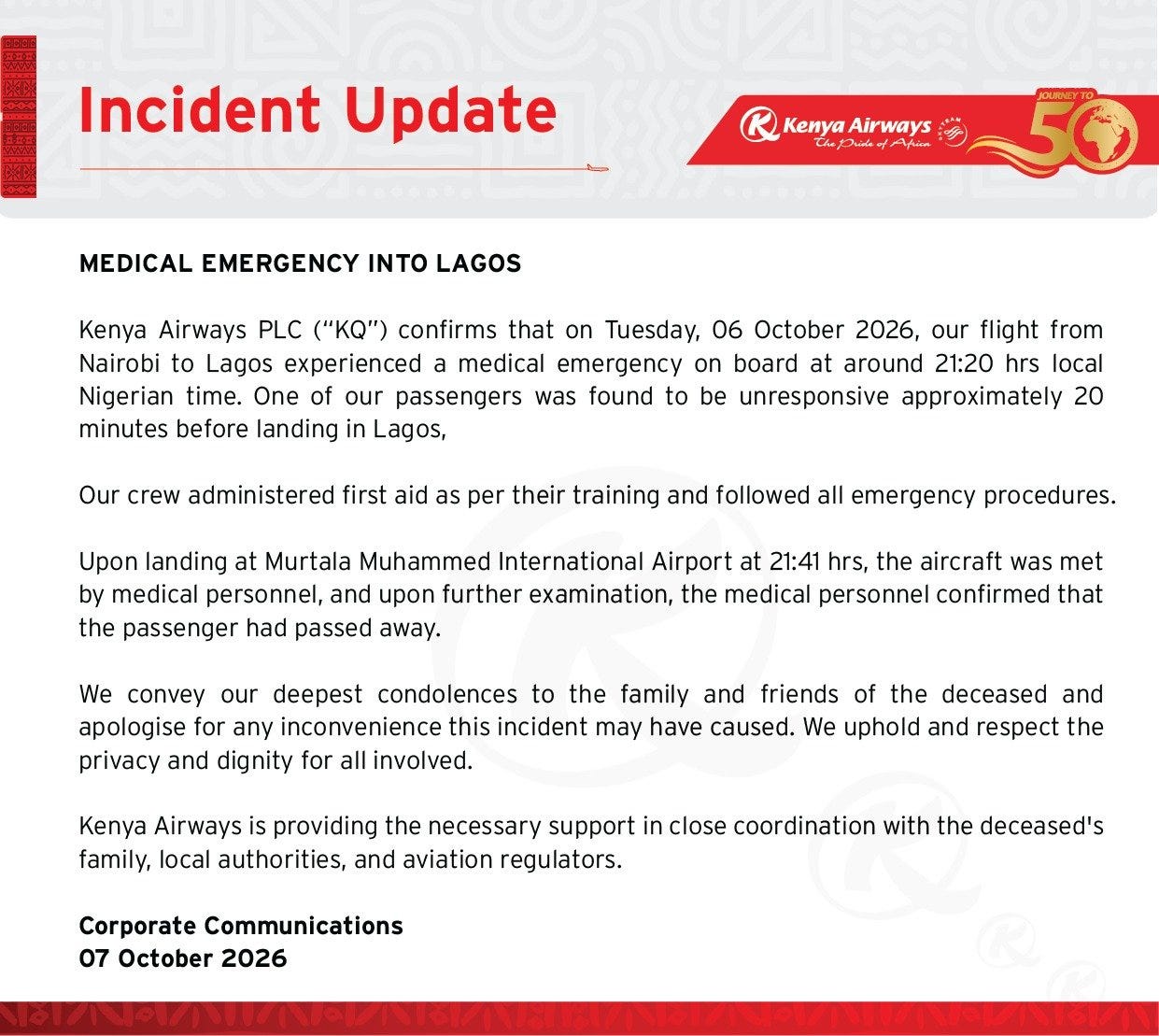
Kenya Airways issued a statement on Wednesday. It confirmed the medical emergency occurred at about 21:20 Nigerian time. “Our crew administered first aid as per their training and followed all emergency procedures,” the airline said. It expressed condolences to the family and friends of the deceased. It said it was cooperating with local authorities and aviation regulators. It did not address the restraint directly.
The police investigation will examine the circumstances of the death. An autopsy may be requested by the family. The key questions are straightforward. What caused the passenger’s aggressive behaviour? Was the restraint applied correctly? Did the restraint contribute to his death? The answers will determine whether anyone bears criminal responsibility.
Winners: No winners. The police, if the investigation produces answers. The airline, if it is cleared of wrongdoing. Losers: The deceased, who died in restraint. His family, who await answers. Kenya Airways, whose handling of the incident faces scrutiny. The crew and passengers, who witnessed the death. Nigerian aviation authorities, who must investigate a death on a foreign carrier.
Bottom Line: A man died on a plane. He was restrained after trying to open a door. The airline calls it a medical emergency. The police call it an investigation. The family calls it a loss. The facts will decide whether this was a tragedy or a failure. Until the autopsy and the inquiry conclude, the cause remains unknown.