

As September unfolds and millions of children across Nigeria prepare to return to the classroom for the start of a new academic session, the traditional excitement of back-to-school preparation has been replaced by a heavy sense of financial dread. Across open-air markets, neighbourhood bookshops and tailor stalls from Lagos to the Federal Capital Territory, parents are navigating an unprecedented cost-of-living squeeze. The prices of basic educational materials, including exercise books, recommended core textbooks, school bags, sandals, socks and uniforms, have surged sharply compared with their costs just three years ago. For low- and middle-income families whose monthly earnings have been severely eroded by persistent macroeconomic shocks, equipping a child for the school term has transformed from a standard household routine into an excruciating financial trial.
This back-to-school crisis is unfolding against a broader economic backdrop defined by relentless structural inflation and currency volatility. According to the National Bureau of Statistics Consumer Price Index report published in mid-August 2026, Nigeria’s annual headline inflation stood at 15.43 percent in July. While top-line figures indicated a slight moderation from previous months, month-on-month food inflation accelerated sharply to 5.56 percent, demonstrating that daily survival expenses continue to devour the bulk of household income. Meanwhile, prices for clothing, footwear, imported paper products, and educational accessories have risen in lockstep with foreign exchange adjustments and higher transportation tariffs. In private schools across major urban centres, termly tuition fees for low-cost to mid-range institutions now range from ₦50,000 to over ₦300,000 per child, while initial entry costs, including new uniforms, textbooks, and administrative charges, often exceed ₦150,000. Compared with Nigeria’s statutory monthly minimum wage of ₦70,000, the math reveals a staggering deficit for working-class parents.
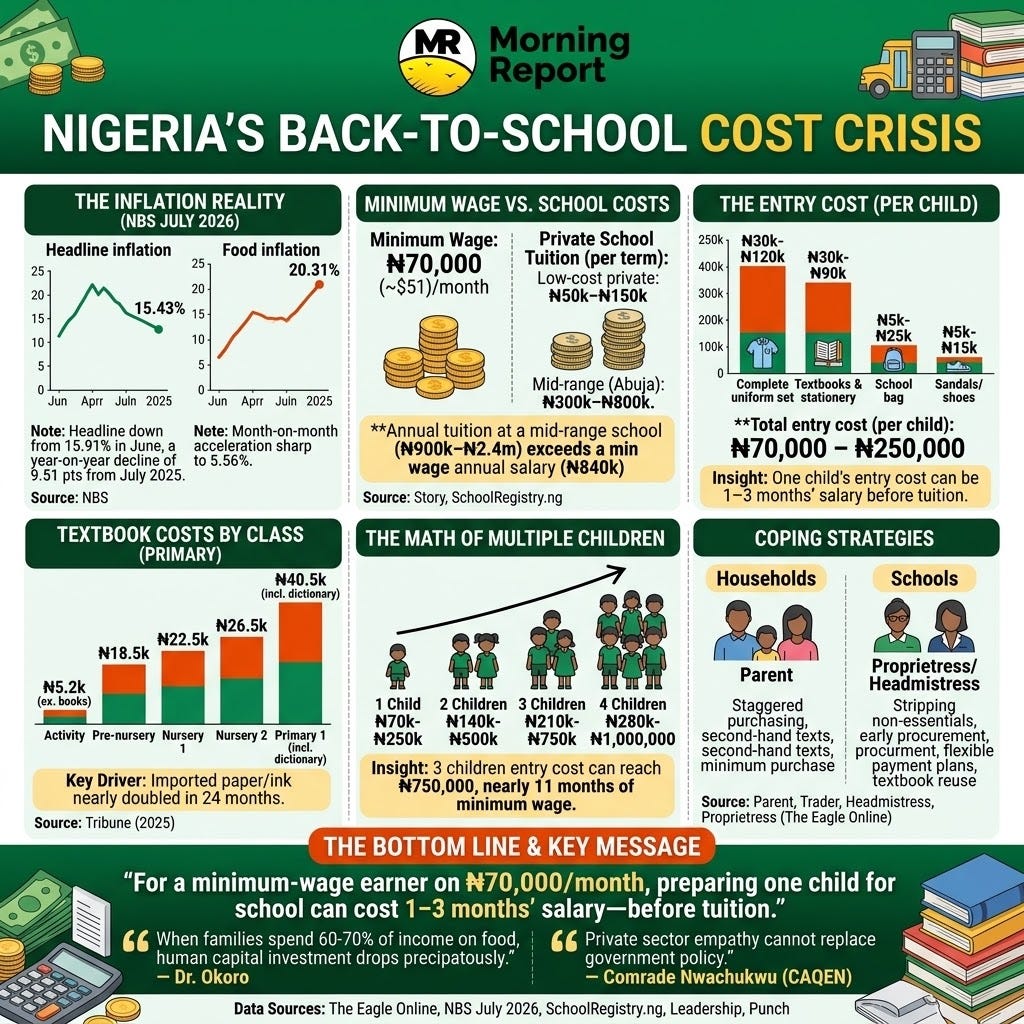
Evaluating these broader economic pressures on September 2, 2026, Dr Clementina Okoro, a Senior Fellow in Development Economics and Education Policy at the University of Abuja, noted that educational inflation is silently deepening social inequality across the country. Dr Okoro explained that when families are forced to spend over sixty to seventy percent of their disposable income purely on basic food staples and cooking fuel, discretionary investment in human capital drops precipitously. She warned that rising costs force low-income households into dangerous coping mechanisms, such as delaying enrolment, transferring children to overcrowded public facilities, or sacrificing nutrition to afford core textbooks, which ultimately harms national literacy levels and long-term workforce productivity.
On the commercial front, merchants who supply educational materials are experiencing the fallout of diminished consumer purchasing power firsthand. Speaking at the bustling Mararaba Market along the Abuja-Nasarawa commercial corridor on September 4, 2026, Mr Ignatius Okafor, a veteran stationery and textbook distributor, detailed how wholesale price shocks have altered buying habits. Okafor explained that the cost of imported paper stock, printing inks and synthetic leather for school shoes has nearly doubled over the past twenty-four months, forcing traders to pass the price increases directly to end-users. He noted that while parents in previous years routinely bought full book lists and multiple uniform sets well before resumption day, current foot traffic is dominated by anxious buyers purchasing single exercise books, negotiating for secondhand texts, or buying only the bare minimum required to clear the school gate.
For individual parents, managing these escalating price tags requires painful compromises within the household budget. Describing the daily reality of back-to-school shopping on September 3, 2026, Mrs Chinelo Ebuka, a parent based in Nasarawa State, shared that the skyrocketing cost of school materials has forced her to make difficult financial decisions every single term. “You may want to buy everything your children need before school resumes, but the money may not be enough. Sometimes, I buy uniforms first and postpone bags, or buy sandals and promise to get other things later,” Ebuka explained. She noted that spreading purchases across future paychecks has become her primary survival strategy, even though it leaves her children temporarily without essential learning tools during the opening weeks of the session.
The financial pressure compounds exponentially for families with multiple school-aged dependents. Highlighting the compounded burden facing wage earners on September 4, 2026, Mr Matthew Caleb, a civil servant residing in the Federal Capital Territory, expressed deep anxiety over the total bill required to prepare his household for the new session. “I have three children returning to school this session, and when you multiply the cost of uniforms, bags, sandals and books by three, the amount becomes overwhelming,” Caleb stated. He pointed out that while civil service salaries remain fixed against inflationary pressures, school suppliers and uniform tailors constantly adjust their prices, leaving parents feeling helpless as the resumption date approaches.
Faced with the growing risk of mass defaults, declining enrolments and parental dropouts, progressive school administrators across the suburban corridor of Karu Local Government Area are taking proactive measures to cushion the blow for struggling families. Highlighting the institutional shifts taking place at the grassroots level on September 5, 2026, Mrs Ezurike Loreth, Proprietress of Flora Home International School in Aso, Karu Local Government Area, explained that the significant increase in the cost of books, uniforms and basic materials has severely impacted both school operations and family budgets. In response, her school undertook a comprehensive audit of its academic requirements to eliminate non-essential financial burdens.
“We asked ourselves what a child truly needs to learn well this term, and we stripped away anything that was not essential,” the administrator said. Ezurike explained that early procurement of educational materials had also helped to reduce costs, as prices often increase close to school resumption when demand is high. Furthermore, the proprietress said parents were being encouraged to reuse textbooks and other learning materials that remained relevant, particularly those that had not changed from one academic session to another. “We ensured this term’s scheme of work builds directly on where the previous session concluded, so there is continuity rather than time lost re-establishing where a class left off,” she added, emphasising that teaching continuity helps offset material shortages.
Similarly, other administrators are restructuring fee collection mechanisms to prevent children from being locked out of the classroom due to immediate cash constraints. Outlining the practical interventions implemented at her institution on September 6, 2026, Mrs Gladys Ohiwere, Headmistress of Leadway Academy in Masaka, said the school introduced flexible payment arrangements for parents to ease the burden of paying school fees and other educational expenses at once. According to her, parents can spread payments over several months to meet their financial obligations gradually without destabilising their monthly household feeding budgets.
“As a school, we make our payment arrangements flexible. Instead of parents paying a huge amount at once, payments can be broken down into parts. This month you pay this, next month you pay another part, and the following month you complete the balance. This makes it easier for parents,” she said. On maintaining educational quality amid rising costs, the headmistress said the school avoided unnecessary charges that could place additional financial pressure on parents. “We do not compromise on the quality of our education, but we also make sure that whatever we do does not unnecessarily increase the cost of education for parents.”
Evaluating these adaptive measures on September 7, 2026, Comrade Anthony Nwachukwu, National Coordinator of the Coalition for Affordable Quality Education, praised private school proprietors for introducing flexible payment plans and streamlining curricula. Nwachukwu stressed, however, that private sector empathy cannot replace government policy. He urged federal and state authorities to institute targeted subsidies on educational paper imports, provide free basic textbook packages in public schools, and monitor private school fee hikes to protect vulnerable children from becoming casualty statistics in Nigeria’s ongoing economic trial.
As the bell tolls for the commencement of the new academic year, the landscape of Nigerian education reflects a stark divide between adaptation and hardship. In this challenging climate, the winners are schools that have adapted to rising costs by removing non-essential items, facilitating textbook reuse, and offering flexible payment plans. The losers, particularly parents with multiple children, are those struggling to afford basic school materials amid the high cost of living. Until macroeconomic stability improves and targeted social support reaches families, preparing a child for school will remain one of the most daunting financial hurdles in Nigerian homes.
Bottom Line: School resumption is a financial nightmare for many parents. The cost of books, uniforms and bags has soared. Schools are adapting, but the burden on families is growing.