


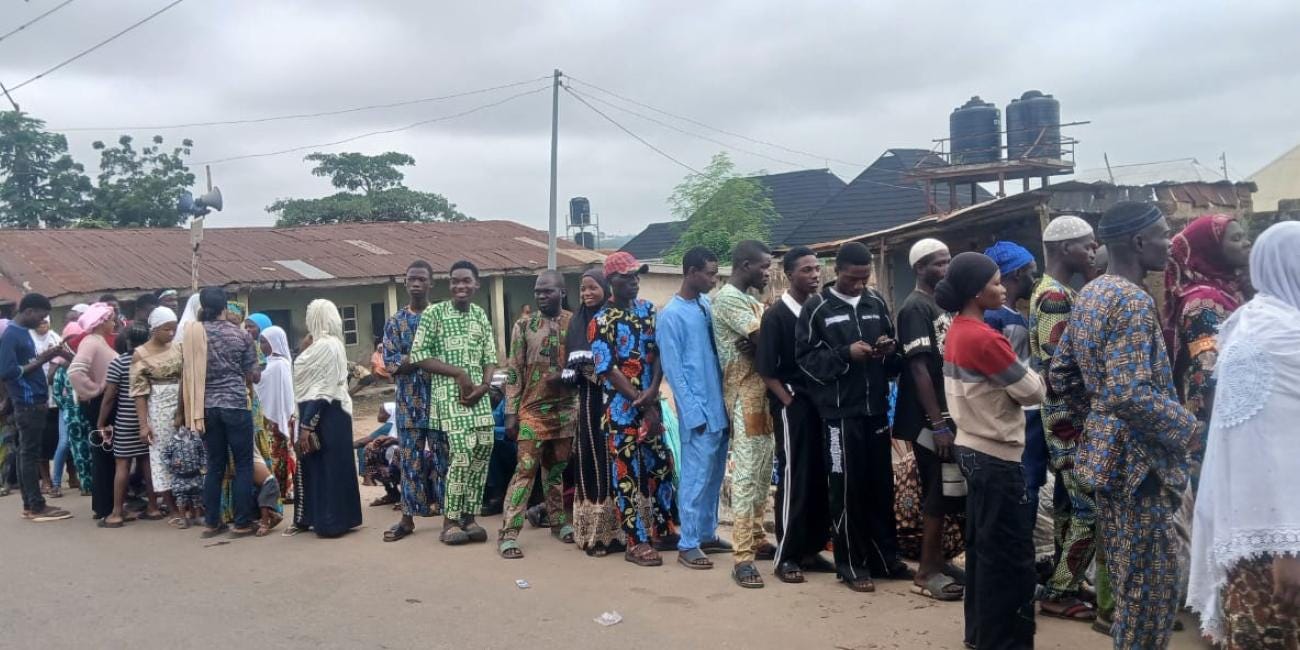
The Osun State governorship election began on Saturday with early promise, as voters turned out in large numbers across the state to elect a new governor. But the day quickly descended into controversy with the arrest of a serving state legislator and 146 suspected political thugs, along with viral videos alleging fraud, vote-buying and attempts to manipulate the process.
In the early hours, the scene was one of orderly civic participation. At Ward 8, Unit 7 in Ilesa, voting commenced at exactly 8:30 a.m., with a large number of voters already gathered. The African Democratic Congress party agent, Moruf Ajayi, commended the Independent National Electoral Commission for the timely arrival of its staff. “Their presence contributed significantly to the prompt commencement of voting activities,” he said.
Across the state, INEC officials arrived early at most polling units, and voters queued peacefully, checking the registers pasted on walls for their names. At Government Technical College, Ile-Ife, police and NSCDC officers were on ground, and voter turnout was high. The presiding officer confirmed that all election materials were complete and that backup BVAS machines were available in case of any problems.
At Ward 4, Unit 6 in Ede North, INEC ad hoc staff arrived early, while voters also turned out early for the exercise. At Ward 4, Unit 13 in Osogbo, voters arrived as early as 6:50 a.m., awaiting electoral officials and voting materials. The atmosphere remained peaceful across the state, with heavy security presence observed around polling units.
But the early promise was not universal. At Ward 8, Unit 10, voting was delayed because tables and chairs were unavailable for displaying voting materials. The INEC Presiding Officer, Elizabeth Adaramaja, explained: “We had been at the polling unit since 6:45 a.m., but there was nowhere to sit or display the election materials properly.” Party agents were forced to scramble for basic furniture, highlighting the logistical challenges that continued to plague the process. One electorate, Kikelomo Adeyeye, noted that the blame should not be placed on INEC but on party leaders expected to provide tables and chairs for ad hoc staff.
The peaceful atmosphere was shattered when the police command in Osun announced the arrest of a serving member of the state House of Assembly, Abiola Inaolaji, alongside 146 suspected political thugs in Ikire, Irewole Local Government Area. The lawmaker, a member of the Accord Party, was arrested by the Federal Bureau of Investigation and Intelligence Response Team in the early hours of Saturday. Police spokesperson DSP Abiosun Ojelabi said the arrests were part of intensified security operations to prevent actions that could undermine the credibility of the electoral process.
In a viral video, a man identified as Ibrahim was seen confessing to facilitating the movement of 146 suspects to Osun from neighbouring states to vote in the election. The video raised serious questions about organised attempts to manipulate the electoral outcome through imported voters and thuggery.
The arrest of a serving legislator and the scale of the alleged thuggery network represented a significant escalation of the tensions that had been simmering in the state for months. It also raised questions about security agencies' capacity to maintain order and prevent intimidation at polling units across the state.
Social media was flooded with allegations of fraud. Videos and photos circulated widely, with users alleging attempts to manipulate the election through fake ballot papers, vote-buying and the importation of thugs. One particularly damaging allegation claimed that vehicles suspected of carrying illegal INEC materials and cash for vote-buying were seen entering a school owned by a chieftain of the All Progressives Congress.
Governor Ademola Adeleke, who is seeking re-election on the Accord Party platform, cast his vote at Sagba Abogunde Ward 2, Unit 9 in Ede North. Speaking shortly after casting his ballot, Adeleke expressed confidence in emerging victorious. But he also raised security concerns, alleging that a police officer had been deployed to disrupt the electoral process in Ede. “We also received information about our supporters being scared away in Modakeke and some areas in the state by some police officers to disenfranchise them,” he said.
The governor also urged his supporters to watch out for fake ballot papers that could be used in some polling units to deceive the electorate. His warnings reflected the deep distrust that had come to characterise the electoral process, with both sides accusing the other of planning to manipulate the outcome.
The Accord Party Deputy Governorship candidate, Prince Kola Adewusi, voted at Akodi-Seru, Ilode 1, Ward 001, in Ile-Ife. Adewusi commended INEC for arriving on time and lauded the electorate for the large turnout. He expressed optimism that the party would emerge victorious, but also raised concerns over the uneven arrival of INEC officials at some polling units. “While officials arrived early in some areas, the situation was different in others,” he noted.
The All Progressives Congress also expressed confidence in the process. Mr Tijani Muideen, an APC agent, urged stakeholders to ensure that the election was peaceful and devoid of harassment or intimidation. “Election should not be a do-or-die,” he said, calling on security personnel to maintain a high level of professionalism. But the scale of the arrests and the viral videos that continued to circulate undercut his words.
The day’s events left voters and observers uneasy. The early promise of an orderly election gave way to a day of arrests, allegations, and deepening distrust. The true test of the election would not be the initial turnout, but whether all parties would accept the final outcome as a true reflection of the will of the people.
The winners: the voters of Osun, who turned out to exercise their franchise despite the tensions; and the security agencies, which made arrests that could deter future electoral violence. The losers: the credibility of the electoral process, further eroded by allegations of fraud and manipulation; and the Nigerian government, which must now confront the systemic challenges that continue to plague the country’s elections.
Bottom Line: Osun voted, but the day was marred by arrests, allegations and a deepening erosion of trust. The question is whether all parties will accept the final outcome or whether the state will descend into further conflict.