


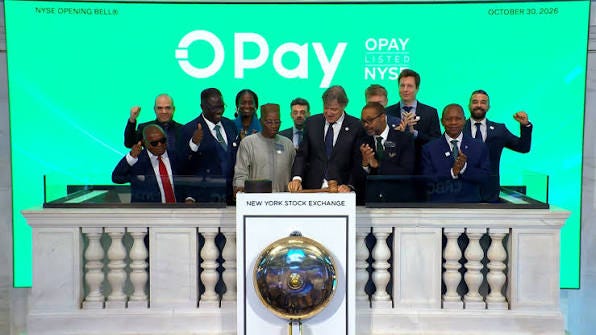
OPay has priced its New York Stock Exchange listing at $19 to $21 per American Depositary Share. The amended registration statement filed with the US Securities and Exchange Commission on 23 October says the company will sell 16 million ADSs under the ticker OPAY. Each ADS represents ten ordinary shares.
At the top of the range, the offering raises about $336 million before the underwriters’ option to buy 2.4 million more ADSs. The filing expects roughly 2.1 billion ordinary shares to be outstanding after the offering and a concurrent private placement. That would value OPay at about $4.4 billion.
Nine investors have indicated interest in buying up to $270 million of ADSs at the IPO price. They include Redwheel and the Coronation Africa Frontiers Fund at up to $50 million each, and existing shareholder SBVA at up to $20 million. Stanbic Africa Holdings, part of Standard Bank Group, has agreed to buy up to $200 million in a private placement, capped at 4.99 per cent of the company.
The filing reveals a business that has moved well beyond transfers. Loan financing services brought in $236.1 million in the six months to June, against $130.6 million from transaction-based services. Provisions for expected credit losses were $118.4 million over the same period. OPay swung from a $50.8 million net loss in 2024 to a $72.5 million profit in 2025. It held $918.7 million in cash and short-term investments at the end of June.
Nearly 90 per cent of OPay’s revenue comes from Nigeria. That concentration is both the pitch and the risk. US investors are being asked to pay a premium for a consumer lending business operating in a single, volatile market.
This mirrors the trajectory of Nigerian fintechs that have scaled from payments into credit. PalmPay and Moniepoint have followed similar paths. The difference is that OPay is testing whether Wall Street will value an African consumer lender at a multiple comparable to global peers. The answer will set a benchmark for the entire sector.
The filing also says OPay’s board and shareholders have approved a secondary listing on the Nigerian Exchange after the US debut, subject to Nigerian rules and market conditions. That would give Nigerian investors a chance to buy into a company they already use.
Winners and Losers
Winners: OPay, which gains capital and a global valuation benchmark. Early investors and shareholders, who gain liquidity at a premium. The Nigerian fintech ecosystem, which gains proof that a home-grown company can list in New York.
Losers: Competitors like PalmPay and Moniepoint, which now face a better-capitalised rival with a public currency for acquisitions. The Nigerian Exchange, which loses the primary listing to New York. Nigerian users, who may face higher fees if the company prioritises shareholder returns over affordability.
Bottom Line: OPay is asking Wall Street to value a Nigerian lending business at $4.4 billion. If the IPO prices at the top of the range, it validates the fintech sector. If it prices low or breaks issue, it signals that US investors see African consumer credit as a risk, not an opportunity.