


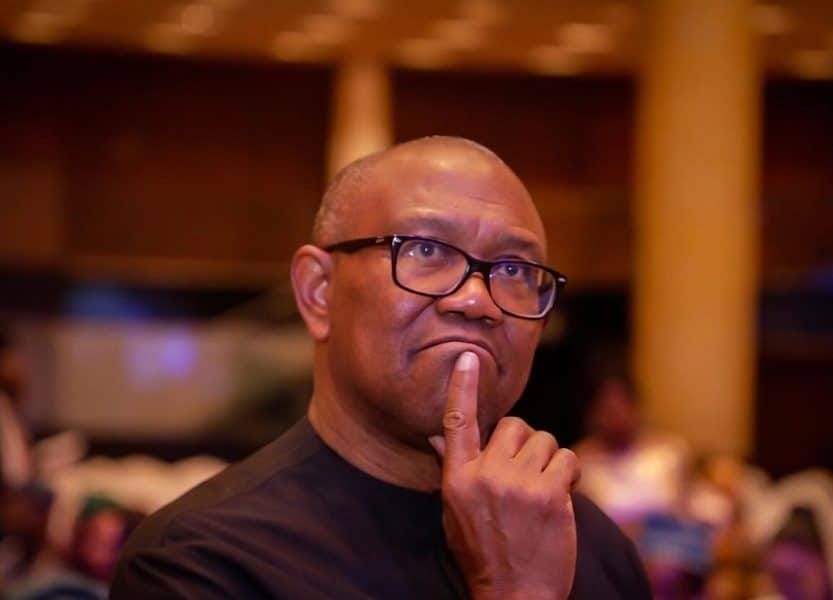
The political fallout from the International Monetary Fund’s disclosure on Nigeria’s fiscal reporting has intensified. Peter Obi, the presidential candidate of the Nigeria Democratic Congress (NDC), has renewed his demand for President Bola Tinubu’s resignation, citing what he described as evidence of “grand corruption” under the current administration.
The renewed criticism follows remarks by the IMF’s resident representative in Nigeria, Christian Ebeke, who said last week that public spending equivalent to about two percent of the country’s gross domestic product, approximately ₦8.83 trillion, was undertaken outside the budget framework in 2025. The IMF official said the discrepancy made Nigeria’s fiscal deficit appear smaller than its actual financing needs.
In a statement issued on Sunday via X, Obi described the disclosure as “horrible” and argued that the amount exceeded 35 percent of Nigeria’s ₦23.96 trillion capital expenditure budget for 2025. He said it was larger than the combined allocations for education (₦3.52 trillion) and health (₦2.38 trillion). “This expenditure is not budgeted and is therefore not under legislative oversight or administrative scrutiny,” Obi said.
He maintained that proper deployment of the funds could have significantly improved public services and job creation. “If such an amount is properly used and accounted for, it could transform Nigeria’s public health and education sectors. It could create hundreds of cottage industries that can provide jobs for thousands of graduates and build a solid foundation for economic development. But we cannot account for it,” Obi said. He added that corruption had become entrenched in government and posed risks to the country’s stability. “The sort of corruption that is ingrained in total disregard of elementary rules of public finance management poses a grave danger to national security and the stability of the Nigerian state,” he said.
The former Anambra State governor also renewed his demand that Tinubu step down, saying recent developments reinforced concerns he had earlier raised over the administration’s performance. “A few days ago, I called on President Tinubu to resign from office for incompetence, lack of capacity, lack of compassion, and failure to improve on his campaign promises,” Obi said. “But with the daily revelations of pervasive corruption in this administration and its total lack of commitment to the welfare and security of Nigerian citizens, the only reasonable action is for President Tinubu to resign from office.”
Obi’s latest intervention comes a day after former Vice President Atiku Abubakar urged the Economic and Financial Crimes Commission (EFCC) and the Independent Corrupt Practices and Other Related Offences Commission (ICPC) to investigate the off-budget spending allegation.
The Federal Government has denied the allegation. In a statement issued on Sunday, the Minister of Finance, Taiwo Oyedele, said reports suggesting that about two percent of Nigeria’s GDP was spent through a “shadow budget” lacked evidence. He insisted that the Federal Government does not operate any unofficial budget, arguing that all withdrawals and spending of public funds were authorised through Appropriation Acts, Supplementary Appropriation Acts and other laws passed by the National Assembly. He clarified that some capital projects span multiple budget cycles and are implemented under approved rollover provisions, adding that such expenditures should not be interpreted as spending outside the budget.
“For the avoidance of doubt, the Federal Government does not operate a ‘shadow budget’ or expend public funds outside the constitutional and statutory framework established for public finance,” Oyedele said. He challenged those making the allegations to provide evidence of specific projects executed without appropriation or legal authorisation.
This dispute echoes the pattern seen during the 2014 oil price crash, when the government relied on off-budget financing through the Excess Crude Account and various special purpose vehicles. The mechanism then was different, but the result was the same: a fiscal position that looked healthier than it was. The IMF’s 2025 Article IV consultation had already estimated a fiscal “statistical discrepancy” of 2.7 percent of GDP and raised concerns about opaque financial arrangements.
The winners: the opposition, which has gained a political weapon. The losers: the Nigerian public, which still does not have a clear answer on where ₦8.83 trillion went, and the government’s credibility on fiscal transparency.
Bottom Line: ₦8.83 trillion is missing from the budget. The opposition says it is corruption. The government says it is accounting. Either way, Nigerians are not getting answers.