


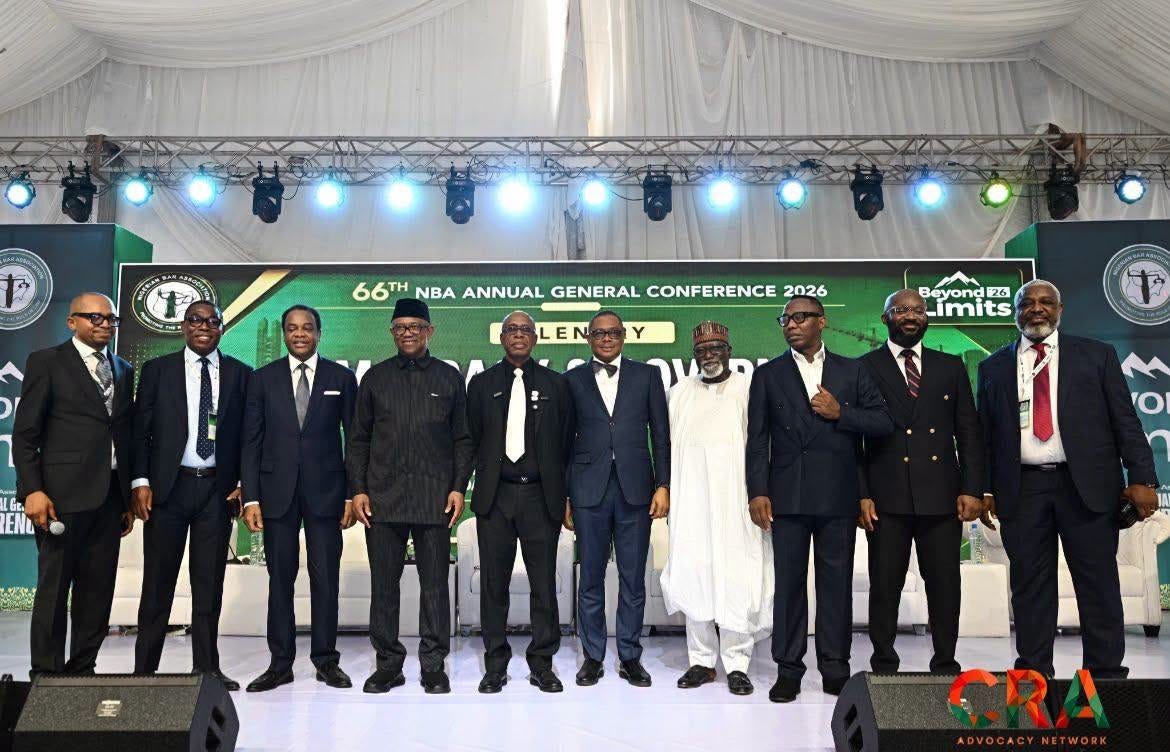
The Nigerian Bar Association conference in Rivers State delivered a session for the ages as four presidential candidates tore into the nation’s twin crises of insecurity and fuel subsidy removal with a raw, unfiltered intensity rarely seen outside party-controlled campaign rallies. Prince Adewole Adebayo of the SDP, Labour Party’s Peter Obi, former Rivers Governor Rotimi Amaechi, and AAC candidate Omoyele Sowore engaged in a high-stakes exchange that was part policy debate and part personal score-settling.
The Roots of Insecurity
Adebayo opened with an explosive claim: Nigeria’s security funds are being looted before they reach the front lines. “When you see the EFCC tracing assets of former security chiefs, those are funds meant for defending the nation ending up in luxury cars and political campaigns,” he said. He went further, asserting that insecurity is actively driven by state actors and political elites who profit from illegal mining and kidnapping ransoms.
His prescription was three-pronged: regulate the mining cadastre to hold companies accountable for security in their operational areas, reform the Office of the National Security Adviser to decentralise security management, and establish a “People’s Army” by reorganising the Armed Forces into local divisions embedded within regional communities.
Obi took a different tack, arguing that poverty, not just bullets, fuels the insurgency. “Kinetic operations alone cannot defeat insecurity,” he said, insisting that mass job creation and poverty reduction are the primary tools to deter criminality. He advocated for auditing the national security architecture, enhancing troop welfare, and institutionalising support for community-based vigilante networks that understand local terrain. He cited his administration’s direct partnership with community vigilantes in Anambra State as a scalable blueprint.
Amaechi countered with his Rivers State model. “During my tenure, we pulled soldiers back from intrusive roadblocks and replaced kinetic action with massive state employment,” he said, pointing to the construction of over 500 primary schools, 300 health centres, and extensive roads that hired thousands of workers. He supported state policing but warned that without a strong, independent judiciary, devolved police powers would simply lead to localised abuse. His central insight was stark: “80% of effective policing is intelligence gathering and only 20% is physical enforcement.”
The Subsidy Showdown
When the debate turned to fuel subsidy removal, the gloves came off. Amaechi, who served as Minister of Transportation, dismissed the entire subsidy regime as an economic scam. “The concept of fuel subsidy as implemented in Nigeria was a scam,” he said, pointing to crude oil swaps that never accounted for the multitude of refining by-products. He argued that energy should be treated as an endowment to drive domestic productivity rather than punished because the government failed to police borders against smuggling.
Sowore, never one to mince words, delivered a blistering counter. “Repeated subsidy removals since 1988 have functioned merely as wealth transfers from the public to political elites and governors,” he said. He declared he would never remove fuel subsidies, asserting that petrol is the only direct social buffer ordinary citizens receive from national oil wealth. He also criticised the failure to build working mass-transit alternatives, referencing the incomplete Rivers Monorail project under Amaechi.
Personal Blows
The policy clashes quickly turned personal. Sowore directly called out Amaechi and Obi, claiming that career politicians have run the country down and should apologise rather than seek power again. Amaechi fired back: “Playing to the gallery will not win you an election,” reminding Sowore that winning requires appealing to over 93 million registered voters, not just the lawyers in the hall.
Obi was forced to defend his record on the 13-month health strike during his tenure in Anambra. He explained that the industrial action resulted from his structural overhaul of the state health sector. Rather than funding mismanaged government hospitals, his administration diverted funding directly to accredited mission-run nursing schools and hospitals, resulting in the highest number of accredited nursing and midwifery schools in the region.
The winners: the lawyers and viewers who witnessed a rare unfiltered debate on Nigeria’s most pressing issues. The losers: the political establishment, whose record was laid bare for all to see.
Bottom Line: Four candidates, two crises, one unforgettable session. The NBA conference proved that when politicians are stripped of their scripts, the truth can still break through.