


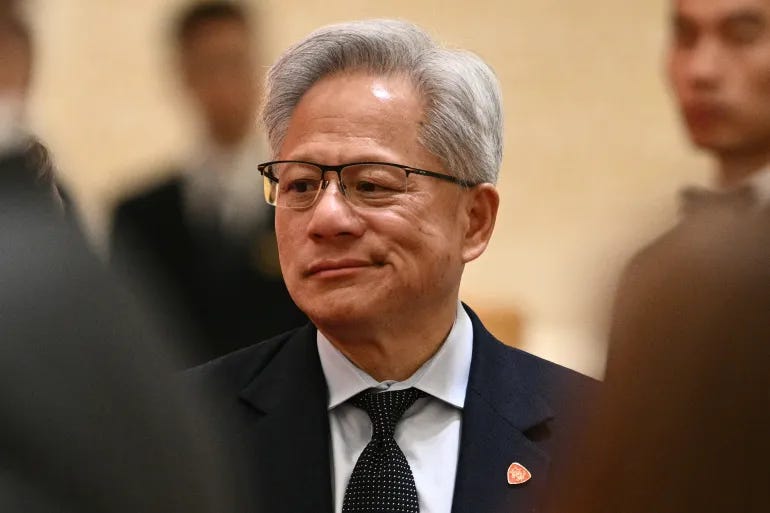
Nvidia has added approximately $983 billion to its market value after its board reinstated co-founder Jensen Huang as president and chief executive officer, less than two weeks after his resignation.
The American technology company’s shares rose by 34% on Monday, November 23, climbing to $169.24 from Friday’s closing price of $125.53.
The rally pushed Nvidia’s market capitalisation to approximately $4.06 trillion, restoring its position as the world’s second-most valuable company behind Apple.
The board announced that it had unanimously approved Huang’s return with immediate effect after a series of discussions and meetings. It said the decision followed assurances about his leadership and input from senior United States government officials.
According to the company, the board was satisfied with Huang’s candour and ability to lead and concluded that his reinstatement posed no national security risk.
Harvey C. Jones, Nvidia’s board chairman, said the directors believed Huang remained the right person to lead the company.
Huang described his return as an honour, promising renewed commitment to the company and its employees, investors and business partners.
WHY HUANG RESIGNED
Huang stepped down on November 12, ending his 33-year leadership of the technology company.
His resignation followed reports concerning his personal relationships, including an alleged affair with Alice Huang, a businesswoman suspected by United States intelligence officials of having links to Chinese intelligence.
The allegations raised national security concerns because of Nvidia’s position as the world’s leading supplier of advanced artificial intelligence chips.
Huang acknowledged making serious mistakes in his personal life and creating difficulties for the company’s board. He nevertheless maintained that he would cooperate with any independent investigation.
Following his departure, Nvidia appointed its Chief Financial Officer, Colette Kress, as interim chief executive.
The board initially indicated that it would not reinstate Huang. However, pressure from employees, investors, industry leaders and political figures intensified over the following days.
United States President Donald Trump also publicly supported Huang’s return, arguing that his leadership was important to Nvidia and the American economy.
Reuters reported that Trump said his intervention had played an important role in securing the reinstatement.
INVESTIGATION CONTINUES
Despite restoring Huang to his position, Nvidia’s board has not closed the investigation surrounding the allegations.
The company established an independent committee to investigate whether Huang was targeted by a foreign intelligence operation. The committee will work with independent legal advisers, while Huang has pledged to cooperate.
Nvidia has also established a National Security and Export Control Committee to oversee trade compliance and potential security risks.
The company is beginning the search for a chief compliance officer who will oversee compliance across its operations and report to the board’s governance committee.
These measures come as Nvidia faces increased scrutiny over the movement of advanced artificial intelligence chips into China and possible violations of American export restrictions.
The company has said it will continue cooperating with ongoing government investigations and inquiries.
THE AI INDUSTRY’S BIG BET ON ONE MAN
Huang’s return demonstrates how heavily Nvidia’s business and the wider artificial intelligence industry depend on his leadership.
He transformed the company from a graphics processing unit manufacturer known mainly for video-game technology into the dominant supplier of chips used to develop and operate artificial intelligence systems.
His influence extends beyond product development. He has cultivated relationships with major technology companies, cloud computing providers, investors and government officials.
Nvidia’s customers include some of the world’s largest technology companies, which depend on its processors to build artificial intelligence infrastructure.
His resignation therefore created uncertainty about the company’s direction at a time when competition for artificial intelligence dominance is intensifying.
The immediate winners include Nvidia shareholders, whose investments gained substantially in value following Monday’s rally. Technology companies that depend on Nvidia’s chips also stand to benefit from renewed leadership stability.
However, the controversy raises questions about corporate governance and the extent to which a company valued at trillions of dollars can depend so heavily on one executive.
The board may have concluded that losing Huang presented a greater business risk than reinstating him while investigations continued.
Bottom Line: Nvidia’s $980 billion market-value surge shows the extraordinary influence Jensen Huang has over the artificial intelligence industry. But his return also raises a difficult corporate governance question: when a company’s success becomes closely tied to one individual, how much accountability can its board realistically enforce?