


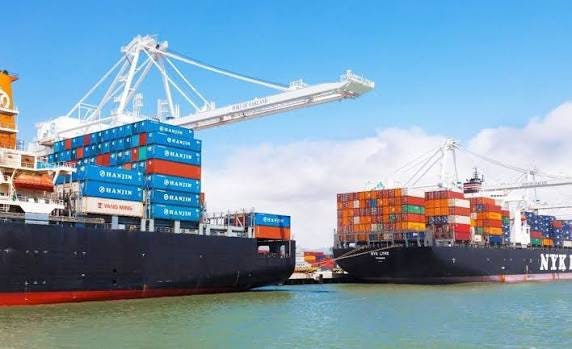
The Nigerian Ports Authority (NPA) handled 2,300 ships across Nigerian ports in the first half of 2026. That is a 6.9% increase over 2,152 ships in the same period of 2025. Gross Registered Tonnage rose 20.9% to 96.6 million, up from 79.9 million. Total cargo throughput climbed to 68.2 million metric tonnes from 60.8 million. The managing director, Abubakar Dantsoho, disclosed the figures at the Nigerian Ports Consultative Council quarterly meeting in Lagos.
Nigeria’s port system has been a bottleneck for decades. Apapa congestion, poor road access and multiple agency checkpoints made cargo evacuation slow and expensive. The Lekki Deep Sea Port opened in 2023 as a solution. Onne has expanded. But the NPA has long depended on captive cargo, imports destined for Nigeria only. Transit cargo to landlocked neighbours has never materialised at scale. That remains the gap between Nigeria’s ambition as a regional hub and its actual performance.
Inward cargo stood at 38.4 million tonnes. Outward cargo grew 23.5% to 29.2 million tonnes. Container traffic rose 10.3% to 815,236 twenty-foot equivalent units. Imports accounted for 67% of containers. Exports were 25%. Transshipment surged 169.5% to 35,574 units, but still only 4% of throughput. Vehicle handling rose 42.5% to 103,375 units, driven by transshipment at Tin Can Island.
Lekki Port handled nearly 40% of national throughput. Dangote Refinery operations alone accounted for over 76% of Lekki’s cargo traffic. Onne contributed 22.7%, supported by LNG exports. Calabar and Rivers ports combined for just over 4%. Dantsoho described Dangote as a game changer and said its planned expansion to 1.4 million barrels per day requires infrastructure investment and a balanced tariff policy.
Not everything improved. Vessel turnaround time worsened 6% to 5.3 days from 5 days. Berth occupancy rose 3.1% to 36.1%. Dantsoho identified insufficient funding as a major constraint. The Federal Government deducts 50% of revenue from government-owned enterprises automatically. He urged the council to back an 80:20 revenue split in the NPA’s favour.
The Nigerian Railway Corporation said freight operations at Ijora, Moniya and Papalanto are nearly complete. Rail deployment, its managing director said, would remove trucks from Apapa and cut logistics costs.
Winners: Lekki Port, which absorbs national growth. Dangote Refinery, which anchors the cargo base. The NPA, which reports volume increases. Vehicle importers and dealers, who benefit from faster handling. Losers: Apapa and Tin Can, which lose relative share. Calabar and Rivers ports, which remain marginal. Shippers, who face longer vessel turnaround. The NPA, if the 50% deduction continues and modernisation stalls. Landlocked neighbours, who still lack transit cargo routes.
Bottom Line: Ship numbers and tonnage are up. Turnaround time is worse. Lekki and Dangote are carrying the growth, while older ports fade. Volume is not efficiency, and Nigeria is not yet a transit hub.