


In the sprawling urban tapestry of Lagos, silence is perhaps the rarest commodity of all. From the dense residential lanes of Amukoko in Ajeromi-Ifelodun to the commercial hub surrounding Pen Cinema in Agege, the city operates at a relentless, deafening pitch. The daily atmosphere is a heavy, overlapping wall of sound: the sharp throbbing hum of thousands of small petrol generators, the sudden blare of commercial bus horns, the competitive shouts of street traders and transport touts, and the amplified reverberations of religious calls and evening sermons. For millions of residents and small business owners living within this auditory pressure cooker, noise pollution has ceased to be a mere urban inconvenience. It has evolved into a grinding environmental hazard that disrupts sleep, erodes workplace concentration, damages mental health, and tests the limits of community tolerance.
At the busy Ajose Street Roundabout in Amukoko, sensory overload continues from dawn until long after midnight. The neighbourhood’s mixed-use character, where residential tenements sit wall-to-wall with metal fabrication shops, petty traders and informal transport parks, creates an environment where escape from sound is virtually impossible. Examining the daily operational reality for local merchants, Mr Olumide Adebayo, a shop owner in Amukoko, explained that excessive, unyielding noise has become a permanent feature of commercial life, severely diminishing his ability to rest or recharge during long business hours.
Adebayo highlighted the deep structural engine driving much of the neighbourhood’s noise: a chronically inadequate public electricity supply that forces virtually every shop and household to rely on individual generators. He observed that because residents and entrepreneurs operate within the exact same tight geographical footprint, people have little choice but to endure the mechanical roar, stressing that no amount of individual goodwill can quiet the community until the state delivers reliable grid power to replace private generators.
While mechanical noise provides a constant baseline rumble, human friction adds a far more erratic and distressing layer to the urban soundscape. Interlocking with the mechanical drone of generators is the unpredictable chaos of the street economy. Detailing another pervasive source of neighbourhood disturbance, Miss Bola Daniel, a fellow shop owner at Amukoko, pointed to informal transport handlers and street touts as major catalysts of daily disruption. She described how their constant shouting, aggressive rowdiness and frequent verbal altercations create an uncomfortably hostile environment for both business operators and passing customers. Daniel noted that this atmosphere of perpetual hostility not only drives away potential patronage but also subjects nearby workers to intense psychological strain throughout the day.
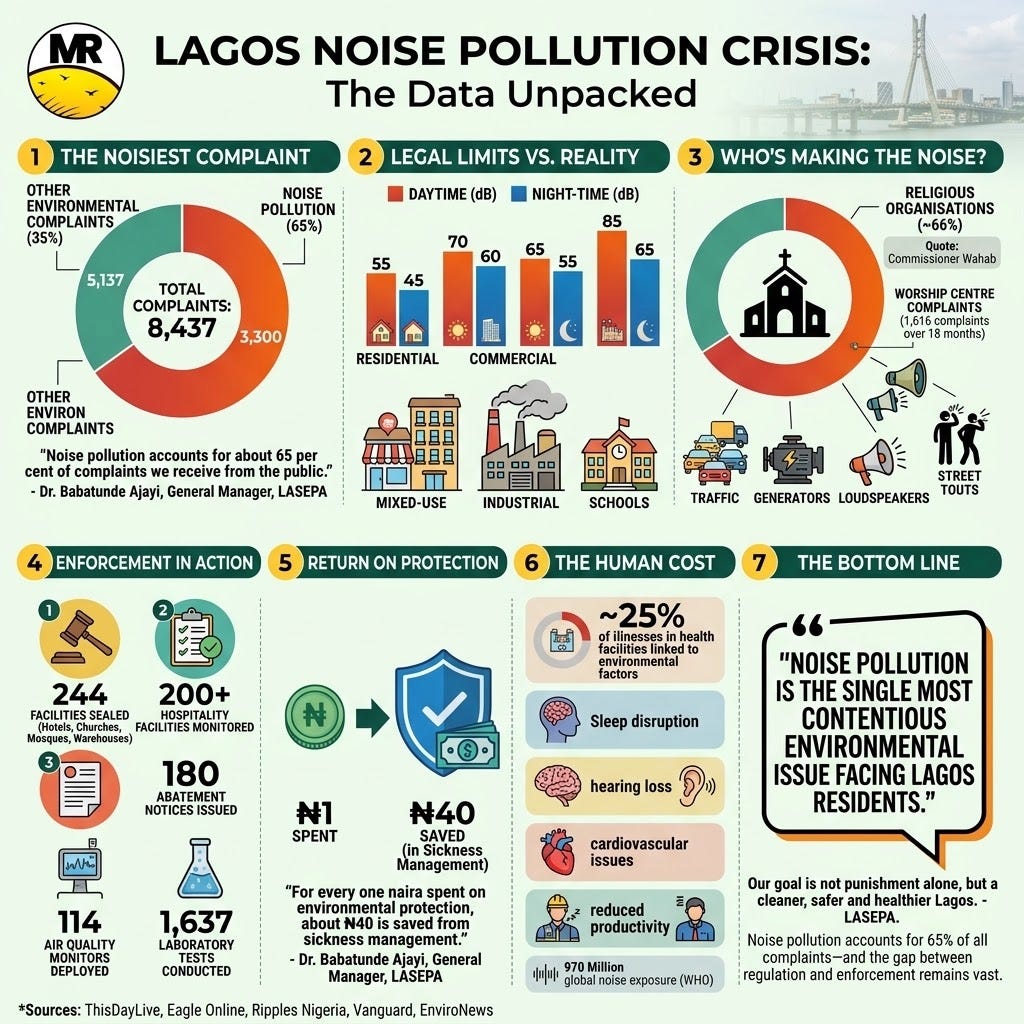
The impact of this acoustic overload becomes particularly severe when the sun sets, and working citizens try to find sanctuary in their homes. In dense residential blocks, the line between public commercial activity and private domestic life has completely dissolved. Speaking on the domestic toll of neighbourhood noise, Mrs Saidat Adegoke, a resident of Amukoko, shared that unthrottled sound, particularly originating from places of worship and religious gatherings, has turned basic nightly rest into a constant struggle. She explained that late-night services, early-morning broadcasts and outdoor loudspeakers positioned directly toward residential windows leave families with virtually no quiet hours to recover from gruelling work days. Adegoke advocated firm spatial planning interventions, arguing that high-decibel commercial operations and places of worship should be legally required to relocate farther from residential zones or adhere strictly to soundproof building standards.
For small business owners whose livelihoods depend on mental focus, precision, and sustained attention, the chaotic noise environment represents a direct financial tax on productivity. Describing the operational friction caused by ambient street noise, Mr Mustapha Ahmed, a shop owner in Amukoko, noted that blaring street music, mobile market advertisements and constant public shouting severely impair his concentration on the job. Ahmed explained that the lack of quiet continuously slows his work output, leading to avoidable delays in completing client tasks and fulfilling orders. He said community members have repeatedly tried informal engagements with persistent noise makers to seek voluntary compromises, but these efforts have yielded virtually no lasting improvement. Ahmed urged local administrative authorities and community leaders to step in decisively by establishing clear, enforceable neighbourhood rules and running comprehensive sensitisation campaigns to educate residents on the civil obligation to reduce noise.
The crisis extends far beyond Amukoko, echoing across major commercial transit nodes throughout the state. Around the Pen Cinema Market in Agege, where major road networks intersect with dense informal trading zones, the nighttime soundscape reaches extreme levels. Capturing the struggle of young residents navigating this environment, Adebola Ajayi, a student living near the Pen Cinema market precinct, described an overwhelming evening mix of blaring truck horns, shouting market touts, and unthrottled commercial loudspeakers playing music late into the night. For Ajayi, this constant auditory invasion directly hinders her personal development, continually distracting her from evening studies and disrupting her sleep. She called on environmental regulators to enforce existing statutes without compromise, emphasising that commercial markets situated in immediate proximity to residential homes must not be permitted to operate with total disregard for the surrounding community.
Official state environmental monitoring data fully substantiate the widespread grievances expressed by residents. Addressing the magnitude of the crisis during the 11th Noiseless Lagos Summit, Dr Babatunde Ajayi, General Manager of the Lagos State Environmental Protection Agency (LASEPA), revealed that noise pollution constitutes approximately 65 percent of all environmental complaints logged by the agency across the state. This overwhelming volume of public petitions underscores that noise is the single most contentious environmental issue facing urban citizens. According to statutory guidelines established by LASEPA, ambient noise levels in designated residential areas must not exceed 55 decibels during daytime hours and must not exceed 45 decibels at night. These regulatory standards are reinforced by legal instruments, specifically Part VI, Section 177 of the Lagos State Environmental Management and Protection Law of 2017, which explicitly prohibits excessive, harmful noise in both private and public spaces.
Despite the clear legal frameworks on paper, a massive gap remains between statutory prohibition and practical enforcement on the street. LASEPA regularly conducts enforcement operations, sealing non-compliant religious centres, nightclubs, and industrial facilities, yet the sheer scale of the megacity, combined with limited enforcement resources, means informal neighbourhood noise often goes unchecked. Mobs of touts, unshielded generators and loud commercial displays continue to operate with near-total impunity in grassroots communities.
To bridge this divide and restore basic livability to Lagos neighbourhoods, a multi-pronged strategy is urgently required. Community members and legal experts agree that regulatory agency action must be paired with fundamental infrastructural improvements. Providing stable, reliable public electricity remains the single most effective intervention to eliminate the millions of noise-emitting generators currently paralysing residential areas. Concurrently, state enforcement mechanisms must be decentralised, with functional local reporting hotlines and rapid-response teams that can respond to neighbourhood noise complaints before disputes escalate.
Ultimately, the fight against noise pollution in Lagos is a fight for human dignity, public health and urban order. As the megacity continues its rapid demographic and economic expansion, citizens' right to rest, study, and work in a healthy environment cannot be treated as an afterthought. By combining infrastructure investment with rigorous law enforcement and grassroots civic education, Lagos can begin to quiet its streets, ensuring that its vibrant economic energy no longer comes at the devastating cost of its citizens’ peace of mind.
The winners: none. The losers: the residents of Lagos, who are paying for the city’s dysfunction with their health and sanity; and the Nigerian government, which has failed to protect its citizens from an environmental hazard.
Bottom Line: Lagos is a city under siege by noise. The generators, the touts, the loudspeakers, the neighbours, it never stops. The question is whether the government will act or the noise will continue to drive residents to the brink.