


In the bustling commercial quarters of Kano, where the morning air fills with the sounds of open-air markets and heavy traffic, economic policy is not measured by spreadsheet projections or international financial indices. It is evaluated in the relentless arithmetic of daily survival: the rising cost of a bag of local rice, the escalating fare for a minibus across town, and the daunting quarterly tally of school fees. For a minimum-wage worker earning Nigeria’s statutory ₦70,000 per month, a floor established in 2024 that currently translates to roughly $42, abstract statistical adjustments offer zero relief when a paycheck fails to cover basic nutritional needs.
This widening chasm between macro-level figures and domestic hardship has moved into sharp focus following the release of Global Finance magazine’s 2026 ranking of the world’s poorest nations by Gross Domestic Product per capita at Purchasing Power Parity (PPP). In the latest comparative assessment, Nigeria experienced a steep decline, dropping 12 places from 44th position in 2025 down to 56th out of the 60 countries evaluated near the bottom of global economic output. Nigeria recorded a PPP-adjusted GDP per capita of $9,532.92, a figure that stands well above its nominal GDP per capita of approximately $1,500, yet reflects a severe erosion in comparative living standards.
The Purchasing Power Parity metric is designed to adjust raw economic output for national differences in price levels, inflation and localised living costs, providing a clearer reflection of what a unit of currency actually buys within an economy. While African nations continue to dominate the lowest tiers of the global ranking, accounting for nine of the ten poorest countries, led by Burundi at $994.23 per capita, followed by the Central African Republic and South Sudan, Nigeria’s sharp slide places it below nations such as Djibouti, though still ahead of Nicaragua, Bangladesh, Angola and Laos. For Africa’s most populous nation, this slide highlights how sustained domestic price shocks and currency realignments have eroded the real purchasing capacity of ordinary citizens.
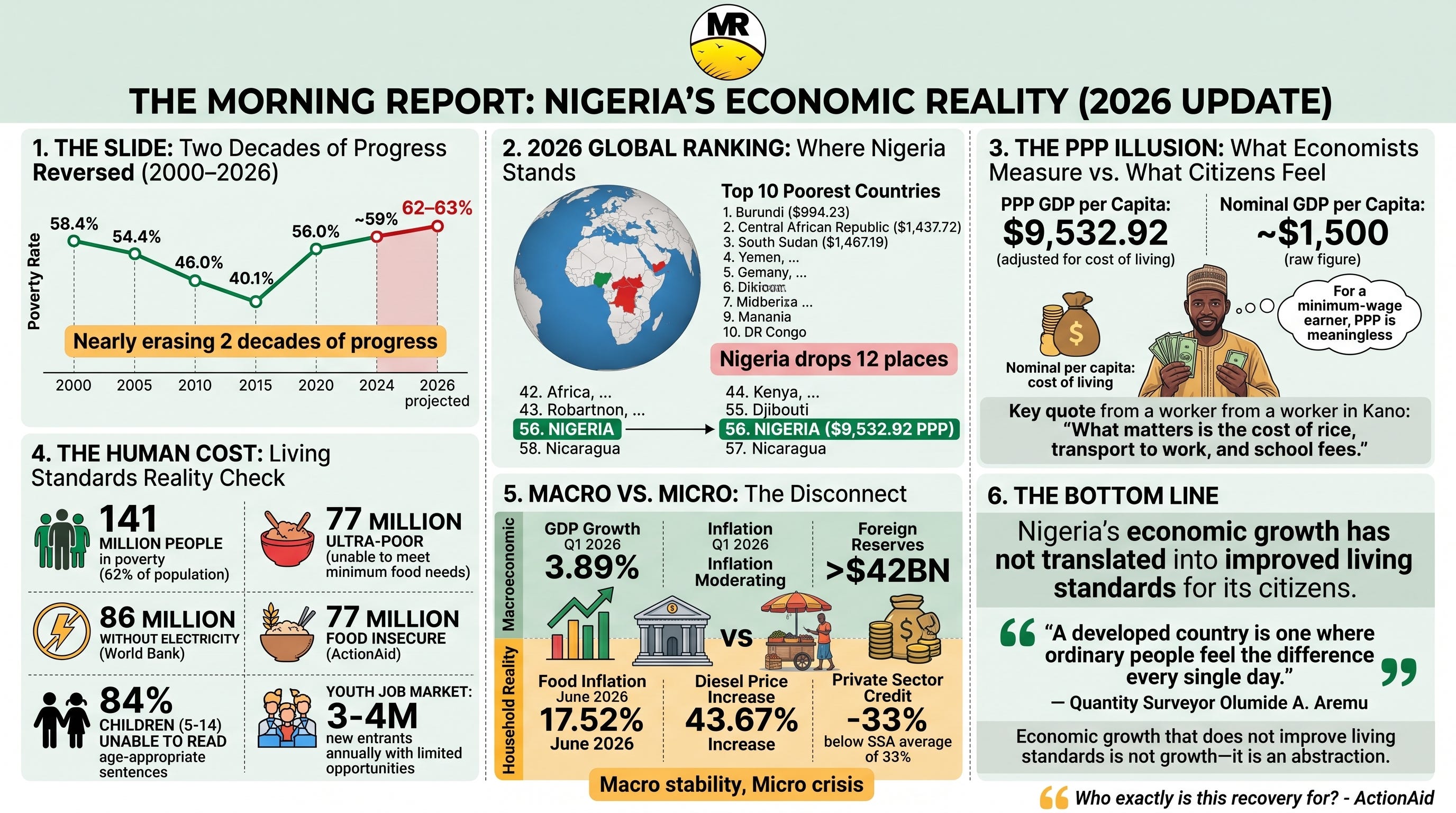
Within official governance circles, the administration maintains that these painful adjustments are the unavoidable precursor to long-term structural stability. Speaking on the nation’s financial trajectory in Abuja on August 24, 2026, Minister of Finance and Coordinating Minister of the Economy Wale Edun declared that Nigeria has successfully transitioned out of an acute crisis management phase into an era of structural consolidation. Edun pointed to key macroeconomic indicators as evidence of recovery, citing external foreign exchange reserves rising above $51 billion, exchange rate volatility stabilising within the ₦1,400 to ₦1,500 per dollar corridor, a national debt-to-GDP ratio holding at a sustainable 36.1 percent, and projected real GDP growth between 4.2 percent and 4.68 percent for 2026. From the perspective of fiscal managers, two years of aggressive structural reforms, anchored by fuel subsidy removals and exchange rate unification, are beginning to establish a durable foundation for future capital accumulation.
Providing support for this narrative of top-line stabilisation, the National Bureau of Statistics (NBS) released its monthly Consumer Price Index report on August 18, 2026, showing a second consecutive month of headline inflation moderation. The bureau reported that annual headline inflation dropped to 15.43 percent in July 2026, down from 15.91 percent in June, marking its lowest statistical level in four months. Official statisticians attributed this slowdown primarily to core inflation easing to 14.97 percent, supported by minor decreases in localised fuel tariffs and relative calm in the foreign exchange market.
However, independent economic analysts argue that top-line statistical easing creates a false sense of security while masking acute microeconomic distress. Evaluating the official statistics on August 24, 2026, development economist and public policy expert Prof. Ken Ife characterised the latest economic data as a profound paradox of conflicting realities. Ife pointed out that while headline numbers slowed due to a 2.3 percent drop in average energy costs, food inflation experienced an alarming month-on-month acceleration, climbing to 5.56 percent in July from 3.75 percent in June.
Prof. Ife emphasised that national aggregates obscure deep regional disparities that inflict severe hardship on vulnerable communities. In states such as Adamawa, annual headline inflation hovered near 33.03 percent in July, while regional food inflation spiked to an extraordinary 51.36 percent, more than double the national food inflation baseline of 20.31 percent. Ife explained that persistent insecurity in agricultural belts, high maritime freight tariffs and exorbitant logistics costs involved in moving harvested produce to urban centres continue to drive basic food items out of reach, warning that without emergency releases from strategic grain reserves, localised nutrition crises will deepen regardless of national GDP statistics.
This disconnect between corporate balance sheets and household welfare was further detailed in PricewaterhouseCoopers’ H2 2026 Economic Outlook, published on August 21, 2026. Olusegun Zaccheaus, Partner and Chief Economist at PwC Nigeria, noted that while first-quarter GDP growth reached 3.89 percent alongside record trade surpluses, macroeconomic stabilisation has largely failed to translate into improved living standards. Zaccheaus highlighted that severe structural bottlenecks continue to prevent top-line expansion from generating inclusive prosperity, leaving Nigeria’s national poverty headcount projected at 63 percent for 2026. He urged policymakers to pivot immediately toward direct consumer support, targeted transport subsidies for agricultural goods, expanded credit for micro-enterprises, and aggressive investments in rural feeder roads and power grids.
Expanding this critical evaluation into a broader historical context, political economist Tunde Leye observed on August 25, 2026, that Nigeria’s current economic descent must be understood through the lens of long-term governance trends rather than isolated statistical cycles. Leye highlighted that Nigeria’s population has doubled since the return to democratic rule in 1999, yet the trajectory of poverty reduction has shifted dramatically under different political administrations. He noted that in every single one of the People’s Democratic Party’s (PDP) 16 years in power, Nigeria’s national poverty rate consistently dropped. Conversely, Leye pointed out that since 2016, marking the All Progressives Congress’s (APC) first full year in power, the national poverty rate has increased every single year and now stands higher than the baseline poverty rate recorded at the start of the Fourth Republic in 1999. This historical perspective illustrates that the recent slide in global purchasing power rankings is the outcome of a decade-long structural reversal in household wealth creation that has failed to keep pace with rapid demographic expansion.
From the perspective of organised labour, the mathematical reality of household income has reached a critical breaking point. Speaking on behalf of industrial workers on August 22, 2026, Nigeria Labour Congress (NLC) Deputy President Benson Upah stated that the national minimum wage of ₦70,000 has been rendered obsolete by relentless price increases before its full implementation across all 36 states could even be realised. Upah remarked that when a single 50-kilogram bag of rice or a month of basic public transit consumes the entire monthly salary of an entry-level worker, wage mandates become purely symbolic. He stressed that labour unions are witnessing unprecedented levels of working poverty, where employed citizens are forced to skip meals, pull children out of school or incur perpetual debt simply to subsist.
For a minimum-wage earner in Kano, the ₦70,000 salary is not a wage. It is a sentence. A bag of rice costs more than a month’s salary. School fees are a luxury. Healthcare is a gamble. The government’s talk of reserves and debt-to-GDP ratios is a language spoken in a different world. The numbers are real. The hunger is real. The gap between the two is the story of Nigeria’s economy.
Ultimately, Nigeria’s fall to 56th place in Global Finance’s purchasing power rankings serves as a sobering reminder that national economic health cannot be evaluated solely through foreign exchange reserves or trade balances. While government officials defend current reforms as necessary medicine for sustainable growth, the lived reality across Kano, Lagos, and rural farming communities reveals an electorate bearing the brunt of sustained economic contraction. As poverty figures remain elevated above 1999 levels despite a doubling population, the central challenge facing Nigeria’s economic managers is no longer just stabilising macroeconomic indicators, but ensuring that the output of the nation translates into tangible, dignified living conditions for the millions of citizens who drive its economy.
The winners: the government, which can point to macroeconomic stabilisation; and the Nigerian economy, which is showing signs of recovery. The losers: the Nigerian people, who are bearing the brunt of the reforms; and the Nigerian government, which must find a way to translate macro-stability into improved living standards.
Bottom Line: Nigeria’s economy is stabilising on paper. The people are suffering on the ground. The gap between the two is the crisis of our time. The question is whether the government will bridge it or let it widen.