


Drive along almost any federal highway in Nigeria, and the evidence stands in plain sight: skeletal frames of half-built hospitals, rusting gantries of stalled power projects, schools that never opened. The Chartered Institute of Project Managers of Nigeria put the value of abandoned projects at over ₦17 trillion in 2024. By November 2025, the House of Representatives had opened an investigation into abandoned federal properties and projects estimated at more than ₦20 trillion.
A Presidential Projects Assessment Committee, set up as far back as 2011, identified 11,886 abandoned federal projects that would cost an estimated ₦7.78 trillion to complete. Lawmakers have since cited reports suggesting that roughly six in 10 projects initiated since independence were never completed. The economist Bismarck Rewane has called the country a “morgue of abandoned projects”.
These are not merely engineering failures. They are the visible monuments to an invisible deficit: Nigeria’s chronic refusal to evaluate its own policies and its deeper refusal to act on evidence even when it exists.
Every modern government makes mistakes. What distinguishes well-governed states is not that they avoid error, but that they detect it early, learn from it and correct course. That feedback loop, design, implement, evaluate, adjust, is the elementary physiology of effective governance. In Nigeria, the loop is broken at both ends. Policies are launched without ex-ante appraisal of whether they can plausibly work, and terminated without ex-post evaluation of whether they did. The result is a state that governs blindly, unable to distinguish its successes from its failures, doomed to repeat the latter and unable to replicate the former.
Consider the pattern. A new administration arrives, discards its predecessor’s flagship programmes, often unexamined, and launches its own, with fresh acronyms and familiar ambitions. Youth employment schemes, social investment programmes, agricultural interventions and subsidy regimes have each cycled through this ritual of birth, fanfare and abandonment. Rarely does anyone in authority pause to ask the two questions on which rational policy depends: Did the last one work? And how do we know?
It is not that Nigeria lacks the institutional paperwork. The federal government launched a National Monitoring and Evaluation Policy in August 2022, promising evidence-based policymaking, results-oriented budgeting and a government-wide evaluation system. On paper, it is a respectable document, with seven guiding principles and an implementation framework. In practice, the policy has yet to be implemented across ministries, departments and agencies, and has not cascaded to states and local governments. Nigeria, in short, has a policy on evaluation but no culture of it.
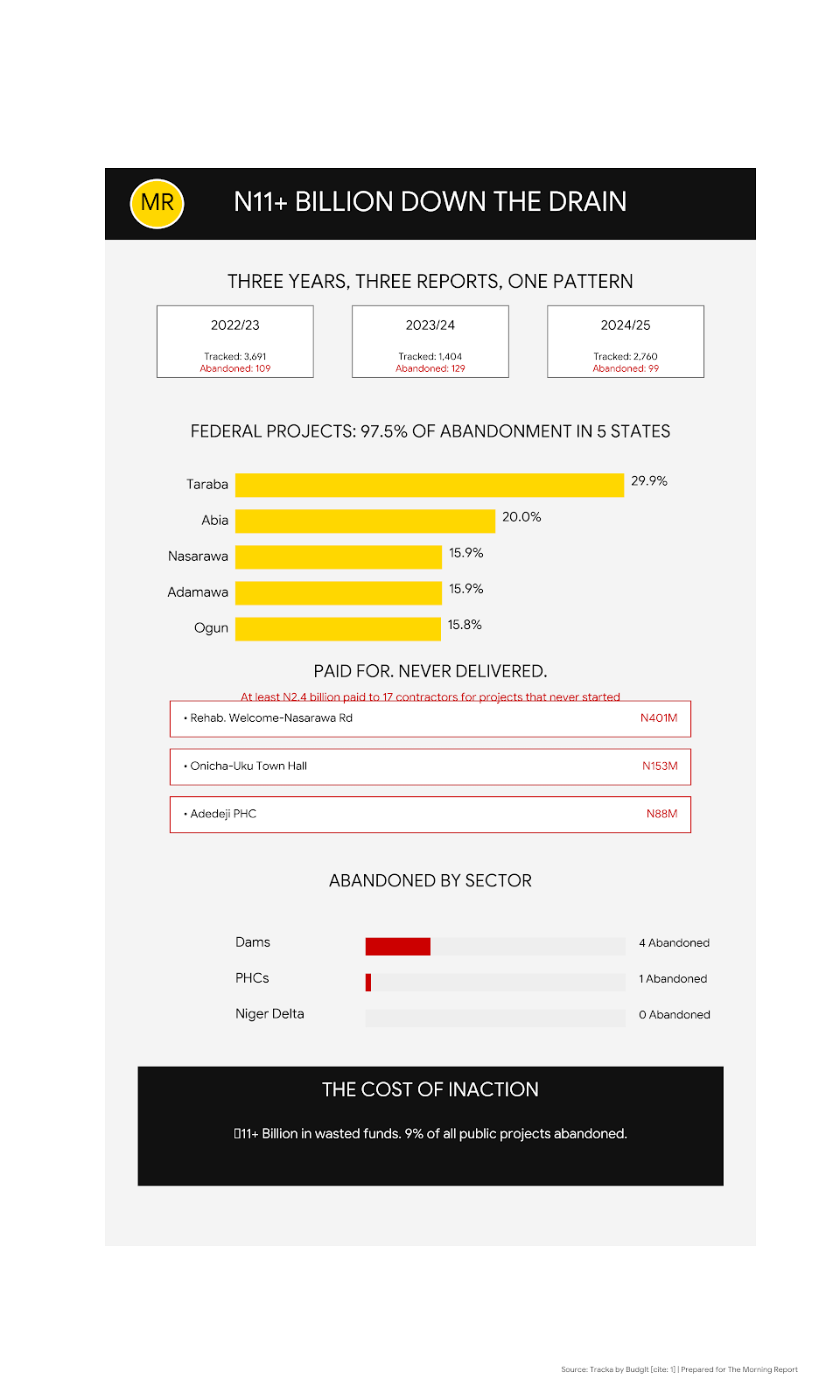
The costs of this amnesia are not abstract. When policies are neither appraised before launch nor evaluated after, three pathologies follow. First, resources flow to programmes on the strength of political sponsorship rather than demonstrated results, which is how a country with Nigeria’s infrastructure deficit accumulates ₦20 trillion in abandoned projects. BudgIT’s Tracka report for 2024/2025 tracked 2,760 federally funded capital projects and found that only about half were completed. In Benue, the worst performer, 40 per cent were never executed at all, and five states alone accounted for 97.5 per cent of the abandoned works, some ₦7.8 billion in mobilisation fees paid to contractors who then vanished.
Professor Ngozi Odu, a public policy analyst, described the pattern as “institutionalised waste”. “Policies are designed to satisfy political constituencies, not to solve problems,” Odu said. “The evaluation is optional, so it never happens. We are spending trillions without knowing what works.” Dr Okechukwu Eze, an economist at a Lagos-based research institute, agreed: “Any organisation that spends billions without tracking outcomes would be bankrupt. The government has the luxury of printing money, but the people pay the price.”
On the other hand, some argue that evaluation is not the missing piece. “Nigeria has enough reports gathering dust on shelves,” said Femi Olaofe, a development consultant. “The problem is not a lack of data. It is a lack of political will to act on data. Politicians want to claim success, not measure failure.” Another analyst, Bamidele Oyewole, said the problem is structural: “The civil service rewards process, not outcomes. You get promoted for following procedure, not for delivering results. Evaluation is seen as a threat, not a tool.”
Neutral observers point to the political economy of abandonment. “Evaluation would expose failures, and failures would embarrass politicians. So they avoid evaluation entirely,” said Dr Yemi Akinbode, a governance researcher. “The paradox is that avoiding evaluation is more expensive in the long run.” Another observer, Kemi Ogunleye, added: “The international community has tried to push evaluation frameworks for years. Nigeria adopts them on paper and ignores them in practice. The culture is the real barrier.”
This mirrors the 1970s and 1980s, when Nigeria launched numerous development plans that were abandoned mid-cycle. The mechanism then was different, but the result was the same: wasted resources, unfinished projects and a state that never learns.
The winners: contractors who collect mobilisation fees and disappear; politicians who launch projects for photo opportunities; and bureaucrats who benefit from the absence of accountability. The losers: Nigerian taxpayers, who fund projects that are never completed; Nigerian citizens, who wait for infrastructure that never comes; and the Nigerian state, which governs blindly.
Bottom Line: Nigeria has ₦20 trillion in abandoned projects. The problem is not a lack of plans. It is a lack of evaluation. The state is governing blind. And it is costing the country everything.