


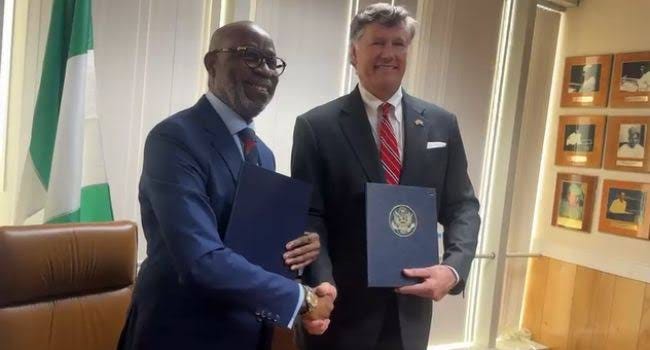
Nigeria and the United States have signed an agreement to deepen cooperation on critical minerals. The deal was signed on the margins of the 81st UN General Assembly. Minister of Solid Minerals Development Dele Alake signed for Nigeria. US Deputy Secretary of State Christopher Landau signed for the United States. The ceremony took place at Nigeria House in New York.
Nigeria holds significant mineral reserves. Lithium, cobalt, gold, tin and coltan are found across the country. Most are exported as raw materials. Value addition happens abroad. In 2023, the government announced plans to ban raw mineral exports. In 2024, it introduced incentives for local processing. The United States wants supply chains outside China. China dominates global mineral processing. The US sees Nigeria as an alternative source. Nigeria sees the US as a source of capital and technology. The agreement formalises that alignment.
Alake said Nigeria would not accept arrangements that left it supplying raw minerals while others created the value. “We are not here to remain as a source of raw materials for the value that others create,” he said. He said the agreement promotes cooperation across the mineral value chain. That includes geological data, exploration, processing, infrastructure and technical capacity. He said Nigeria wants its minerals to generate industries, skills, jobs and investment. “The signatures are promises,” he said. “In the months ahead, we will identify viable projects, mobilise investment and build commercial partnerships.”
Landau described the agreement as a sign of deepening relations beyond minerals. “What this signifies beyond just the minerals is the signal that we are sending that the United States and Nigeria are partners,” he said. He backed Nigeria’s push to retain value. “You don’t want to just be a source of raw materials. You want some of that value-added chain. Those are very legitimate and compelling issues.”
The agreement follows months of engagement between Nigerian and US officials. Nigeria has promoted local processing to reduce dependence on raw exports. The framework's success will be measured by projects developed, facilities built, and skills transferred.
Winners: Nigeria, which gains a partner. US companies, which gain access. Local processors, if investment follows. Communities near mining sites, if jobs follow. Losers: Raw material exporters, if exports are restricted. China, which faces competition. Middlemen, who profit from opacity. The environment, if mining expands without safeguards.
Bottom Line: Nigeria signed a minerals deal with the US. The promise is investment, processing and jobs. The signatures are easy. Delivery is the test. Without processing plants and skills transfer, the deal is paper. With them, it could transform the sector.