


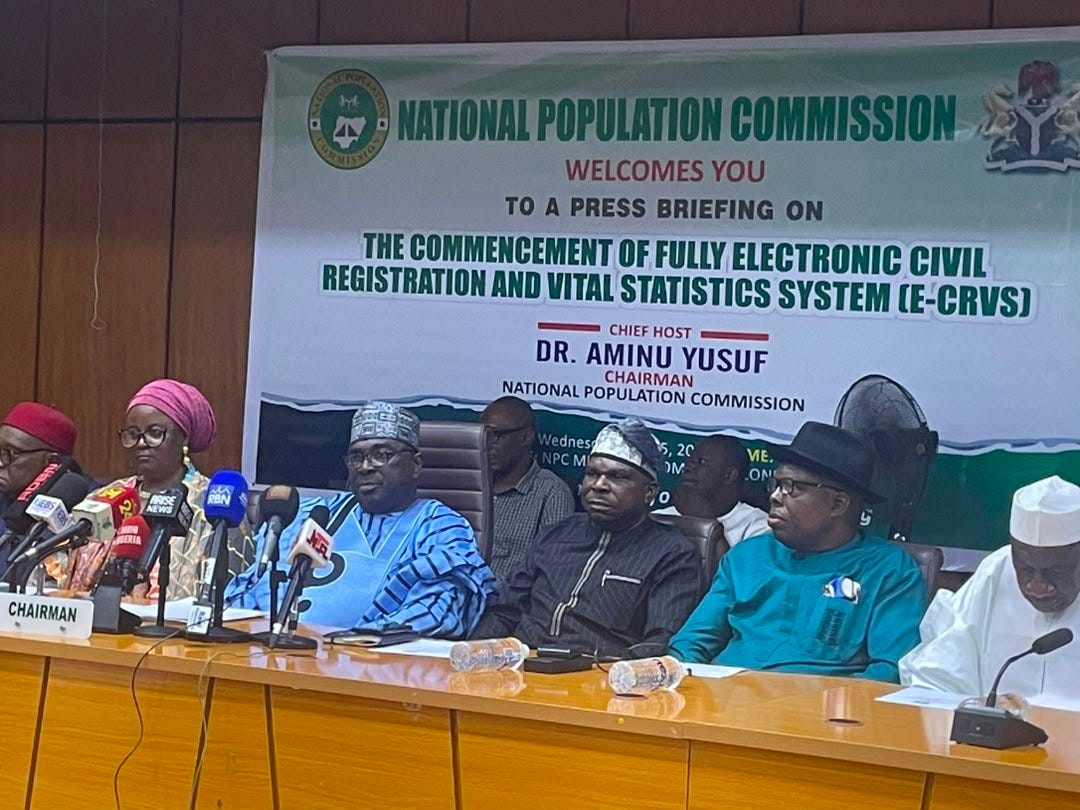
Nigeria records an estimated five million births every year, even as millions of births and deaths remain undocumented. The National Population Commission (NPC) disclosed this on Wednesday, noting that the country’s birth registration coverage now stands at 57 percent, while death registration remains below 20 percent.
Speaking at a press briefing in Abuja, NPC Chairman Dr Aminu Yusuf said the country’s low registration rates continue to deprive millions of Nigerians of legal identity while limiting the availability of reliable demographic data needed for national planning. “These gaps deprive many Nigerians of legal identity and limit the availability of reliable data needed for effective national planning,” he said.
The disclosure came as the commission launched the nationwide digital registration of births and deaths through the VitalReg platform under the Electronic Civil Registration and Vital Statistics system. Yusuf said the platform, which became operational across the 36 states and the Federal Capital Territory on July 1, represents one of the most significant reforms in Nigeria’s civil registration system. The digital platform is designed to provide faster and more efficient services, including 24-hour online access, digital certificate issuance, reduced paperwork and improved data validation.
To improve access, the commission has established 4,011 functional registration centres across the country’s 774 local government areas and plans to increase the number to about 8,000 nationwide. Yusuf assured Nigerians that birth registration and birth notification services would remain highly subsidised, in line with the commission’s commitment to achieving universal registration.
This echoes the 2012 national identity management reforms, which sought to create a centralised database for citizens but struggled with implementation. The mechanism then was different, but the result was the same: a system that promised efficiency but delivered delays.
The winners: the millions of Nigerians who will finally gain legal identity through digital registration. The losers: the generations of Nigerians who grew up without legal documentation, and the Nigerian state, which has failed to collect the data needed for effective planning.
Bottom Line: Five million births a year, but death registration is below 20 percent. Nigeria is counting the living but not the dead. That is not a system. That is a gap.