


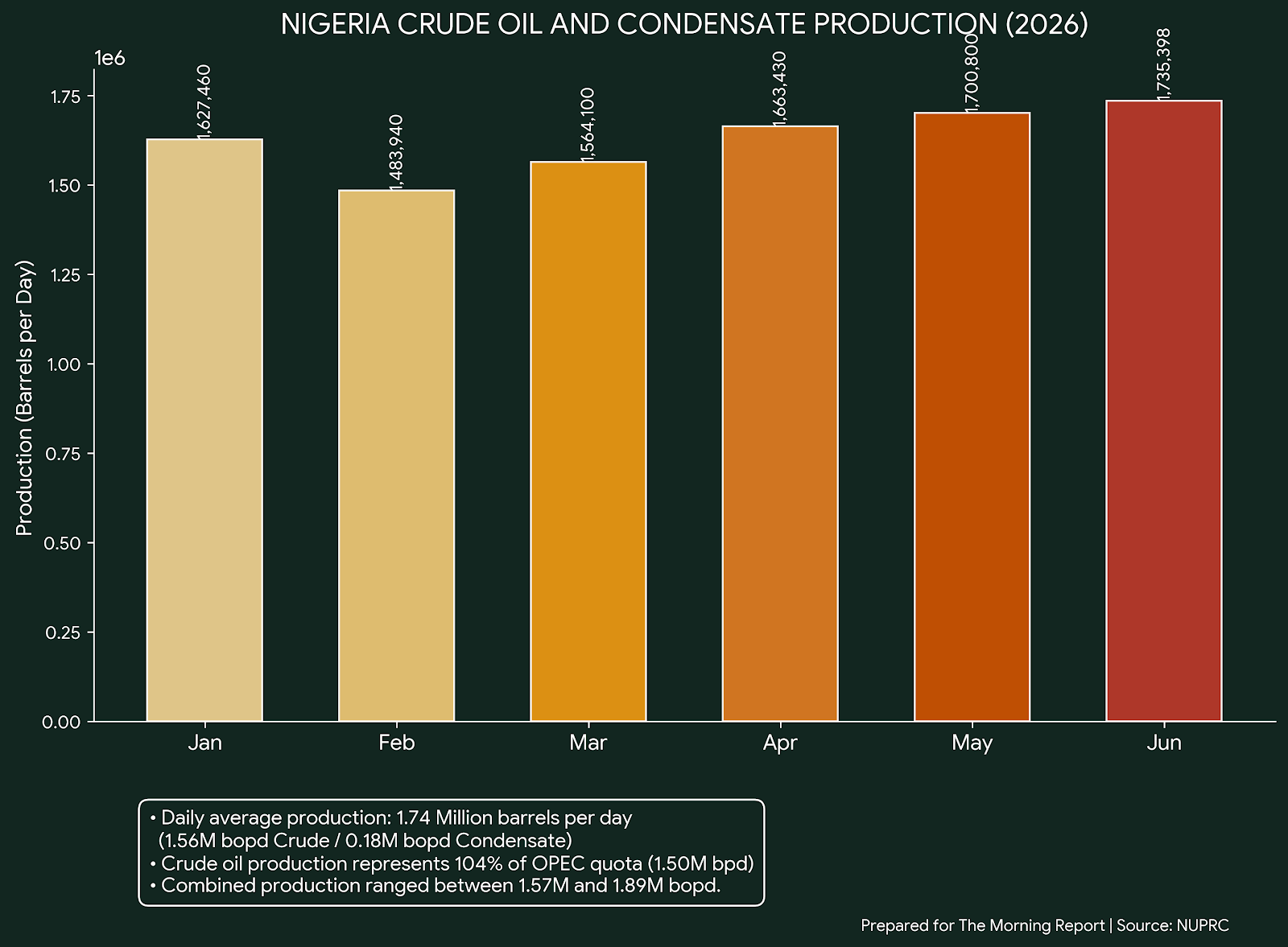
Nigeria’s crude oil production has continued its upward trajectory, rising to 1.56 million barrels per day in June, its highest level in six years and the second consecutive month above its OPEC quota. According to the Nigerian Upstream Petroleum Regulatory Commission (NUPRC), total crude oil and condensate production averaged 1.735 million barrels per day in June, comprising 1.56 million barrels per day of crude and 0.18 million barrels per day of condensate. The production figures represent 104 percent of Nigeria’s OPEC quota of 1.5 million barrels per day.
The NUPRC said the performance reflects improved operational stability across most production assets, with no significant pipeline disruptions recorded during the review period. “This enhanced operational stability supported improved production uptime and crude evacuation efficiency,” the commission stated. “Although a limited number of assets experienced short-duration operational shutdowns, the overall impact on national production was minimal”. The commission also noted that scheduled turnaround maintenance activities were effectively managed and completed without significant disruption to production operations.
A breakdown of production by terminal shows that Bonny Terminal led with 318.28 thousand barrels per day, up from 293.88 kbpd in May. Forcados Terminal followed with 306.36 kbpd, up from 289.90 kbpd. Qua Iboe Terminal recorded 164.73 kbpd, down from 173.36 kbpd, while Escravos Oil Terminal posted 138.03 kbpd, up from 135.47 kbpd. Bonga ranked fifth with 103.66 kbpd.
The sustained growth reflects “the continued commitment of operators and industry stakeholders towards improving operational efficiency, maintaining asset integrity, and enhancing production reliability across the Nigerian upstream petroleum sector,” NUPRC stated.
This is good news for Nigeria’s economy. Higher production means more revenue for the government, which is desperately needed to fund the 2026 budget and service the country’s mounting debt. But the increase in production must be seen in context. Nigeria’s OPEC quota is 1.5 million barrels per day, but the country’s production capacity is significantly higher. Years of underinvestment, pipeline vandalism and crude theft have kept production below potential. The current increase is a recovery, not a breakthrough.
This mirrors the 2014 production peak, when Nigeria produced over 2 million barrels per day before the oil price crash and the resurgence of militancy in the Niger Delta. The mechanism then was different, but the result was the same: a production boom that was not sustained. The question is whether this recovery will be different.
The winners: the Nigerian government, which earns more revenue; the operators, who have improved efficiency; and the Nigerian economy, which benefits from increased oil income. The losers: the Nigerian public, which has not seen the benefits of increased production in the form of lower fuel prices or better public services.
Bottom Line: Nigeria is pumping 1.56 million barrels per day, its highest level in six years. That is good news. The question is whether the government will use the additional revenue wisely or waste it as it has in the past.