


Nigeria builds. Then it dismantles. Billions of naira are mobilised to construct power grids, bridges, telecom masts and rail lines. Criminal syndicates then strip them, melt them and sell the metal. What began as localised theft is now a multi-billion-naira underground economy. It paralyses public utilities. It threatens national security. It mortgages the country’s physical future. Borno State has drawn a line. It now treats scrap metal trading not as informal livelihood but as a vector of terrorism and sabotage.
The Borno flashpoint
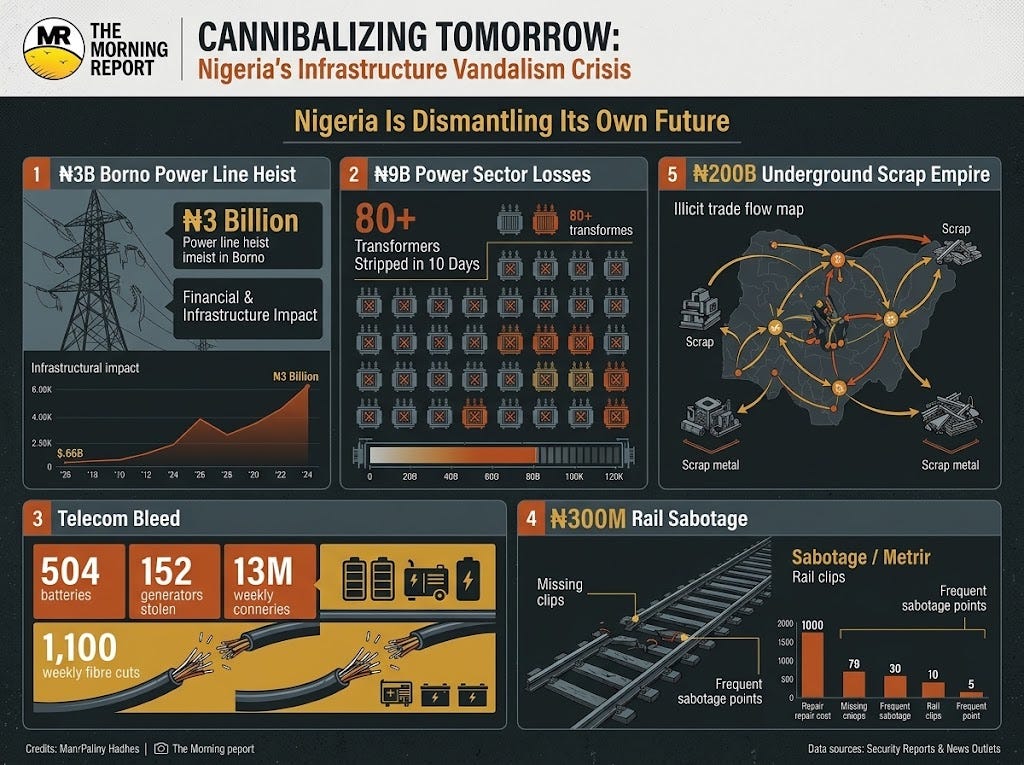
Governor Babagana Zulum imposed a sweeping ban on scrap metal scavenging and trading. The trigger was coordinated sabotage. A ₦3 billion electricity transmission infrastructure linking Damaturu to Maiduguri was looted and destroyed. The northeast has spent years restoring power after Boko Haram and ISWAP attacks. Military forces pushed insurgents back from population centres. A second economic army moved in. Scavengers and metal traffickers stripped newly installed transformers, high-tension cables, bridge guardrails and public water installations. They sold the copper and aluminium to smelting networks connected across international borders.
The Zulum administration argued that unregulated scavenging had become an advance intelligence and logistics wing for terrorist networks. Criminal groups use scrap proceeds to fund weapons. The destruction of power lines plunges communities back into darkness. That erodes counter-insurgency gains. The ban is an extraordinary state intervention. It places security above informal commerce. Security forces now crack down on unauthorised metal yards and transit corridors.
The national scourge
Borno’s crisis is tied to asymmetric warfare. The wider epidemic is not. Across Nigeria, public assets are treated as open-access quarries. In Onitsha’s “Iron Condemned” markets, stolen metal is bought and sold openly. In Lagos and Abuja, streetlights, rail tracks and copper grounding wires disappear. Viral footage has shown citizens dismantling public bridges and urban infrastructure in broad daylight.
Cheta Nwanze, Lead Partner at SBM Intelligence, captured the stakes in a commentary published in Financial Nigeria. “The bridge they are pulling down is not just a structure of concrete and steel,” he observed. “It is the future of a country that is being cannibalised by its own citizens.”
The economic cost is staggering. Distribution companies lose millions of dollars annually replacing vandalised transformers and armoured cables. Neighbourhoods sit in darkness for months. The Nigerian National Petroleum Company has spent tens of billions of naira repairing pipelines ruptured by oil thieves and metal scavengers. Telecommunications operators report that backup batteries, copper feeder cables and generator parts vanish from base stations as fast as they are installed. Dropped calls and network failures follow. Digital connectivity degrades for millions of subscribers.
The anatomy of the trade
Why does vandalism persist despite severe penalties? Look at the economics. Unemployment is high. Poverty is deep. Inflation is relentless. The informal scrap sector has absorbed millions of desperate youths. Discarded iron, copper wiring, aluminium frames and structural steel fetch immediate cash. Middlemen aggregate the materials for industrial smelting or illegal export.
The line between legitimate recyclers and criminal syndicates is blurred. Unscrupulous merchants operate nocturnal warehouses. Stolen public infrastructure is melted into ingots. Its identity is obscured before transport to commercial hubs. The supply chain operates with minimal oversight. State borders are porous. Enforcement channels are corrupt.
Dr Ibrahim Danladi is a senior researcher in informal economy dynamics at the University of Abuja. He spoke in Abuja on 19 September 2026. “We are witnessing a dangerous collision between mass unemployment and criminal enterprise,” he said. “When young men see that stealing public copper cables or bridge rails pays ten times what a legitimate daily wage earner makes, and when enforcement is weak, the incentive structure breaks down entirely. The scrap metal trade has become a parasite feeding on the host body of national infrastructure.”
Voices from the frontlines
The human cost is felt in communities. Hajiya Aisha Umar is a women’s cooperative leader in Maiduguri. She spoke on 20 September 2026. “Government struggled for years to bring back electricity and water to our ward,” she said. “We rejoiced, thinking our suffering was over. But within weeks, thieves came in the dead of night, cut down the transformer cables, and stripped the distribution poles. They left us in darkness just so they could sell a few kilograms of copper. It is pure wickedness against our own people.”
Utility providers are exhausted. Engr Olumide Akintola is a regional maintenance director for a major electricity distribution network. He spoke in Lagos on 21 September 2026. “Our engineering teams spend more time replacing stolen infrastructure than expanding capacity,” he said. “We install aluminium and copper cables today, and within forty-eight hours, surveillance reports show they have been harvested by criminal rings. Without active community policing and total enforcement of trade bans on unverified scrap, no utility company can guarantee sustainable service delivery.”
Public sentiment is hardening. Citizens who bear the brunt of blackouts and collapsed amenities want vandalism treated as economic sabotage. They want long prison sentences. Borno’s total ban reflects a growing consensus. Ordinary theft laws are not enough.
The regulatory dilemma
Not everyone supports blanket bans. Legitimate recycling associations and secondary metal dealers say sweeping prohibitions criminalise hundreds of thousands of honest workers. Collectors gather household waste, discarded vehicle parts and industrial scrap. Industry representatives argue for rigorous licensing instead. They want mandatory digital registration for all scrap dealers. They want traceability protocols for metal transactions. They say recycling plays a vital circular-economy role. It feeds domestic steel mills and reduces environmental waste.
Security analysts counter that voluntary self-regulation has failed. In high-risk zones like the northeast, and in cities plagued by critical infrastructure theft, armed syndicates ignore voluntary codes.
Barrister Nkechi Nnamdi is a Lagos-based corporate governance and security law consultant. She spoke on 22 September 2026. She argued for a dual-track strategy. “We cannot ignore the legitimate recycling sector, but we also cannot coddle an unregulated black market that destroys public property,” she said. “Governments must draw a bright red line: trading in sensitive public infrastructure, such as high-tension electrical cables, rail tracks, manhole covers and bridge components, must be classified as a felony. At the same time, authorities must work with recognised scrap cooperatives to certify private-sector metal sources. That ensures honest workers can still earn a living while criminal syndicates are systematically locked out.”
Historical anchor
This is not new. In 2013, Nigeria’s power sector was privatised. Distribution companies inherited ageing infrastructure and weak protection. Vandalism rose. In 2016, the recession pushed more people into informal metal collection. In 2020, the #EndSARS protests were followed by the looting of public assets in several states. Each shock deepened the trade. The pattern is consistent. Economic distress feeds scavenging. Weak enforcement rewards it. The infrastructure that should support recovery is stripped instead.
Winners: Scrap merchants, who profit from stolen metal. Smelting networks, which gain raw material. Exporters, who ship ingots abroad. Corrupt enforcement officials, who look away. Armed groups, which fund operations from scrap proceeds. Losers: Communities plunged into darkness. Distribution companies, which replace assets endlessly. Telecom operators, which lose equipment and revenue. The NNPC, which repairs sabotaged pipelines. Taxpayers, who fund infrastructure twice. Honest scavengers, whose livelihood is criminalised by association. The economy, which loses productivity. Nigeria itself, whose physical foundation is being dismantled.
Bottom Line: Borno’s ban is a response to an emergency. It is not a national strategy. Nigeria needs technological surveillance along critical corridors. It needs unyielding judicial deterrents. It needs stringent licensing across the scrap supply chain. It needs community vigilance. A country cannot build its way to prosperity while its citizens tear down tomorrow’s foundation for today’s scrap value. The bridge being pulled down is not concrete and steel. It is the future.