


The Nigeria Governors’ Forum (NGF) has denied holding $100 million linked to the Paris Club refund controversy, insisting that it never received the money or participated in the transaction now before an Abuja court.
The clarification follows a November 19 interim order by the High Court of the Federal Capital Territory (FCT), which directed 29 commercial banks to freeze up to $100 million allegedly linked to the governors’ forum.
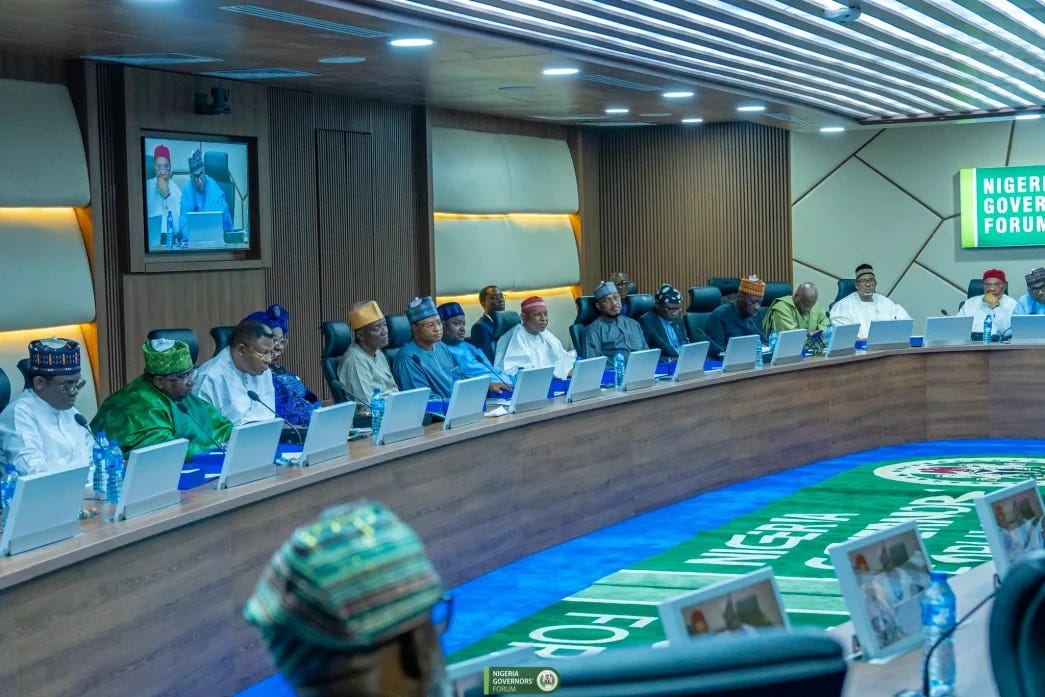
The money, estimated at ₦135.58 billion, is at the centre of a dispute involving lawyer Ted Iseghohi-Edwards, the Association of Local Governments of Nigeria (ALGON) and the NGF.
In a statement signed by its Director of Media and Strategic Communications, Yunusa Tanko Abdullahi, the forum said the dispute arose from alleged dealings between Iseghohi-Edwards and ALGON.
“The Nigeria Governors’ Forum has no hand in that transaction and did not engage any party thereto, nor held any such monies in its custody at any time,” the statement said.
The forum added that its legal team was reviewing the court documents and would respond through the appropriate legal channels.
But how did a dispute over professional fees connected to the Paris Club refunds become a ₦135 billion court battle involving the governors?
The dispute dates back to 2016, when Iseghohi-Edwards said ALGON engaged his legal firm to represent Nigeria’s 774 local government councils in matters relating to the London and Paris Club refunds.
The refunds followed the reconciliation of deductions from states’ allocations to service external debts. The Federal Government subsequently released funds to state and local governments after the reconciliation exercise.
However, disagreements emerged over consultancy and legal fees allegedly owed to professionals involved in recovering or facilitating the refunds.
Iseghohi-Edwards instituted a suit against the Federal Government, identified as FHC/ABJ/CS/856/2016, over outstanding professional fees.
According to his court filings, the Federal High Court established the government’s indebtedness of $318 million in a judgment delivered on February 16, 2018. He said the government later made a part-payment of $159 million through promissory notes.
His present claim rests on an alleged indemnity issued by the NGF on December 20, 2018. He argues that the document entitled him to $100 million if the Federal Government was found liable for the outstanding professional fees.
The lawyer maintains that the condition was fulfilled following the court judgment and subsequent payment arrangement. He also alleged that the NGF failed to honour its undertaking despite a formal demand issued on October 8, 2026.
WHY THE COURT FROZE THE MONEY
On November 19, Justice Charles Agbaza granted an interim Mareva injunction following an ex parte application by Iseghohi-Edwards.
A Mareva injunction is a court order designed to prevent a defendant from moving or dissipating assets that may be needed to satisfy a judgment.
The judge restrained the NGF from withdrawing, transferring or otherwise dealing with the disputed amount. He also directed 29 commercial banks to preserve any qualifying funds held in the forum’s accounts.
The banks were ordered to disclose within 48 hours whether they maintained accounts containing the money. Where such accounts existed, they were required to identify the balances and amounts preserved.
The order does not establish that the NGF received or currently holds the disputed $100 million. It is an interim measure intended to preserve assets while the court considers the claimant’s application.
That distinction is important because the forum has now directly challenged the central premise of the claim, saying it never held the money.
The case is scheduled to return to court on December 1, when the judge is expected to hear the motion on notice for an interlocutory injunction.
The immediate parties with the most at stake are Iseghohi-Edwards, who is pursuing the $100 million claim, and the NGF, which denies any involvement in the transaction. ALGON’s role is also central because the claimant says the local government association originally retained his services.
The 29 banks face a separate obligation to comply with the preservation order and disclose whether they hold relevant funds. Meanwhile, local governments and taxpayers have a broader interest in understanding how professional fees connected to public revenue distributions were negotiated and documented.
The NGF’s denial does not settle the dispute. The court will have to examine the alleged indemnity, the claimant’s evidence and the forum’s response before determining whether any payment is legally due.
Bottom Line: The NGF says it never received the $100 million, while the claimant insists an indemnity makes the money payable to him. The December 1 hearing could clarify whether this is a legitimate claim for unpaid professional fees or a dispute built on an obligation the governors say they never assumed.