


In Nigeria’s fast-moving digital economy, financial transactions occur at the speed of a smartphone tap. From viral social media charity drives rallying support for emergency surgeries to sleek fintech apps that let users open accounts in seconds, digital finance has fundamentally transformed how money moves across the country. Yet, beneath this veneer of rapid innovation lies a darker, highly sophisticated shadow economy. The latest annual report from the Nigeria Financial Intelligence Unit (NFIU) has sounded a stark alarm, revealing that organised criminal networks, cyber syndicates, and money launderers are aggressively exploiting critical vulnerabilities in Nigeria’s financial ecosystem. Specifically, the report shines a harsh spotlight on the proliferation of social media crowdfunding schemes, glaring onboarding gaps in financial technology platforms and the widespread operation of unregistered digital accounts.
The NFIU’s findings describe a troubling landscape in which criminals have adapted to modern digital habits faster than institutions can build safeguards. Crowdfunding across platforms like X, Instagram and Telegram, once celebrated as a triumph of public solidarity and grassroots mutual aid, has increasingly been hijacked as a conduit for washing illicit funds. At the same time, fintech operators competing fiercely for market dominance have often streamlined customer onboarding to the point that identity verification becomes an afterthought. By allowing users to create accounts with minimal documentation, unverified phone numbers, or unlinked identification numbers, these platforms inadvertently offer money launderers a range of disposable wallets to layer and conceal illegal transactions.
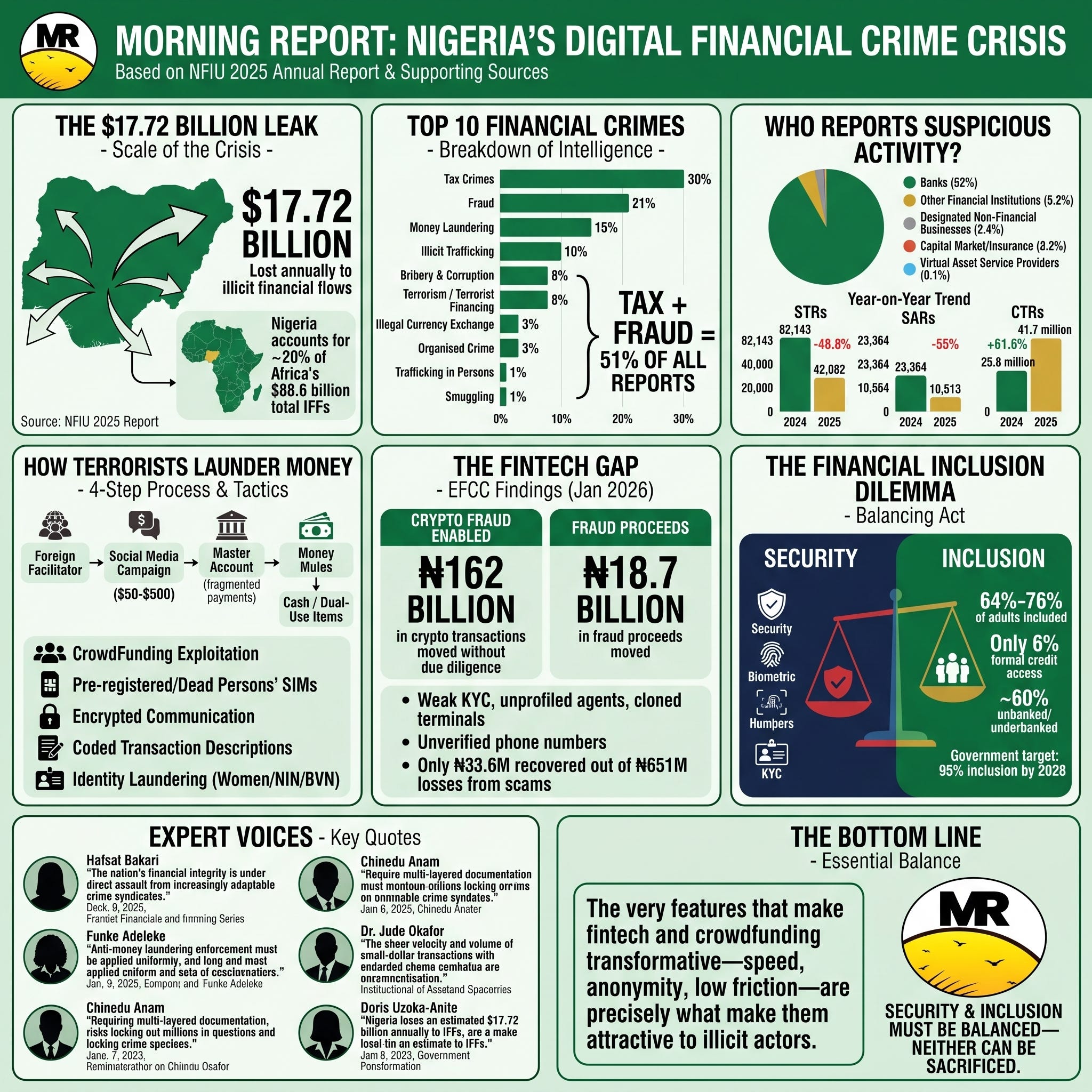
The intelligence agency’s warning is a clear call to action for regulators and financial institutions to immediately strengthen their Anti-Money Laundering (AML) controls. Presenting the report’s key imperatives on August 21, 2026, NFIU Chief Executive Hafsat Bakari declared that the nation’s financial integrity is under direct assault from increasingly adaptable crime syndicates. Bakari explained that intelligence analysts have tracked multi-billion naira illicit streams generated from kidnapping, cyber fraud and illegal narcotics trade that were intentionally fragmented and routed through thousands of tier-one fintech accounts and fake charity campaigns. She stressed that financial institutions can no longer prioritise rapid user acquisition over national security, insisting that mandatory biometric verification, cross-matching of Bank Verification Numbers (BVN) with National Identification Numbers (NIN), and real-time transaction monitoring must become non-negotiable baselines across all digital financial platforms.
This call for stringent regulatory oversight is strongly supported by the traditional banking sector, where compliance officers have long complained about an uneven playing field. Commercial banks, bound by rigid statutory frameworks and exhaustive Know Your Customer (KYC) requirements, often view nimble fintech start-ups as high-risk entry points into the broader banking network. Speaking on August 18, 2026, Funke Adeleke, Head of Compliance at a major commercial bank, argued that legacy institutions are frequently left to clean up the mess created by lax non-bank onboarding protocols. Adeleke noted that when a fintech platform allows an unverified account to receive millions of naira under the guise of an informal crowdfunding drive, that money inevitably flows into the broader clearing system, exposing traditional banks to severe regulatory penalties. She emphasised that anti-money laundering enforcement must be applied uniformly, asserting that any financial intermediary handling public funds must meet identical compliance standards, whether it operates from a marble bank branch or a mobile application.
However, the prospect of a sweeping regulatory crackdown has sparked intense concern within Nigeria’s vibrant technology sector. Innovators and tech policy experts warn that heavy-handed interventions could inadvertently cripple the very engine driving financial inclusion for millions of unbanked citizens. Pushing back against rigid compliance mandates on August 19, 2026, Chinedu Anam, a prominent fintech founder and digital policy analyst, cautioned regulators against imposing archaic banking hurdles on micro-financial services. Anam argued that requiring multi-layered documentation for entry-level digital wallets risks locking out millions of informal traders, rural workers and young Nigerians who lack formal state identification documents. He pointed out that fintechs succeeded precisely because they dismantled the bureaucratic barriers of traditional banking, warning that forcing early-stage startups to implement prohibitive compliance infrastructure will stifle innovation, scare off venture capital and push vulnerable populations back into an unmonitored cash economy.
The tension between security and accessibility is particularly acute in the realm of social media crowdfunding. Over the past decade, online fundraising has served as a vital social safety net in a country where public healthcare and formal welfare systems are severely underfunded. Yet, the ease with which a compelling narrative can be broadcast to millions makes it an ideal instrument for financial deception. Explaining the technical mechanics of this exploitation on August 22, 2026, Dr Jude Okafor, a financial intelligence and cybersecurity researcher, detailed how organised syndicates weaponise emotional narratives. Dr Okafor explained that criminal networks frequently launch synthetic crowdfunding drives using stolen images or fabricated medical crises, employing automated bot networks to boost visibility. Once donations accumulate, they rapidly disperse the funds through a chain of unregistered micro-accounts before converting them into digital assets or withdrawing them at agent banking kiosks. He noted that the speed and volume of these small-dollar transactions let illicit actors bypass traditional threshold triggers, making detection nearly impossible without sophisticated machine-learning analytics.
While researchers highlight these systemic vulnerabilities, grassroots advocates fear that aggressive state intervention could dismantle life-saving community networks. Defending the humanitarian necessity of digital fundraising on August 20, 2026, Aisha Bello, Director of a grassroots relief foundation, urged authorities to avoid painting all online donation drives with a broad brush of criminal suspicion. Bello emphasised that viral social media campaigns can mean the difference between life and death for families facing sudden medical catastrophes or community displacement. She cautioned that if regulators impose cumbersome registration procedures or freeze accounts associated with informal public appeals, the primary victims will not be sophisticated money launderers, but innocent citizens desperately seeking communal aid when state support is absent. Bello urged regulators to collaborate with platform developers to create transparent, light-touch verification badges for legitimate fundraisers rather than criminalising public generosity.
This dilemma closely echoes warnings from the 2020 financial sector review, which also exposed systemic gaps in money laundering controls across non-bank financial institutions. Then, regulatory responses led to aggressive account freezes, heightened reporting mandates, and restrictions on certain digital transaction channels. While technological tools and financial platforms have evolved significantly over the past six years, the underlying structural vulnerability remains the same: a regulatory framework struggling to keep pace with financial disintermediation.
As authorities prepare new policy frameworks to address the NFIU’s findings, legal scholars urge caution to ensure the enforcement push does not infringe constitutional rights. Addressing the legal ramifications on August 23, 2026, Barrister Tunde Olayinka, a constitutional lawyer, warned against repeating the administrative overreach that characterised past financial enforcement cycles. Olayinka stressed that while combating money laundering is a legitimate state interest, regulatory bodies and law enforcement agencies must strictly adhere to due process. He cautioned that arbitrarily freezing personal or corporate accounts without prior judicial authorisation violates basic constitutional guarantees of property and fair hearing. Olayinka asserted that effective crime prevention relies on meticulous intelligence gathering and institutional accountability, rather than blanket restrictions that punish law-abiding citizens and digital entrepreneurs.
Ultimately, the NFIU’s annual report serves as a critical mirror reflecting the dual nature of Nigeria’s digital financial revolution. The very features that make fintech platforms and social media crowdfunding so transformative, speed, anonymity, low friction and global reach, are precisely the characteristics that render them attractive to illicit actors. Resolving this crisis requires a delicate balance. Regulators must resist the temptation to retreat into rigid, paper-heavy bureaucratisation that stifles economic growth, while financial technology operators must accept that sustainable innovation cannot exist without robust security and transparent identity verification. Bridging the gaps in Nigeria’s financial system will not be achieved through panic-driven crackdowns or defensive posturing, but through collaborative, intelligent regulation that protects the nation’s financial integrity while preserving the transformative power of digital opportunity.
The winners: the NFIU, which has raised the alarm; and the Nigerian financial system, which will be strengthened by the response. The losers: the criminal syndicates that exploit the system; and vulnerable Nigerians who may lose access to life-saving crowdfunding if regulators overreach.
Bottom Line: Fintech and crowdfunding are being weaponised. The response must be smart, not heavy-handed. The question is whether Nigeria can secure its financial system without crushing the innovation that drives it.