


As the 2027 presidential election draws closer, the Nigeria Democratic Congress (NDC) has intensified its campaign message, presenting its candidate, Peter Obi, as the alternative to President Bola Tinubu’s administration.
Moses Cleopas, the party’s national chairman, described Obi as Nigeria’s only hope for rebuilding the country, protecting lives and repositioning the economy.
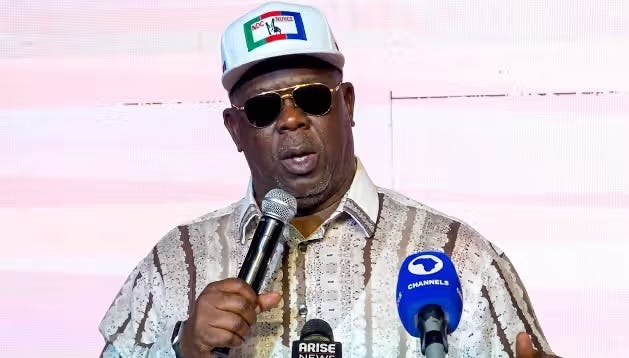
Cleopas made the remarks on Friday, November 20, during his 57th birthday celebration in Yenagoa, Bayelsa State. The party’s National Publicity Secretary, Osa Director, conveyed his position in a statement.
The former senator urged Nigerians to vote out Tinubu, accusing his administration of failing to address worsening economic hardship, insecurity and the rising cost of living.
He argued that the country could not afford another four years under a government that had failed to improve living conditions.
For Cleopas, the 2027 election should be more than another contest between political parties. He wants voters to treat it as a referendum on Tinubu’s first term.
“Second-term election is a referendum. It is standing on the leg of your previous performance. If you have done well, they give you another mandate. If you have not done well, they ask you to go home,” he said.
The NDC chairman also asked Nigerians to assess presidential candidates based on their records, competence and understanding of the country’s problems.
He cautioned against allowing religious considerations and party loyalty to determine voting decisions, insisting that national development and accountability should take priority.
The endorsement comes as Obi and his running mate, Rabiu Musa Kwankwaso, prepare to challenge the ruling All Progressives Congress (APC) in 2027.
Obi, a former Anambra State governor and Labour Party presidential candidate in 2023, has joined the NDC ahead of the next election. His political movement now faces the task of translating his support into a nationwide electoral structure capable of competing against the APC.
That challenge is significant. Nigeria’s opposition has struggled to maintain a united front against Tinubu, with disagreements over party platforms, leadership and presidential ambitions weakening attempts to build a common political alternative.
Obi’s departure from the African Democratic Congress-led opposition arrangement, alongside Kwankwaso’s movement into the NDC, has further reshaped the opposition landscape.
Cleopas’s declaration that Obi is Nigeria’s only hope is therefore both an endorsement and a campaign position. It seeks to present the NDC candidate as the answer to the country’s economic and security challenges while putting pressure on the incumbent president to defend his record.
But describing a candidate as the country’s only hope is easier than demonstrating how that candidate would deliver change. Nigerians will expect more than criticism of the current administration. They will want clear policies on inflation, employment, electricity, insecurity, education and the management of public resources.
The NDC stands to benefit from Obi’s political profile and the support he brings into the party. Tinubu, meanwhile, faces renewed scrutiny over his administration’s performance as the opposition prepares its case for a change of government. Ultimately, voters will decide whether Obi’s record and proposals offer a more convincing alternative.
Bottom Line: Cleopas has made Obi the centrepiece of the NDC’s 2027 campaign. But Nigeria’s problems require more than declarations of political hope. The party must explain how its candidate intends to turn that hope into measurable improvements in people’s lives.