


Nigeria’s domestic airlines operated 7,961 flights in August 2026. Of those, 4,765 were delayed. That is a delay rate of 59.9%. Cancellations remained low at 36 flights, or 0.45%. The data comes from the Nigeria Civil Aviation Authority (NCAA) in its Summary of Domestic Airline Flight Disruption Operations for August 2026.
Nigerian domestic aviation has struggled with reliability for years. In June 2026, the NCAA reported 5,225 delays and 190 cancellations over two months. The causes are structural: ageing fleets, pilot shortages, airport infrastructure failures and weather. In April 2026, the NCAA warned passengers to expect disruption during the rainy season, acknowledging that the system cannot cope with predictable weather patterns.
The airline-level data is brutal. United Nigeria Airlines recorded the highest delay rate at 76.6%, with 943 delays from 1,231 flights. Air Peace followed at 71.4%, with 1,330 delays from 1,864 flights. Enugu Air had a 66.3% delay rate. Arik recorded 62.5% and Max Air 60.7%. Umza Air had the lowest delay rate at 12.9%.
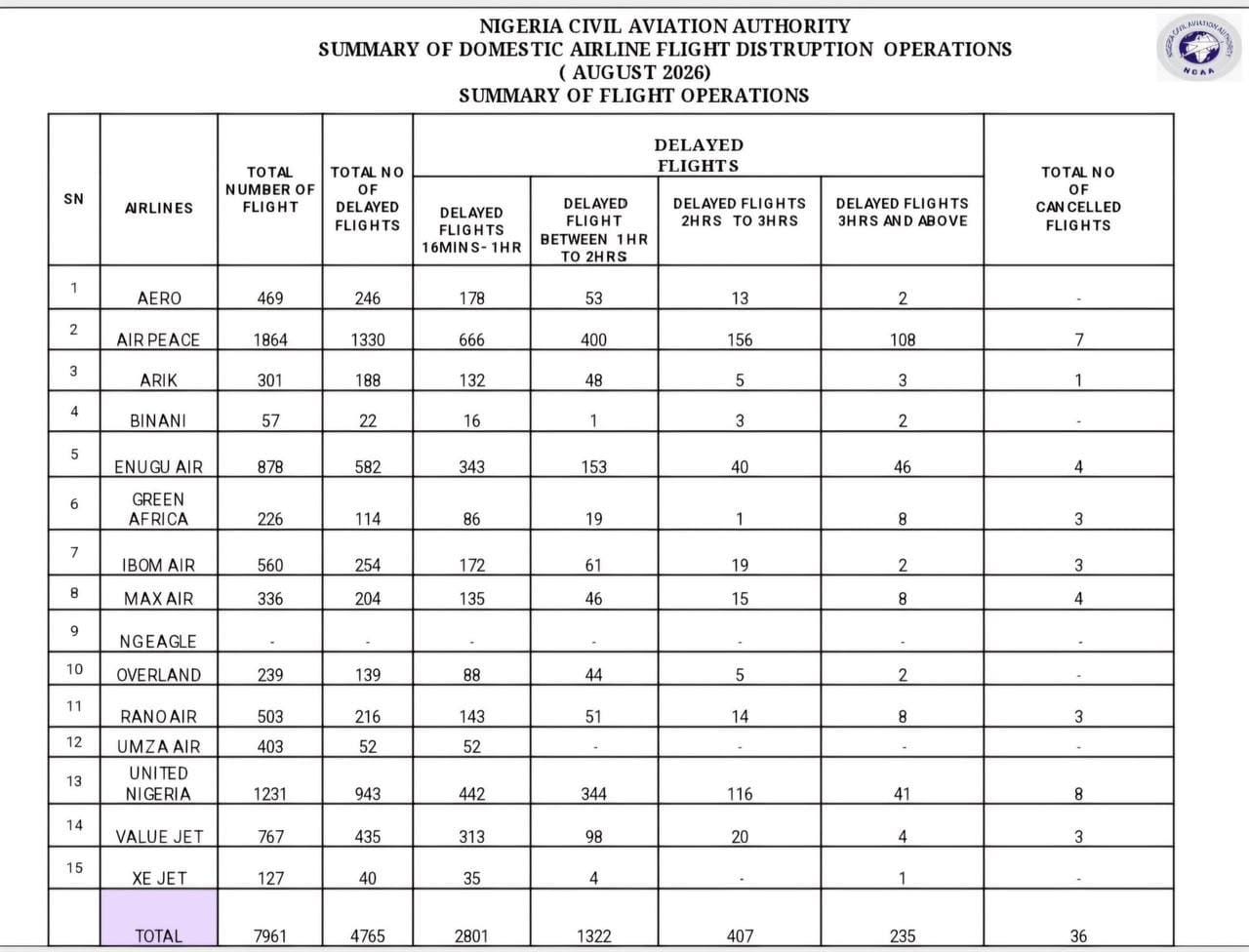
The cancellations were concentrated. United Nigeria recorded eight, Air Peace seven, and Enugu Air four. Aero, Binani, Overland, Umza Air and XE Jet recorded no cancellations. That variation suggests cancellations are a management choice, not an operational inevitability. Airlines cancel when the cost of flying empty or late exceeds the cost of grounding the aircraft.
The NCAA has issued warnings to Air Peace and Max Air over persistent delays, sudden cancellations and crew shortages. It has also identified airport ground equipment failures, such as malfunctioning baggage conveyor belts, as a significant cause. The regulator can name the problem. Fixing it requires investment that airports and airlines have not made.
Passengers bear the cost. A 60% delay rate means that more often than not, a scheduled flight does not leave on time. Business meetings are missed. Connections are lost. The economic cost is invisible but real.
Winners: Airlines that maintain better on-time performance, such as Umza Air, which can claim reliability. The NCAA, which publishes data and names names. Losers: Passengers, who face chronic uncertainty. United Nigeria and Air Peace, whose brands suffer. The aviation sector, which loses credibility. Businesses that rely on air travel for logistics and personnel movement.
Bottom Line: A 60% delay rate is not an operational hiccup. It is a structural failure. The NCAA can publish the numbers. It cannot make the planes leave on time.