


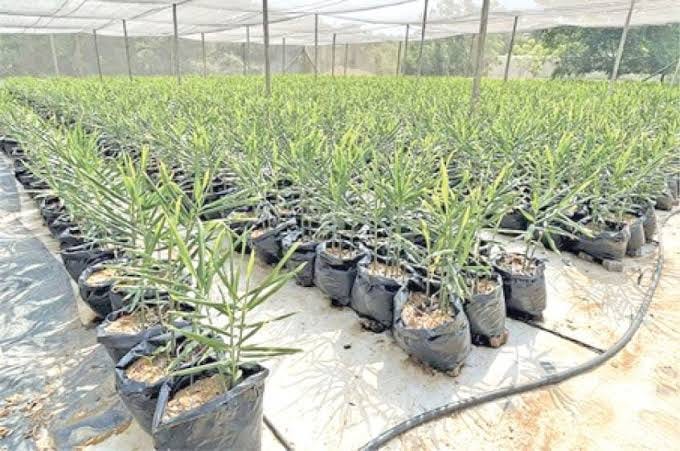
The National Biotechnology Research and Development Agency has developed new ginger planting materials with improved resistance to fungal attack. The agency is also advancing a biological spray solution. Abdullahi Mustapha, the agency’s director-general, disclosed this on Tuesday at the 60th Annual Conference and Diamond Jubilee of the Agricultural Society of Nigeria in Abuja. He said the two measures tackle the problem from both sides: healthy planting material and crop protection.
Nigeria was Africa’s largest ginger producer and the world’s seventh-largest exporter. Production stood at 751,473 metric tonnes in 2022, according to FAO data. Ginger blight, a fungal disease, struck in 2023. Output collapsed to 67,600 metric tonnes, an AFEX Commodities estimate. It recovered only partially to 159,600 metric tonnes in 2024. The disease has resurfaced in Kaduna this year. Export earnings fell from ₦23.76 billion in the first nine months of 2023 to ₦6.28 billion in the same period of 2024. By 2025, exports had fallen to zero.
Mustapha said the industry was valued at about $730 million before the outbreak. Farmers lost roughly ₦12 billion in 2023 alone. Jobs and livelihoods disappeared. Some farmers left production entirely. The agency’s new material is meant to reverse that. “With field validation, farmer training and coordinated deployment, they offer a route to rebuilding production, restoring export confidence and protecting a valuable source of national revenue,” Mustapha said.
The recovery effort extends beyond the laboratory. The National Agricultural Development Fund and the National Root Crops Research Institute launched the Ginger Value Chain Recovery and Sustainability Programme in June. It provides six metric tonnes of disease-free rhizomes, germplasm conservation, tissue culture propagation and seed system development. An earlier programme, GRATE, supported about 6,000 farmers in Kaduna, Plateau and the FCT with improved seeds and pest management support.
The economic stakes are high. Domestic ginger prices rose from ₦1,000 per kilogramme in 2022 to ₦13,000 in 2026. That spike priced Nigerian ginger out of export markets. Local demand absorbed the scarce supply. Farmers who still had crops earned windfalls. Most did not.
Jude Mbanasor, president of the Agricultural Society of Nigeria, called for sustained investment in research, extension services and infrastructure. He urged stronger collaboration between government, academia, farmers and the private sector.
Winners: NBRDA, which shows research capacity. Ginger farmers, if the new material reaches them. The Bank of Agriculture, which is partnering on financing. Seed multipliers, who gain demand. Exporters, if volumes recover. Consumers, if prices fall. Losers: The blight, if the resistance holds. Farmers who left the sector and cannot return. Exporters who lost buyers to other suppliers. Importers of ginger, who face renewed competition. Taxpayers, if the research is not deployed. Local consumers, if renewed exports raise domestic prices again.
Bottom Line: Nigeria lost its ginger export market in three years. NBRDA has bred resistance and is developing a bio-fungicide. The science is promising. The test is the field. Farmers need the material, the training and the financing. Without them, the laboratory stays a laboratory. With them, the $730 million industry can return.