


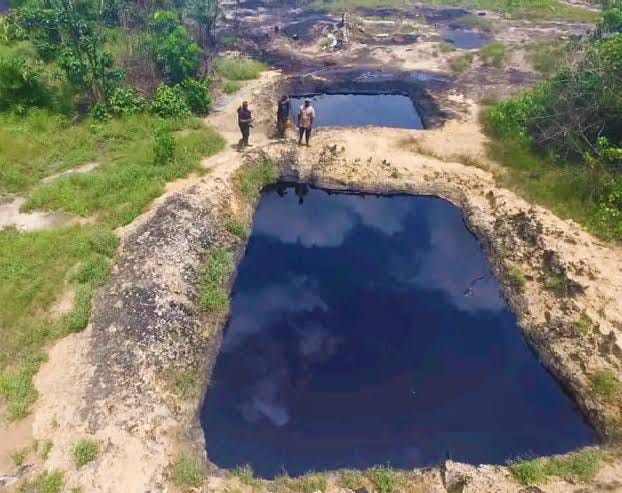
The Nigerian Navy has uncovered about 25,000 litres of substance suspected to be crude oil in a dugout reservoir in the Oteghele general area of Delta State. Nigerian Navy Ship DELTA made the discovery on Thursday. It followed credible intelligence. The Director of Naval Information, Captain Abiodun Folorunsho, disclosed this in an operational report on Friday.
Oil theft has plagued the Niger Delta for over two decades. Illegal refining operations dot the creeks of Delta, Rivers and Bayelsa. They damage the environment, destroy farmland and deprive the treasury of revenue. In 2013, the government estimated losses at 400,000 barrels per day. The scale has not shrunk. The Navy has conducted numerous raids. Storage infrastructure is critical to the illicit supply chain. Raids on reservoirs disrupt distribution. They do not end the trade.
The latest discovery raised the total quantity NNS DELTA uncovered in Oteghele over two consecutive days to 65,000 litres. An earlier operation on Wednesday uncovered approximately 40,000 litres in the same area. Folorunsho said the reservoir and its contents were handled in accordance with established procedures. “The successive operations highlight the importance of maintaining pressure on locations used for suspected storage of illicit petroleum resources,” he said. “Through these interventions, the Nigerian Navy is reinforcing its resolve to deny criminal operators the opportunity to exploit petroleum resources unlawfully.”
He reaffirmed the Navy’s commitment to sustaining operations that protect Nigeria’s critical economic assets. The operations follow a similar pattern to earlier raids. In September, the Navy uncovered about 182,000 litres of suspected stolen crude in Bethel Creeks, Rivers State. It also uncovered 10,000 litres of illegally refined diesel in Eleme.
The raids are tactical wins. They remove product and equipment. They do not eliminate the market. Buyers of cheap illegal fuel remain. Refiners rebuild. The cycle continues.
Winners: The Navy, which demonstrates capacity. The legitimate petroleum sector. The environment, which avoids some pollution. Losers: Illegal refiners, who lose product. Communities dependent on the trade for income. The government, which loses revenue. Buyers of cheap illegal fuel.
Bottom Line: Sixty-five thousand litres in two days. The Navy is disrupting storage. The trade continues because demand continues. Enforcement is necessary. It is not sufficient.