


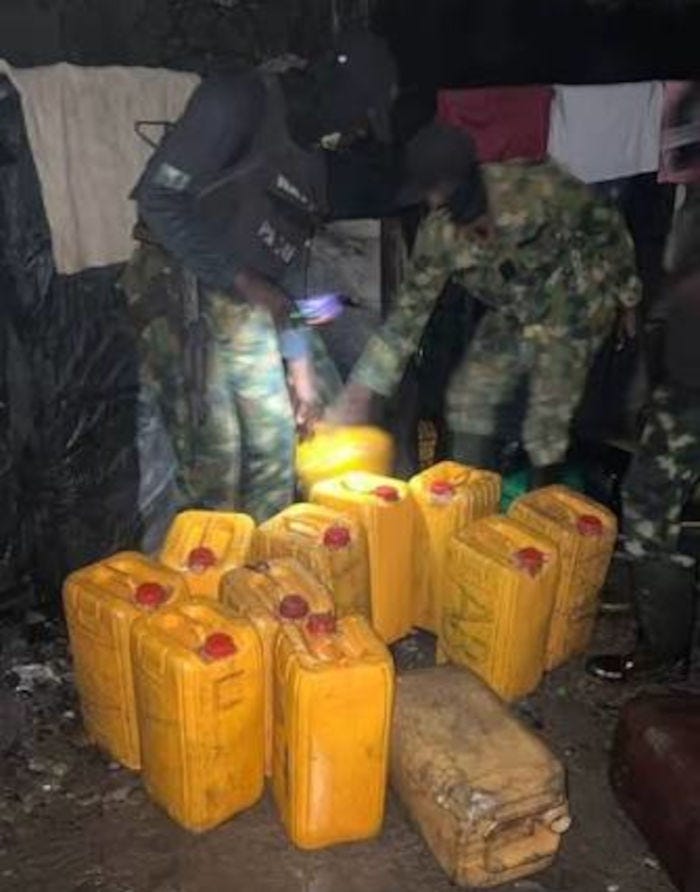
The Nigerian Navy has uncovered a warehouse containing approximately 10,000 litres of suspected illegally refined Automotive Gas Oil (AGO) in Rivers State. The discovery was made by Nigerian Navy Ship (NNS) PATHFINDER on Saturday during a patrol of the Eleme-Okrika-Onne general area. The products were contained in 400 jerrycans of 25 litres each.
Oil theft and illegal refining have plagued the Niger Delta for decades. In 2013, the government estimated that Nigeria lost about 400,000 barrels per day to theft. The scale has not shrunk. Illegal refining operations dot the creeks of Rivers, Bayelsa and Delta states. They pollute waterways, destroy farmland and deprive the treasury of revenue. The Navy has conducted numerous raids, but the trade persists because demand and profitability remain high.
The Director of Naval Information, Navy Captain Abiodun Folorunsho, said the raid exposed a suspected storage and distribution point within the illicit petroleum supply chain. The product was suspected to have been sourced from locations outside the immediate community and stored for onward sale to buyers. No illegal refining site was identified at the location. No arrests were made, as the suspected operators fled upon sighting the naval patrol team. The recovered products were handled in accordance with established anti-crude oil theft procedures.
Folorunsho framed the operation as significant beyond the volume recovered. He said it disrupted a critical link in the illicit supply chain. By denying operators a facility to accumulate and move illegally refined products to market, the Navy constrained the commercial network that sustains illegal refining. That framing is important. Raids on refining sites destroy equipment. Raids on storage facilities disrupt distribution. Both are necessary, but neither eliminates the underlying trade.
The economics of illegal refining are straightforward. A jerrycan of illegally refined diesel sells for less than the market price. Buyers include factories, transport operators and households seeking cheaper fuel. The demand is real. The supply chain responds. Each raid removes one node. New nodes appear.
Winners: The Navy, which demonstrates operational capability. The legitimate petroleum sector, which gains a marginal competitive advantage. The environment, which avoids some pollution from illegal refining.
Losers: Illegal refiners and distributors, who lose product and revenue. Communities that depend on the illicit trade for income. The government, which loses revenue to theft. Buyers of cheap illegal fuel, who face higher prices.
Bottom Line: Ten thousand litres is a fraction of the trade. The Navy knows this. The raid is a disruption, not a solution.