


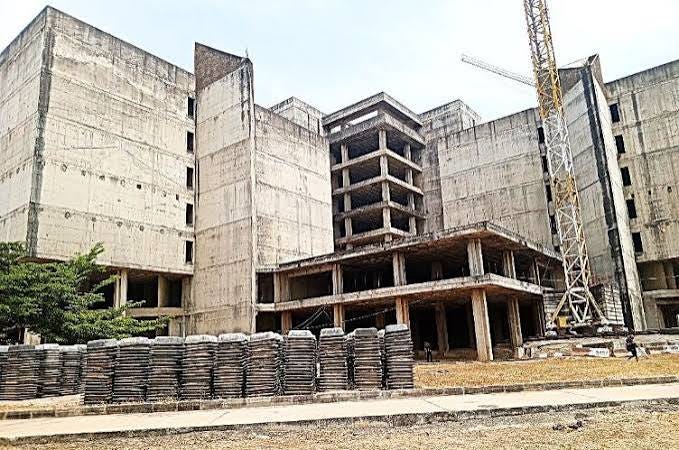
More than a year after the federal government announced that construction of Nigeria’s long-abandoned National Library headquarters would resume on June 1, 2025, the project site remains inactive. The Minister of Education, Dr Tunji Alausa, pledged to inspect the project in Abuja, where he announced that construction would resume with dedicated funding from the Tertiary Education Trust Fund (TETFund). “The Federal Ministry of Education is pleased to announce that construction work on the National Library will recommence on June 1, 2025,” the ministry informed in a statement after the visit, describing the move as a significant step towards completing a project that has remained stalled for nearly two decades.
Alausa attributed the planned resumption to what he described as the Tinubu administration’s political will. “We now have dedicated funds from the Tertiary Education Trust Fund that will enable us to move back to the site on or before June this year,” the minister said. He also assured Nigerians that the government had adopted a phased approach to reviving the project. “Even though earlier estimates placed the remaining cost at ₦90 billion, with revised costs expected to run into the hundreds of billions, we are committed to moving the project forward efficiently with the resources at hand,” he also said.
Despite these assurances, however, there has been no visible construction activity more than a year after the government’s June 1, 2025 deadline. Responding to enquiries on why work is yet to resume, the Special Adviser on Media and Communication to the Minister of Education, Ikharo Attah, attributed the delay to procurement and administrative procedures. “The delay is because of the need to comply with procurement processes, as well as getting the Federal Executive Council (FEC) approval. He is determined to get the library constructed, but it has to be done procedurally,” Attah said.
The National Library headquarters has become one of Nigeria’s most enduring symbols of abandoned public infrastructure. Designed in 1981, the project was awarded to Reynolds Construction Company in 2006, with an expected completion period of 22 months. Construction stalled in 2012 because of funding constraints, leaving the 11-storey structure only partially completed. Successive administrations have repeatedly announced plans to revive the project, while the estimated completion cost has continued to rise from ₦18 billion in 2013 to projections approaching ₦200 billion.
Despite Senate resolutions, interventions by the Governing Board of the National Library, funding approvals under the administrations of former Presidents Goodluck Jonathan and Muhammadu Buhari, and a ₦32.4 billion Federal Executive Council approval in 2023, construction has remained stalled. In September 2025, First Lady Oluremi Tinubu launched a fundraising campaign in place of birthday gifts to support the completion of the National Library, raising more than ₦25.5 billion.
The Federal Ministry of Education has also announced plans to partner with the Qatar National Library through a memorandum of understanding covering digital services, preservation, staff training, technological standards and knowledge exchange. Despite repeated promises, funding announcements, proposed international partnerships and private fundraising efforts, the government’s commitment to return contractors to the site by June 1, 2025 remains unfulfilled.
For a project conceived more than four decades ago and abandoned for nearly two decades, the absence of construction activities more than a year after government’s self-imposed deadline highlights the persistent gap between official promises and implementation.
The winners: none. The losers: the Nigerian public, who have been denied a national library for decades; and the Nigerian government, whose credibility is eroded by repeated unfulfilled promises.
Bottom Line: The National Library project remains stalled despite repeated promises. The gap between rhetoric and reality is a symbol of Nigeria’s infrastructure crisis. The question is whether the government will finally act or the project will remain abandoned.