


The chronic failure of the Nigerian Armed Forces to meet enlistment quotas in the South-East is no longer a matter of passive civic disinterest; it has hardened into an active, grief-fueled boycott. A joint report published on 9 August 2026 by the International Society for Civil Liberties and Rule of Law (Intersociety) and the U.S.-based Ekwenche Research Institute directly attributes this recruitment shortfall to a massive, unaddressed crisis of missing persons. According to the investigation, over 6,000 Igbo families have lost children who went missing, were extrajudicially detained, or vanished without a trace during military security operations in the region between January 2021 and July 2026. This stark breakdown in trust has transformed military service in the eyes of local communities from a proud national duty into an existential risk for young recruits.
The findings, released in a joint statement by Intersociety Board Chairman Emeka Umeagbalasi and Ekwenche President Justin Akujieze, document a decade-long trajectory of institutional estrangement. The report highlights that the missing 6,000 individuals represent only the most recent wave, building upon thousands of untraced disappearances recorded between August 2015 and December 2019, as well as more than 400 unaccounted-for detentions between January and July 2026 alone. Researchers noted that pervasive state violence, indiscriminate arrests, and controversial labelling of local youths as non-state combatants have created a climate where parents actively forbid their children from entering military screening centres. The resulting vacancy in state quota allocations reflects a profound breakdown of the social contract between the federal security apparatus and the South-East population.
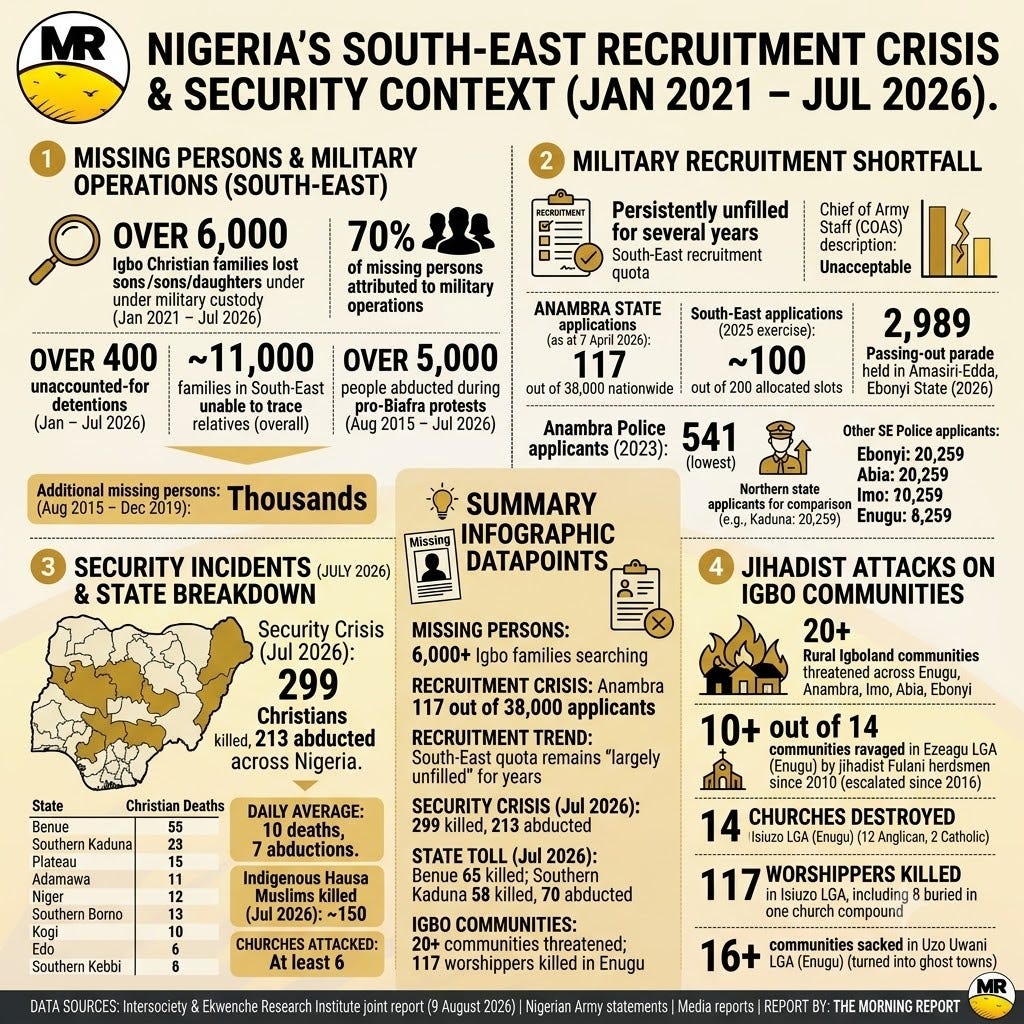
This domestic military boycott intersects dangerously with a deteriorating nationwide security landscape. The joint report emphasised that while state security operations have alienated South-Eastern communities, non-state armed groups and violent extremists have simultaneously escalated attacks across the Middle Belt and Northern regions. In July 2026 alone, researchers tracked 299 deaths and 213 abductions among Christian communities across states like Benue, Kaduna, and Plateau, alongside 150 killings of indigenous Hausa Muslims. The inability of the military to build operational trust in the South-East leaves the armed forces structurally understaffed and regionally skewed at a moment when Nigeria’s security architecture is stretched across multiple active conflict zones.
The persistent deficit of South-Eastern recruits poses severe long-term institutional risks for the Nigerian military itself. Federal character requirements embedded in the Nigerian Constitution were designed to guarantee equitable geopolitical representation within the officer corps and enlisted ranks. When entire geopolitical zones shun recruitment drives, the constitutional mandate of an inclusive, truly national military collapses. Furthermore, security analysts warn that heavy-handed counter-insurgency tactics that produce thousands of unaccounted-for casualties inevitably generate secondary security crises. When local populations view state forces as an occupying mechanism rather than a protective force, intelligence-gathering channels dry up, making long-term stabilisation virtually impossible.
Reversing this deep-seated recruitment crisis will require far more than patriotic media campaigns or traditional lobbying by political elites. Until the federal government and defence headquarters establish transparent mechanisms to account for missing persons, investigate extrajudicial actions, and offer genuine redress to affected families, military recruitment drives in the region will continue to meet empty halls. A national security policy that relies on force without accountability inevitably destroys its own recruitment base, leaving state institutions alienated from the very citizens they are sworn to defend and integrate.
Winners: Violent non-state actors and insurgent groups who thrive in security vacuums created by deep operational mistrust between local communities and national defence forces.
Losers: The Nigerian Armed Forces, whose institutional diversity and operational strength are eroded, and the thousands of bereaved families in the South-East still searching for answers regarding their missing relatives.
Bottom Line: A military cannot successfully recruit from communities where thousands of families view its uniform not as a symbol of national protection, but as a source of unhealed collective trauma.