


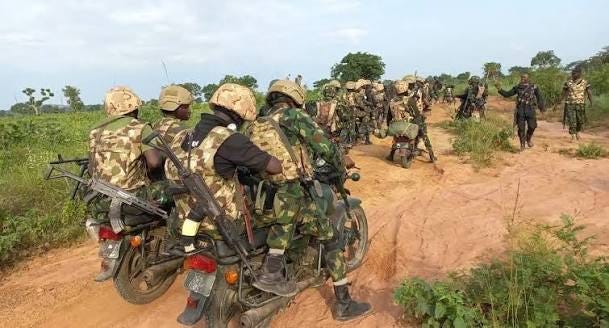
The Armed Forces of Nigeria (AFN) have rescued 66 kidnapped persons. They neutralised several terrorists and arrested scores of suspects. The operations ran between 11 and 17 September 2026. Troops also recovered arms and ammunition. They dismantled terrorist logistics and informant networks. They cleared 12 improvised explosive devices across multiple theatres.
The military’s rescue operations have increased in frequency. In 2024, troops rescued over 1,000 kidnap victims across the country. In 2025, the figure rose. The operations reflect the scale of Nigeria’s abduction crisis. SBM Intelligence recorded 7,825 abductions between July 2025 and June 2026. Most occurred in the northern zones. The military is often the only force capable of reaching remote areas where victims are held. Police lack the firepower and mobility. The Army fills the gap.
Troops of Operation Savannah Shield recorded one of the largest single rescues. They freed 22 victims at Muchiya Village in Rafi Local Government Area of Niger State. They also neutralised five terrorists in separate operations across Kwara and Niger. They recovered firearms, ammunition and motorcycles.
In the northeast, Operation Hadin Kai rescued 14 abductees around Armuda and Gava in Gwoza, Borno. The rescued included Malam Sadiq, Chief Imam of Ngoshe. He was abducted during an attack on his community in March. Troops also rescued a woman who escaped captivity after five months. Two minors who spent six months in captivity were freed. Another family was rescued along the Gwoza-Limankara Road. A repentant terrorist surrendered at Benisheikh with an AK-47 rifle, hand grenade and IED. Troops arrested suspected collaborators and informants.
In the northwest, Operation Fansan Yamma rescued 10 abducted persons at Unguwan Rimi Village in Sabuwa, Katsina. They rescued three more at Gidan Gulbi in Igabi, Kaduna. They intercepted two victims and a child who escaped along the Alikere-Yankara Road in Faskari, Katsina. They also rescued victims after attacks in Kanan Maharba, Sokoto. Troops conducted clearance operations near the Nigeria-Niger border in Kebbi. They recovered a machine gun, rifle, ammunition and four motorcycles.
In the north-central, Operation Whirl Stroke arrested suspected informants and logistics suppliers in Benue, Kogi and Taraba. Operation Enduring Peace rescued a resident and his wife at Ateli Village in Sanga, Kaduna. On 16 September, troops rescued a two-year-old child abducted with his mother at Tayu Village.
In the southeast, Operation UDO KA dismantled an illegal bunkering site near Well Head 17/20 in Egbema West, Imo. They destroyed about 1,300 litres of stolen crude oil. They arrested a suspected secessionist IED fabrication expert on a watchlist. In Edo, Operation Delta Safe arrested a suspected kidnapper on the Benin-Sapele Road. They recovered an AK-47 rifle and ammunition.
Winners: The 66 rescued victims and their families. The military, which demonstrates capacity. Communities in Niger, Borno, Katsina and Kaduna, which see troops active. The Chief of Defence Staff, who can report results.
Losers: Kidnappers, who lose victims and operatives. Terrorist networks, which lose informants. The 12 IEDs, which are cleared before they kill. Nigerians in areas without military presence, who remain vulnerable. The police, whose role is overshadowed.
Bottom Line: Sixty-six rescued in one week. Twelve IEDs cleared. Five terrorists neutralised. The military is doing the work. The question is whether it can sustain the tempo. Nigeria’s abduction crisis is not slowing. The rescues are necessary. They are not a solution.