


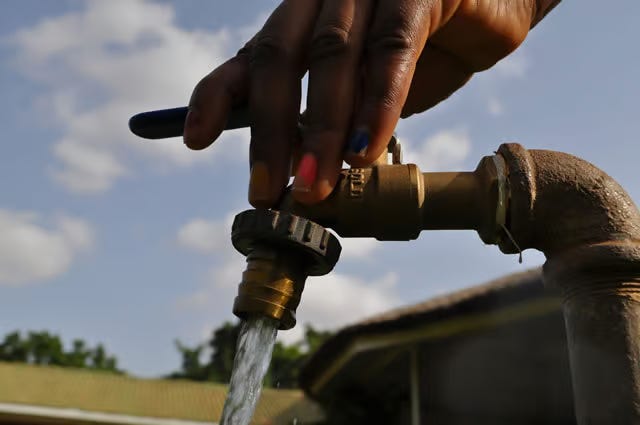
The Lagos Water Corporation has confirmed a figure that should embarrass the state. Its water network serves 34,424 registered households. That is about 1.03% of Lagos’s estimated 20 million residents. The corporation’s Deputy Director for Corporate Affairs and Brand Management, Rasaq Anifowoshe, disclosed the number in an interview with the News Agency of Nigeria. Using an average household size of six, the residents connected number 206,444. The remaining 98% rely on boreholes, vendors and philanthropists.
Historical background: Lagos has promised universal water access for decades. The state’s Water Supply Master Plan estimated daily demand at 540 million gallons. The corporation has an installed capacity of 210 million gallons per day. That capacity was never enough. Actual production has fallen far below it. In 2025, the corporation produced an average of 7.21 million gallons daily. That is 3% of installed capacity. The gap between plan and delivery is not new. It is the defining feature of Lagos water policy.
Current event: Anifowoshe identified the constraints. Ageing distribution pipelines. Population growth. Rapid urbanisation. The need to rehabilitate and expand infrastructure. He said the corporation had begun rehabilitating the Iju and Adiyan facilities. Work is scheduled from February to October 2026. Planned interventions include upgrading mini and micro waterworks, extending distribution networks and digitising infrastructure to reduce losses. A 100-million-gallon-per-day treatment plant is planned for the Lekki-Epe corridor. Public-private partnerships are being pursued.
For residents, the shortfall is a daily cost. At Iponri Housing Estate, Adebayo Solomon spends about ₦1,500 daily on vendor-supplied water. That is ₦45,000 monthly, or roughly ₦547,500 a year. Electricity shortages sometimes disrupt supply, forcing his household to pay more. Another Iponri resident, Abdulkareem Ibrahim, relies on public boreholes provided by philanthropists. His community receives no LWC supply. He fetches water in the morning or after work at night.
In February 2026, the Lagos State Ministry of Environment and Water Resources told Nairametrics that the public system actively serves 1.5 million residents. It said the reported 44% network coverage included residents with mains access but no household connection. The two figures tell different stories. Both are true. Coverage is not supply. Access is not water.
Winners: Private water vendors, who profit from the gap. Borehole drillers, who gain demand. Bottled water companies, which gain customers. Contractors, who win rehabilitation contracts. Losers: The 98% of Lagos residents without LWC supply. Households spending up to ₦547,500 yearly on water. Residents in elevated areas facing low pressure. Communities relying on philanthropist-provided boreholes. Taxpayers whose money funds underperforming infrastructure. The Lagos State Government, whose master plan is failing.
Bottom Line: One per cent coverage is not a statistic. It is a verdict. Lagos cannot call itself a megacity when its public water utility reaches 206,444 people out of 20 million. The rehabilitation projects may help. The Lekki plant may add capacity. But the baseline is so low that it will take decades of investment. Until then, Lagosians will keep paying vendors for water that should flow from taps. The state must deliver. The numbers are damning.