


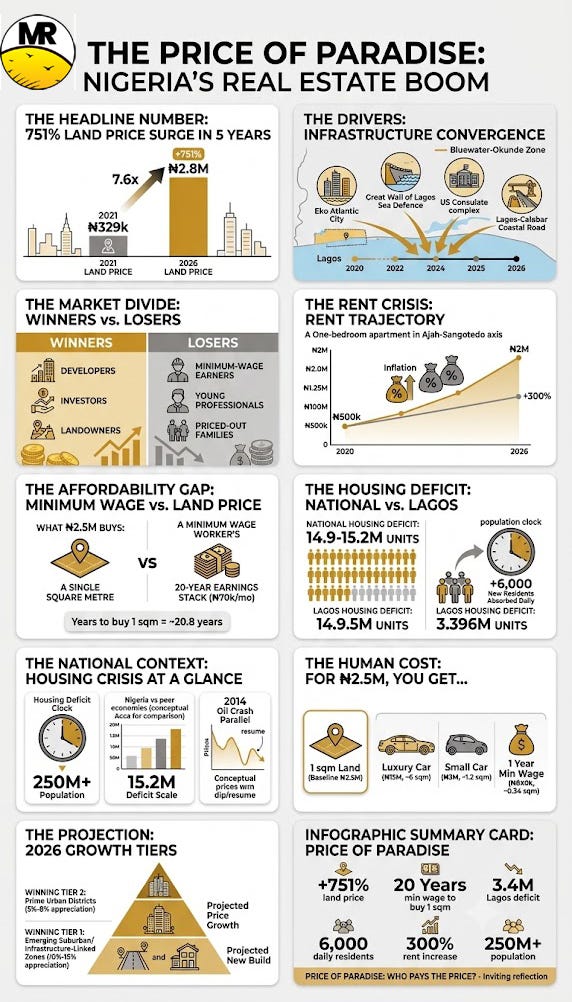
Land values in Lagos’s Bluewater-Okunde Zone have surged by as much as 751 percent in less than five years. According to data released by developers of The Carnelian, a luxury residential project in the district, land prices have risen from about ₦329,000 per square metre in 2021 to between ₦2.5 million and ₦2.8 million per square metre in 2026. The area occupies an 85,000-square-metre stretch of Atlantic oceanfront along the Lagos-Calabar Coastal Road, opposite the Eko Atlantic Beach Resort.
Market observers attribute the sharp rise to the convergence of several large-scale infrastructure projects: the continued development of Eko Atlantic City, construction of the Lagos-Calabar Coastal Road and the new United States Consulate complex within Eko Atlantic. The area is protected by the Great Wall of Lagos sea defence system, adding to its appeal as a secure waterfront location.
Keji Giwa, developer of The Carnelian, described the district as “Eko Miami,” comparing its growth prospects with the transformation of Miami’s Brickell waterfront into a globally recognised financial and luxury residential hub. “The question sophisticated investors ask is not whether ₦2.5 million per square metre is expensive today,” Giwa said. “The question is: what is the probability that this location becomes one of Nigeria’s permanent trophy addresses?” The Carnelian is planned as a 21-storey residential tower comprising 86 luxury apartments overlooking the Atlantic Ocean.
The Bigger Picture: A Market Divided
The Bluewater-Okunde surge is not an isolated phenomenon. It is part of a broader trend reshaping Nigeria’s real estate market. Across Lagos, Abuja, and other major cities, land and property prices have risen far faster than incomes, making the market increasingly inaccessible to the majority of Nigerians.
Residential prices nationwide are projected to grow between five and 15 per cent in 2026, with outcomes varying sharply by market tier. Prime urban districts are expected to record appreciation of between five and eight per cent, while emerging suburban and infrastructure-linked zones are forecast to deliver gains of between 10 and 15 per cent. Lagos remains Nigeria’s most dynamic and constrained residential market, with extreme demand pressure driven by population density, economic concentration and limited land availability.
The drivers are familiar: rapid urbanisation, a growing population of high-net-worth individuals, diaspora remittances, and the perception of real estate as a safe store of value in an inflationary environment. The state absorbs about 6,000 new residents daily, many of whom arrive without formal housing arrangements. Despite decades of interventions, Lagos still faces a housing deficit of about 3.396 million units.
Victor Ameh, Managing Director of Legendary Foreshore, described the current climate as a consolidation season. “Nigeria is in a consolidation season. Reforms are reshaping the economy, but interest rates and capital cost remain heavy,” Ameh said. “In Nigeria, 2026 will punish weak structures and reward operational excellence.” He argued that developers who focus on transparency and operational efficiency will thrive even as the market becomes more competitive.
Festus Asikhia, founder of Festrut Group, emphasised the importance of governance in the sector. “Governance, documentation and accountability remain central to our real estate development approach,” Asikhia said, as the industry faces growing demand for transparency from both regulators and buyers.
Amos Gbadewole, Vice Chairman of REDAN FCT Chapter, pointed to the scale of Nigeria’s housing deficit. “The housing deficit in Nigeria is estimated at over 20 million units for a population of more than 250 million people. That is a huge gap that must be bridged,” Gbadewole said. He called for government regulations and incentives to reduce the cost of building materials, arguing that without intervention, the deficit will continue to widen.
The Sceptics’ View
Not everyone is convinced that the boom is sustainable. Bamidele Adewole, a real estate executive and economist, argued that Nigeria’s mortgage system is fundamentally broken. “Mortgage financing is fundamental. No economy has achieved broad-based homeownership without a functioning mortgage system,” Adewole said. “In Nigeria, the challenge is not just availability but affordability and accessibility. Even where interest rates are relatively lower, the underlying affordability problem persists.”
Havana Group, a luxury property developer, offered a stark warning about the risks in the high-end market. “Millionaires are losing fortunes in Nigeria’s luxury real estate market,” the firm said. “The question now is: will you be next? The luxury real estate market is not broken; it is operating without sufficient transparency and adequate risk frameworks.”
A 2026 report by Independent.ng noted that affordability has emerged as the defining variable in the market. “As households grapple with rising living costs across energy, transport, and food, demand for high-end housing has softened. 2026 is shaping up to be a year of market separation,” the report said. The implication is clear: while prime properties may continue to appreciate, the broader market is under pressure.
The Pragmatists’ Assessment
For those who take a longer view, the fundamentals remain strong. The Nigeria Residential Real Estate Report noted that demand structurally exceeds supply, reinforcing long-term upward pressure on prices and rents. “Nigeria’s population trajectory and urban transition underpin the long-term residential outlook,” the report said.
Edala Research, in its Lagos Residential Market Report 2025, offered a forward-looking assessment. “If demography is truly destiny, then Lagos State stands as the ultimate manifestation of Nigeria’s future,” the report said. “In 2026, the premium on title integrity will rival the premium on location.” The report suggested that buyers are increasingly prioritising clear titles and legal documentation over mere location, a shift that could improve market transparency.
The Human Cost
For a minimum-wage earner in Lagos, the ₦2.5 million per square metre in Bluewater-Okunde is not just unaffordable. It is incomprehensible. That single square metre costs more than 20 years' minimum-wage earnings.
In the Ajah-Sangotedo axis, a one-bedroom apartment that rented for about ₦500,000 in 2020 now averages ₦2 million. In Yaba, Lagos’s technology hub, mid-market areas are experiencing the most intense rental pressure. Average rents in key Lagos nodes have surged by over 105 percent, creating what industry analysts term a “landlord inflation gap” between rental prices and official inflation benchmarks.
Housing experts estimate that Lagos faces a shortage of over three million housing units, a gap that continues to widen due to rapid population growth and limited infrastructure expansion. Nationally, the deficit is estimated at between 14.9 and 15.2 million units.
This mirrors the 2014 oil price crash era, when real estate prices in Lagos initially dipped before resuming their upward trajectory. The mechanism was different then, but the result was the same: a market that rewards the wealthy and punishes the poor.
The winners: developers, investors, and landowners who have seen their assets appreciate in value. The Carnelian’s 86 luxury apartments will serve a tiny fraction of Lagos’s population but generate enormous returns for its developers. The government collects higher taxes and fees from prime real estate transactions.
The losers: ordinary Nigerians who cannot afford housing. The millions of households priced out of the market. The young professionals in Yaba who watch rents climb faster than their salaries. The families pushed to the peripheries of Lagos, spending hours on transport because they cannot afford to live near their workplaces.
Bottom Line: Land prices in Lagos have risen 751 percent in five years. For the wealthy, it is a trophy address. For everyone else, it is a reminder that they are being left behind.