


The crackle of burning rubber, the roar of an agitated crowd, and the final, desperate pleas of an accused suspect have become an all-too-familiar spectacle across Nigeria’s urban centres and rural hamlets. Jungle justice, a brutal, extrajudicial phenomenon where mobs, vigilantes or self-appointed enforcement groups torture, beat or burn individuals suspected of crimes, continues to expose a profound fracture in the nation’s social contract. It is a grim, bloody ritual where suspicion replaces evidence, emotional outrage overrules due process, and summary execution is carried out on asphalt streets. Across market squares, bus stops and university towns, the instant court of public opinion gathers with sticks, stones and petrol, transforming unverified rumours into death sentences within minutes.
Yet, while human rights advocates and legal scholars view this trend as a terrifying descent into lawlessness, a significant portion of the populace views self-help justice not as a crime, but as a bitter necessity born of institutional neglect, chronic police failure and rampant criminality. This divide between legal ideals and survival realities is the heart of the problem.
The Constitutional Perspective
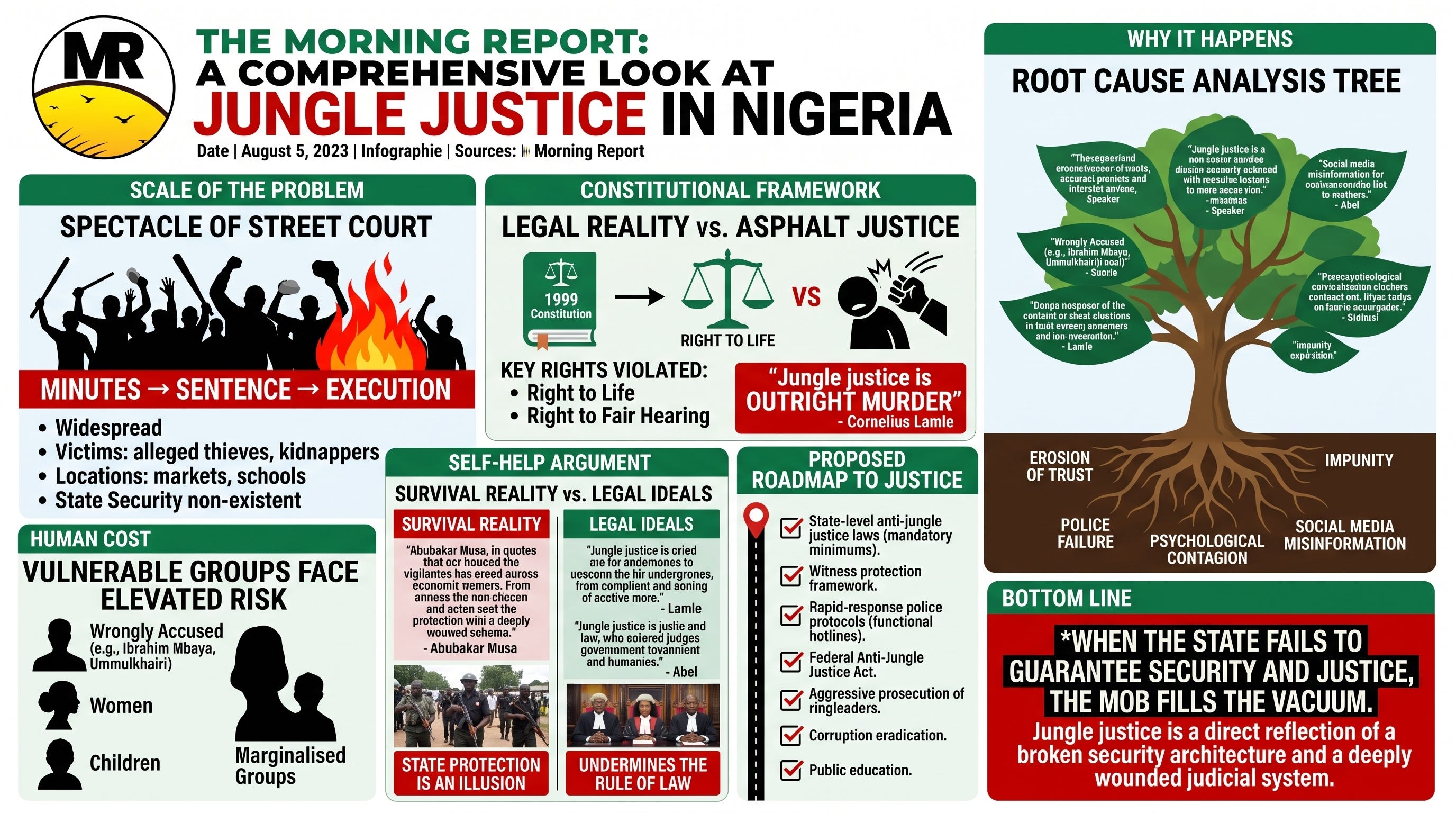
From a purely constitutional perspective, there is no ambiguity: extrajudicial punishment is outright murder. Cornelius Lamle, a legal expert, put it bluntly on August 18: jungle justice has no place under Nigerian jurisprudence. He pointed out that every suspect, regardless of the gravity of the allegation against them, retains the fundamental right to life under Section 33 and the right to a fair hearing under Section 36 of the 1999 Constitution. Under the doctrine of common intention, every single participant in a mob lynching, not merely the individual who strikes the fatal blow, is legally liable as a principal offender in a homicide.
However, as Lamle argued, the primary issue is not a total absence of legislation. The Criminal Code, Penal Code and Administration of Criminal Justice Act already outlaw mob violence. The problem is a catastrophic failure of enforcement. To dismantle this culture of impunity, Lamle called for state-level anti-jungle justice laws with mandatory minimum sentences, a dedicated federal Anti-Jungle Justice Act, a robust witness protection framework, and rapid-response police protocols that ensure a functioning emergency hotline deploys armed officers before a gathering mob seals a suspect’s fate.
The Crisis of Trust
The driving force behind this vigilante impulse is a deep-seated and widespread erosion of trust in the formal legal system. Citizens often see the official apparatus of justice as slow, compromised, or accessible only to the highest bidder. Moses Obeta, a legal practitioner, observed on the same day that the constitution explicitly rejects arbitrary street punishment, yet millions bypass formal courtrooms because they believe suspects handed over to the authorities will simply buy their freedom.
Obeta urged law enforcement agencies to live up to their constitutional duties by conducting thorough, uncompromised investigations and prosecuting offenders without demanding bribes. He stressed that those who lead, participate in, or instigate mob actions must be hunted down, arrested, and subjected to the full weight of criminal prosecution to restore public confidence in state institutions.
The Psychology of the Mob
The psychological mechanics that turn ordinary citizens into violent mobs are as complex as they are dangerous. Dr Adedotun Ajiboye, a psychologist, explained on August 13 that otherwise law-abiding individuals often lose their personal moral compass when engulfed by a collective mob. The anonymity offered by a large, shouting crowd, combined with intense group pressure and a shared sense of moral indignation, dilutes personal accountability and weakens individual restraint. Personal judgment yields to collective hysteria, making individuals far more likely to commit acts of extreme violence that they would never contemplate on their own. When this psychological contagion is fuelled by unverified social media rumours or instantaneous local panic, innocent people are routinely tortured to death before the truth can ever be established.
The Human Cost
This breakdown of restraint carries a devastating, asymmetric toll on the most vulnerable members of society. Naankus Fyaktu, Chairperson of the International Federation of Women Lawyers (FIDA) Plateau Chapter, warned on August 13 that women, children and marginalised individuals face an elevated risk of wrongful accusations, physical assault and sexual exploitation when communities resort to street justice.
Citing recent tragic incidents, such as the brutal torture of Ibrahim Mbaya in Jos over a missing mobile phone and the mob killing of a woman named Ummulkhairi in Kaduna State following unproven child kidnapping allegations, Fyaktu pointed out that misinformation, vindictive accusations and deep-seated societal hatred routinely spark fatal attacks. The consequences extend far beyond the immediate victim, leaving families crushed by severe trauma, public stigma and sudden financial ruin when the person killed happens to be the household’s sole breadwinner.
The Vigilante Counter-Narrative
Yet despite these scathing legal and human rights condemnations, a powerful counter-narrative persists in communities where state security is virtually non-existent. For millions living in vulnerable, unpoliced pockets of the country, taking security and justice into their own hands is viewed not as a lawless aberration, but as a vital act of self-preservation.
Abubakar Musa, a district youth leader and commander of the Kaduna Vigilante Service in Tudun Biri, explained on August 17 why communities are forced to form their own armed defence structures. When overstretched federal police and military units fail to maintain a permanent presence in rural areas, the burden of survival falls squarely on residents. Recounting how his community was repeatedly invaded and terrorised by armed bandits who killed local residents in broad daylight, Musa argued that waiting for formal police interventions or prolonged court trials while violent predators operate with impunity is simply not a viable strategy. For him, organised local vigilance and immediate, decisive intervention are the only effective deterrents keeping their families alive.
The Way Forward
This sharp divide illustrates why eradicating jungle justice requires far more than mere legislative decrees. As legal luminary Simon Abel pointed out on August 18, public behaviour is largely shaped by visible outcomes and concrete experiences. When perpetrators of mob violence walk away without penalty, the public receives a clear message that street justice is acceptable and effective. However, if the government equips security agencies with modern response mechanisms, educates the public and swiftly prosecutes those who organise lynchings, it sends an unmistakable signal that summary executions will no longer be tolerated. Without visible, publicised convictions of mob leaders to serve as a genuine deterrent, public orientation campaigns will remain largely ineffective.
Ultimately, the persistence of jungle justice is a direct reflection of a broken security architecture and a deeply wounded judicial system. When citizens believe that court cases take years to resolve, that criminals can bribe their way out of detention and that police officers will not arrive in time during an active emergency, the chaotic authority of the mob fills the vacuum. Eradicating this menace requires a comprehensive overhaul: federal and state governments must dramatically expand police personnel, establish functional emergency deployment protocols, enforce strict accountability within law enforcement, and ensure that every act of mob violence is met with swift, uncompromising prosecution.
This echoes the 2015 wave of mob violence in the North-east, which also exposed the collapse of formal justice systems in the face of insurgency. The pattern then was the same: a state unable to protect its citizens, and communities taking matters into their own hands.
The winners: none. The losers: the victims of mob violence, who lose their lives without trial; the families left behind, who suffer trauma and financial ruin; the Nigerian state, whose credibility is eroded; and the rule of law itself, which is sacrificed on the altar of immediate retribution.
Bottom Line: Jungle justice is not a solution; it is a symptom. The cure lies in a state that can protect its citizens and deliver fair, swift justice. Until then, the street court will continue to sit in judgment.