


On Sunday, Iran's Islamic Revolutionary Guard Corps (IRGC) announced that it had closed the Strait of Hormuz until further notice. The move came after Iran fired warning shots at a commercial vessel transiting the waterway with its identification systems turned off, and the United States responded with a third round of strikes against Iranian targets. The latest escalation, coming barely a month after an interim ceasefire, has thrown global oil markets back into turmoil and exposed Nigeria's enduring vulnerability to a chokepoint 4,000 miles away.
For Nigeria, Africa's largest oil producer, the news is a familiar dread. Every closure or threat to the Strait of Hormuz triggers a familiar sequence: global crude prices spike, the cost of imported refined products rises, petrol prices climb, transport fares follow, and the cost of everything from a bag of rice to a plate of jollof goes up. The cycle is predictable, yet Nigeria never seems to escape it.
The Chokepoint
The Strait of Hormuz is the world's most consequential maritime chokepoint. Roughly 20% of global oil passes through it daily, about 20 million barrels. Before the war, more than 130 vessels transited the strait daily. By July 10, that number had dropped to 11.
Iran's justification is a matter of international law. Tehran insists it has the right to regulate passage through the strait and has announced plans to charge fees for vessels using the route. Under international law, straits used for international navigation cannot be closed to commercial shipping, but Iran's position is that the strait's southern corridors, which run close to Oman and are protected by the US military, constitute a violation of its sovereignty.
The practical effect is a closure in all but name. Shipping companies and insurers have decided the risk is not worth taking. The result is a de facto blockade that threatens to choke global energy supply once again.
Global Oil Prices and Nigeria's Dilemma
The closure has already moved markets. Brent crude, the international benchmark, closed the week near 120 a barrel during the worst of the war, the market moves that follow each round of strikes have shown Iran's capacity to move energy prices. JPMorgan has told clients that Brent crude could reach 130 per barrel in the near term. Wood Mackenzie has warned that prices could approach $200 per barrel by the end of 2026.
For Nigeria, this presents a familiar paradox. Higher crude prices mean higher export earnings. The 2025 budget was premised on an oil price assumption that has long been exceeded. On paper, Nigeria should be celebrating.
In practice, the celebration is short-lived. Nigeria exports crude but imports a significant amount of the refined products it consumes. Every dollar rise in global crude shows up at the pump within days. The Dangote Refinery, despite its capacity, does not insulate the country from global price shocks because it purchases crude at international prices. Local refining does not mean local pricing.
The Transmission Mechanism
The war in Iran and the closure of the Strait of Hormuz, a strategic chokepoint through which up to a quarter of global oil trade passes, have sent shockwaves through global supply chains. The ripple effects in Nigeria have been severe: rising fuel prices, higher shipping costs and disruptions.
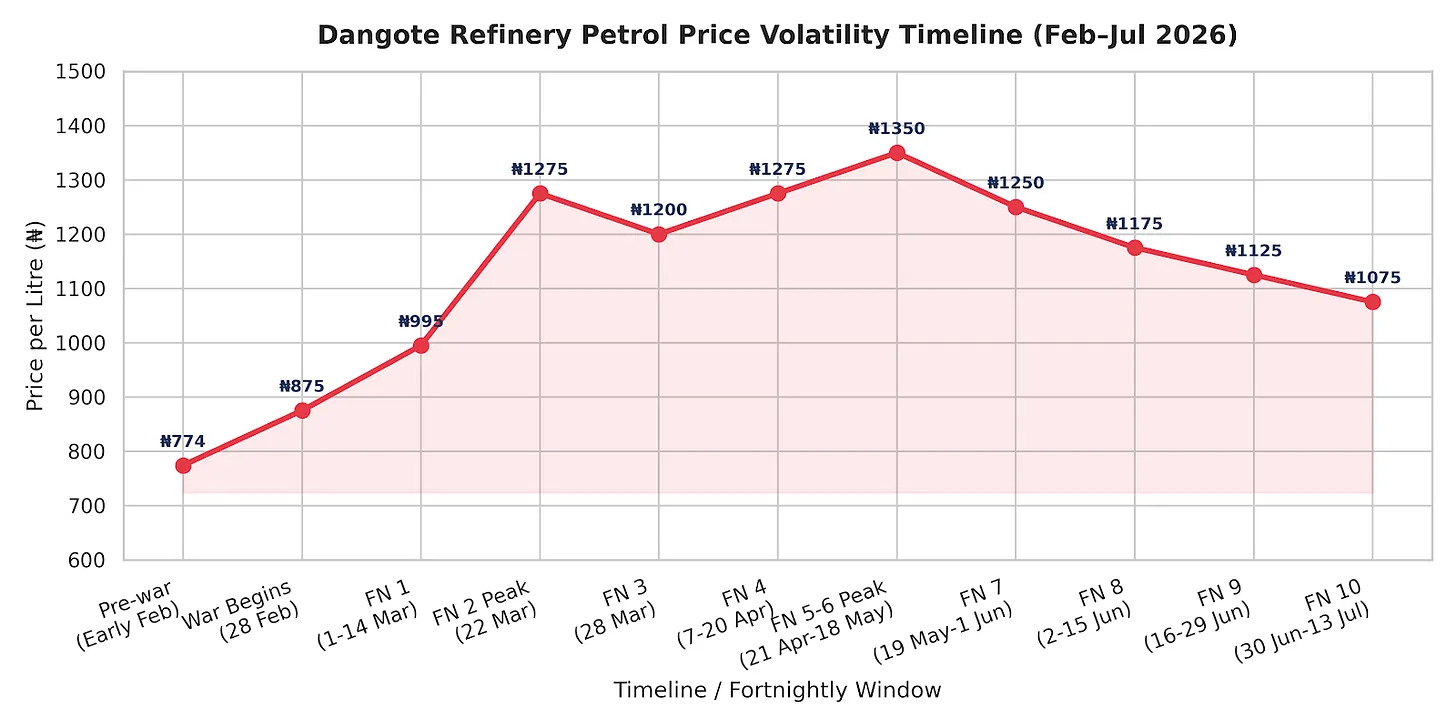
The SBM Intelligence report "Epic Fury, Naija's Burden" tracked the journey of the Iran-Israel-US conflict from a distant missile exchange to a daily assault on Nigerian household budgets. The findings were stark: petrol prices nearly doubled, transport fares tripled in some corridors, and more than four in five traders surveyed across nine cities reported price increases they directly blamed on the war.
A survey of 220 traders across nine Nigerian cities found that 82.7% reported price increases directly linked to the war, 70% faced fuel shortages for generators and transport, and 76.4% experienced sharp increases in transport fares. The Jollof Index, a measure of the cost of a standard pot of rice, hit an all-time high of ₦30,435 in April 2026. Food inflation rose to 16.96% year-on-year, and cooking gas prices climbed 34% in Lagos alone.
The next shock will compound the damage from the last one. In June, an interim peace agreement between the US and Iran had brought temporary relief, with Brent crude falling from a peak of `$114 to approximately $101 per barrel. Petrol prices had retreated from ₦1,325 per litre to around ₦1,000. But the relief was fragile. Now, the strait is closed again, and the cycle is repeating.
Strategic Opportunities Amid the Crisis
The crisis is not all downside. The disruption is reshaping crude trade flows across the Atlantic Basin and positioning West Africa, particularly Nigeria, as a strategic hub for both crude oil and refined petroleum products. As geopolitical tensions continue to disrupt traditional supply routes, Nigeria's proximity to European markets and its deepwater ports give it a competitive advantage.
Nigeria also benefits from rising urea prices. As an oil producer with rapidly expanding domestic refining and urea capacity, the country stands to gain from higher export earnings. IFPRI Food Policy Model simulations suggest Nigeria could even see net welfare gains if increased oil and fertilizer export revenues outweigh rising domestic prices.
However, the economy still depends heavily on imported refined fuel and on imported potash, phosphate and other fertilizer inputs. That dual exposure makes Nigeria's potential policy response both a delicate and consequential challenge.
Cheta Nwanze of SBM Intelligence has been blunt about Nigeria's vulnerability. "Nigeria, Africa's largest oil producer, has no shield," he wrote in the aftermath of the first Hormuz closure. "We export crude but import a significant amount of the refined products we use". His assessment of Nigeria's diplomatic response was equally critical: "Nigeria's wait-and-see diplomacy is no longer fit for purpose".
Rolake Akinkugbe-Filani of EnergyInc Advisors has noted that the crisis could be a moment for Africa to break its dependency on foreign energy. But that break requires investment in refining capacity, storage and alternative supply routes, investments that Nigeria has been slow to make.
Dr Cyril Ampka, an Abuja-based economist, argued that the episode should serve as a wake-up call. "This latest episode should serve as a wake-up call for policymakers to accelerate efforts aimed at strengthening energy security, expanding domestic refining, and reducing the country's exposure to external shocks," he said.
On the other hand, some analysts argue that Nigeria's vulnerability is overstated. The Dangote Refinery has fundamentally altered Nigeria's relationship with refined fuel. By February 2026, domestic refineries, led by Dangote, were estimated to supply around 92% of daily petrol demand. The challenge is that the refinery still buys crude at international prices, meaning domestic pricing remains tied to global benchmarks.
Neutral observers note that Nigeria's exposure is structural rather than cyclical. "The underlying vulnerabilities are unchanged: import dependence, thin fiscal buffers and exposure to chokepoints beyond West African control," SBM Intelligence concluded. The ceasefire was a pause, not a cure.
The Structural Lesson
The crisis has exposed a deeper truth about Nigeria's economy. Despite being Africa's largest oil producer, the country remains a price-taker in global energy markets. It exports crude at international prices and imports refined products at international prices, capturing value at neither end of the transaction.
The solution is not simply to build more refineries. Domestic refining does not insulate a country when feedstock pricing tracks global benchmarks. Nigeria's vulnerability is not just about refining capacity; it is about the absence of strategic fuel reserves, market intelligence systems, alternative import routes and price stabilisation mechanisms.
The crisis is a magnifier, not a cause. Underlying weaknesses, import dependence, poor logistics, and a reactive state, have been present for decades. The next global shock is not a matter of if, but when. Nigeria can either build buffers or continue absorbing blows without defence.
The winners: oil-exporting countries, including Nigeria, which earn more from crude sales in the short term; traders who have stockpiled fuel and can sell at higher prices; and alternative crude suppliers who benefit from disrupted trade flows.
The losers: Nigerian consumers, who pay more for fuel, transport and food; small businesses that cannot absorb higher operating costs; the Nigerian economy, which suffers from higher inflation and lower purchasing power; and the government, which faces renewed pressure on the naira and the fiscal deficit.
Bottom Line: Iran has closed the Strait of Hormuz again. Nigeria is feeling the pain again. The cycle is predictable. The preparation is not. And that is the real tragedy.