


Nigerians may soon pay less than ₦800 per litre for petrol. The Independent Petroleum Marketers Association of Nigeria (IPMAN) has signed a direct purchase agreement with the Dangote Petroleum Refinery, a development that could trigger significant price reductions across the country.
Abubakar Maigandi Shettima, IPMAN’s National President, disclosed the development in Abuja on Monday. “Reducing the price depends on the way we buy the product from the private depot owners and Dangote refinery. And I thank God now, Dangote refinery has accepted the independent petroleum marketers to start purchasing their product directly. So, it’s a plus,” Shettima said. He went further: “At any time when there is a reduction of price, we are ready to reduce the price to even below ₦800, not even ₦900.”
The agreement marks a significant shift in Nigeria’s downstream petroleum sector. Prior to this development, independent marketers who control over 70 percent of Nigeria’s retail filling stations relied largely on third-party private depots for products. The new arrangement bypasses these intermediaries, potentially lowering costs for marketers and consumers.
The direct sales agreement follows a series of price cuts by Dangote Refinery. The refinery has reduced its ex-depot price four times since the end of May 2026, with cumulative reductions exceeding ₦200 per litre. The latest cut, announced in early July, lowered the ex-gantry price from ₦1,125 to ₦1,075 per litre. The refinery has also aligned its coastal loading price with the ex-gantry price, eliminating a previous pricing disparity.
Minister of State for Petroleum Resources (Oil), Heineken Lokpobiri, convened a stakeholders’ meeting on Monday to push for fair pricing. “Government is committed to protecting the interests of stakeholders, the common man, and the deregulation of the sector,” he said. He maintained that deregulation does not mean excessive profiteering and urged stakeholders to find common ground on lowering PMS prices, noting that petrol and diesel prices affect all sectors of the economy.
The Federal Competition and Consumer Protection Commission (FCCPC) raised concerns over the slow pace of price reductions. In a statement, the Commission warned that businesses found taking advantage of consumers through unfair pricing practices could face regulatory action. The FCCPC said its ongoing monitoring revealed that recent reductions in gantry and retail prices have not matched the scale of decline in international crude oil prices.
Dangote Refinery defended its pricing strategy, explaining that petroleum products currently reaching the domestic market are being refined largely from crude inventories purchased weeks or months earlier at significantly higher prices than prevailing international benchmarks. The refinery disclosed that it spent about $4.48 billion importing crude oil over the past two months under supply contracts negotiated before the recent downturn in global oil prices. The company explained that the average landed cost of crude processed by the refinery stood at about $124.80 per barrel in May and $95.25 per barrel in June, compared with the current international benchmark of about $71.01 per barrel.
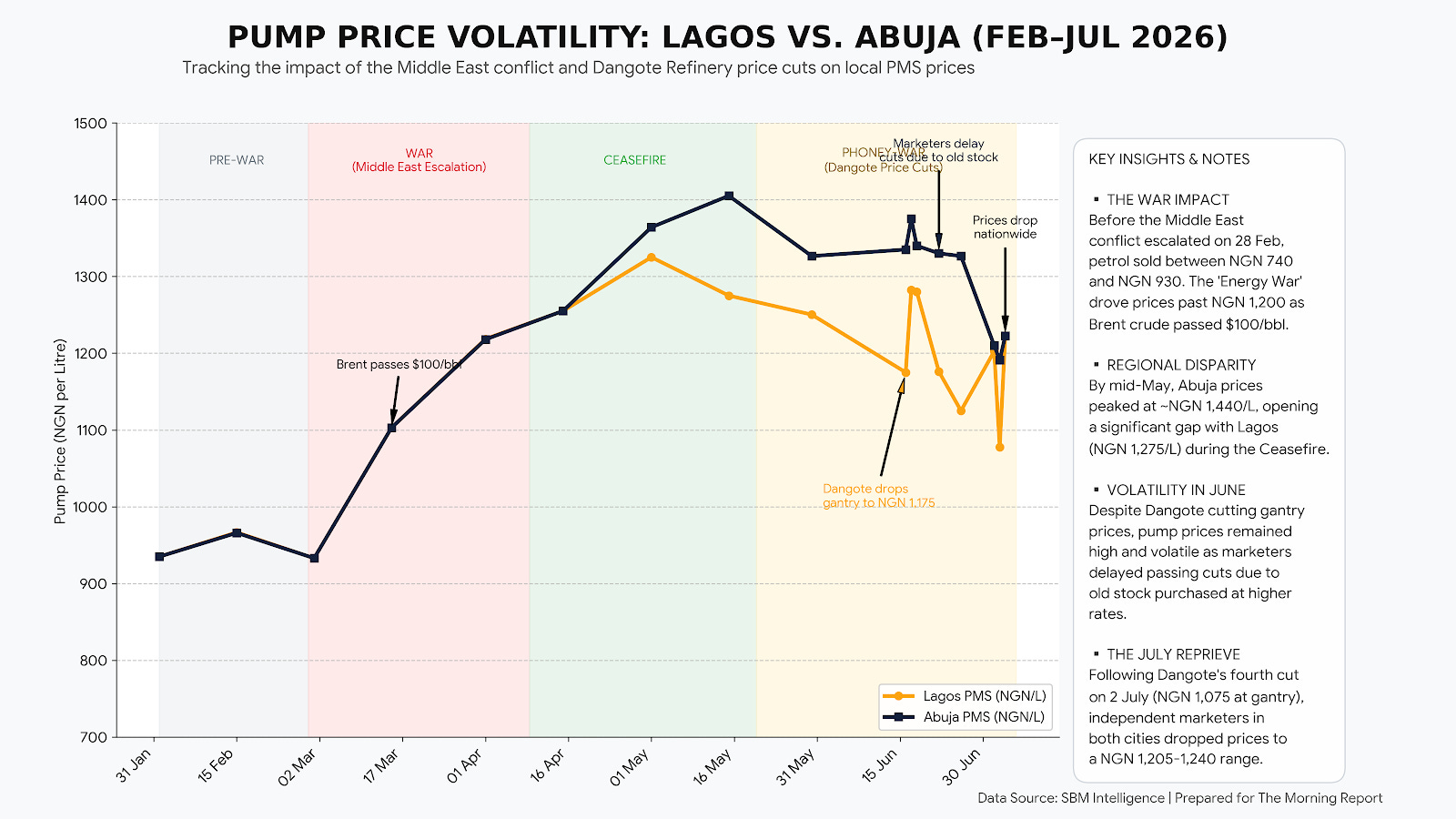
Independent marketers across Lagos, Warri and Calabar responded swiftly to Dangote’s latest price cuts. NIPCO lowered its PMS price by ₦40 per litre to ₦1,078, while Pinnacle cut its price by ₦43 to ₦1,078, recording one of the largest reductions. Aiteo reduced its price by ₦39 to ₦1,076 per litre, the lowest among major Lagos depots. In Calabar, Matrix dropped by ₦32 to ₦1,095, while in Warri, A.Y.M Shafa reduced by ₦38 to ₦1,090.
Filling stations in Abuja began passing on the reductions. AA Rano, Ranoil and NIPCO now sell petrol for between ₦1,205 and ₦1,240 per litre, compared with the previous average of about ₦1,300. MRS stations reduced their Abuja pump price to ₦1,191 per litre, while NNPC adjusted to ₦1,210.
This mirrors the pattern seen since the removal of the petrol subsidy in May 2023. President Bola Tinubu’s decision to scrap subsidies and float the naira led to fuel prices more than doubling and inflation surging to a three-decade high of 34 percent in June 2024. The Dangote Refinery, which began supplying petrol in 2024, represents the most significant shift in Nigeria’s fuel supply chain since the deregulation era began.
The winners: independent marketers who now have direct access to domestic refining, potentially improving their margins and competitive position. Nigerian consumers who may see prices fall below ₦800, offering relief from months of high fuel costs. The Dangote Refinery, which expands its market reach and reduces dependence on intermediary buyers.
The losers: private depot owners who previously served as intermediaries, losing a significant revenue stream as marketers bypass them. Importers who face increased competition from domestically refined products. The Nigerian government, which must now manage the complex task of regulating a deregulated market while protecting consumers and ensuring fair pricing.
Bottom Line: Direct sales to independent marketers could push petrol prices below ₦800. That is good news for consumers. It is bad news for the intermediaries who have been cashing in on the gap between the refinery and the pump.