


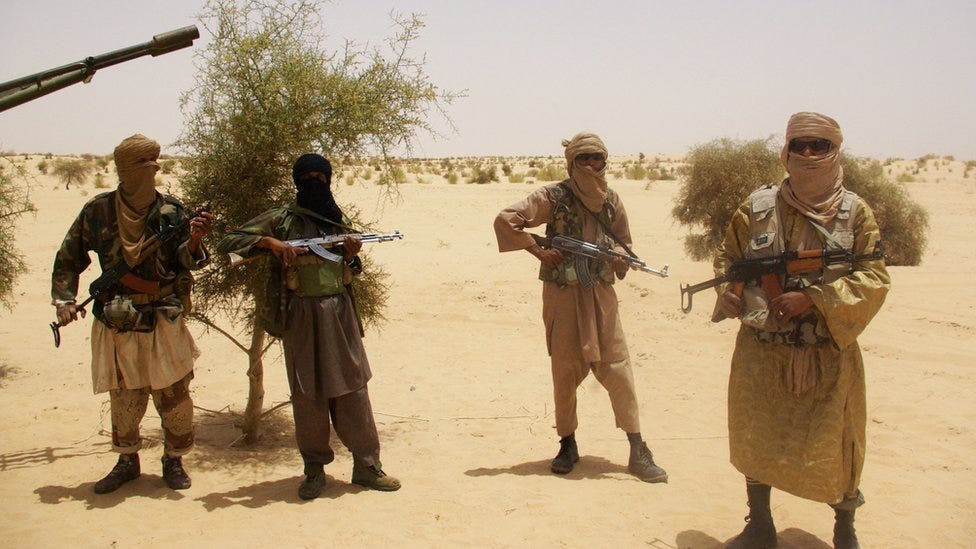
Insurgents in Mali staged attacks in five locations on Saturday, including a northern town where government and Russian fighters are based and a town south of the capital, Bamako. This is the latest threat to the landlocked Sahel nation’s embattled leaders.
The assault targeted army positions in Anefis, Aguelhoc and Gao in northern Mali; Sevare in central Mali; and Kenioroba in the south. The Malian armed forces said soldiers repelled the attacks, and the situation was “totally under control”, adding that 20 terrorists had been killed in Sevare and six in Gao. One pro-government fighter was killed in Gao, and four others were injured.
A spokesperson for a Tuareg-led rebel group, the Azawad Liberation Front (FLA), said it was involved in Saturday’s attacks. The group partnered with the regional al-Qaeda affiliate, Jama’at Nusrat al-Islam wal Muslimin (JNIM), in April in a coordinated operation that hit the airport in Bamako and killed the defence minister.
In Gao, a local official said gunfire and rocket attacks targeting a military camp had continued since before dawn. “No one could go out this morning. The noise was so intense it felt like the roof was going to collapse,” a resident said.
Kenioroba is home to a prison holding members of Mali’s political opposition. A diplomatic source and a security source said the prison was attacked, though one said security forces repelled the assailants.
The attacks highlight the failure of Mali’s military leaders, who seized power in coups in 2020 and 2021, to deliver the improved security they promised. In September 2024, JNIM attacked a paramilitary police training school near the Bamako airport, killing about 70 people.
The Nigerian stake is clear. Mali’s instability has direct consequences for Nigeria’s northern border. The collapse of state authority in Mali has created space for jihadist groups to operate, and those groups have increasingly targeted Nigeria’s Lake Chad region. The pattern is familiar: instability in the Sahel spills over into Nigeria’s North-east.
From a Nigerian vantage point, the attacks are a reminder that the Sahel crisis is not a distant problem. It is a Nigerian problem. The government in Bamako is struggling. The jihadists are gaining ground. And Nigeria’s northern border is becoming more porous by the day.
The winners: the insurgents, who demonstrated their reach. The losers: the Malian people, who continue to suffer under a military regime that cannot protect them, and Nigeria, which faces a growing threat on its northern flank.
Bottom Line: Five attacks in one day. Mali is not under control. And Nigeria’s northern border is feeling the pressure.