


Across the savanna belts and forest corridors of northern Nigeria, a grim transformation has taken root. What was once sporadic criminal banditry has metastasised into an organised, highly lucrative corporate industry. It has established supply chains, sophisticated pricing mechanisms and a tragic cycle of repeat clientele. For the syndicate commanders operating from hidden camps in the forests of Zamfara, Kaduna and Niger states, a human life is no longer viewed through a moral lens. It is a liquid financial asset to be leveraged, priced and traded. For victims’ families, every tangible asset becomes a possible price for survival. Family homes. Inherited farmland. Livestock. Emergency savings.
The scale
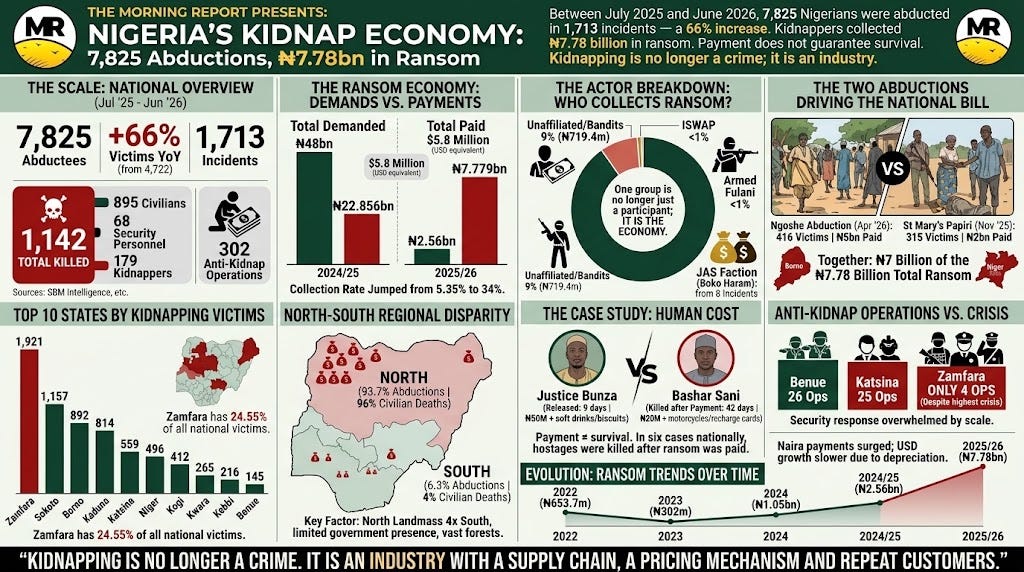
The latest security monitoring data lays bare the magnitude. SBM Intelligence recorded 7,825 abductions across Nigeria between July 2025 and June 2026. Of that total, 7,334, nearly 94%, occurred within the three northern geopolitical zones. The organisation estimated that at least ₦7.78 billion was verifiably paid in cash ransoms during the twelve-month period.
Ikemesit Effiong, Partner and Lead Analyst at SBM Intelligence, analysed the structural evolution of the crisis on 10 September 2026. Kidnapping, he noted, has transcended simple violent crime to become a self-sustaining informal economy. The continuous flow of billions of naira into forest enclaves has created an incentive structure. Ransom payments do not merely resolve immediate crises. They actively recapitalise criminal networks, funding heavy weaponry and operational logistics for future raids.
To understand the current crisis is to trace a twenty-year evolution. The phenomenon gained prominence in the early 2000s as militant activity in the oil-rich Niger Delta, where foreign oil workers were seized for political leverage and structural concessions. By the mid-2010s, the epicentre shifted to the Northwest and North-Central regions. Cattle rustling syndicates and armed groups, locally called bandits, commercialised the tactic into a mass-market enterprise. The 2014 abduction of 276 schoolgirls in Chibok, Borno State, internationalised mass kidnapping. It proved to criminal networks that large-scale target acquisition could command national attention and immense financial leverage. In the years since, mass raids on schools, highway commuters and agrarian villages have become terrifyingly routine.
The shadow supply chain
The modern ransom structure has expanded beyond stacks of cash. Forest commanders now demand complex logistical packages as conditions for release. Brand-new operational motorcycles. High-grade petrol. Bags of food provisions. Hundreds of thousands of naira in mobile network recharge cards to maintain remote communication lines.
Dr Usman Ardo, a Senior Fellow in Security Studies at Ahmadu Bello University, Zaria, described this operational evolution on 11 September 2026. Kidnappers have effectively created a shadow supply chain powered by civilian fear. By demanding non-monetary items like fuel, airtime and motorbikes alongside raw cash, bandit groups bypass formal banking tracks. They immediately sustain their operational camps. Victim communities are forced to act as involuntary logistics managers for the very networks terrorising them.
The mechanics of negotiation
The mechanics play out daily in brutal detail. They spare neither ordinary citizens nor senior public officials.
In Kebbi State, Justice Faruk Hassan Bunza, a respected High Court judge, was abducted from his private residence in July. The kidnappers initially demanded ₦200 million. Days of agonising back-and-forth followed while the jurist was held in deep forest cover. The gang reduced its demand to ₦50 million. He was freed after nine days.
Barrister Aliyu Umar, a close legal colleague of the judge in Birnin Kebbi, confirmed the details on 12 September 2026. The family delivered the ₦50 million alongside specified cartons of soft drinks and sweet biscuits demanded by the gang leaders. Umar noted with bitter irony that even senior custodians of the law are left completely unprotected. They are forced to comply with the arbitrary demands of forest warlords to preserve basic human life.
Payment does not guarantee survival
In this lawless market, fulfilling ransom demands offers no guarantee of a victim’s safe return. In Zamfara State, Bashar Sani, a senior administrator at the College of Education in Maru, was abducted alongside his wife from their home. His extended family and colleagues launched a desperate fundraising campaign. After weeks of frantic effort, the family raised and delivered ₦20 million in cash, three brand-new operational motorcycles and ₦150,000 worth of premium mobile recharge cards to designated drop points deep in the forest. Despite full compliance, Sani was held for 42 gruelling days and ultimately murdered by his captors. His wife was released with deep psychological scars.
Ibrahim Maru, a close family spokesperson, spoke in Gusau on 12 September 2026. Compliance has become a gamble where payment does not guarantee survival. Grieving relatives are left bankrupt and broken.
The southern spread
As banditry pushes southward, quiet agrarian communities in Kwara State have been drawn into the net. In August 2025, three young siblings abducted in the state spent nearly two months in captivity. Their desperate father negotiated a steep initial demand of ₦15 million per victim down to ₦5 million overall. To raise the money, the family liquidated all their inherited farmland and livestock. Upon delivering the agreed sum, the kidnappers seized the father as well. They demanded an additional ₦10 million for his release.
The financial tax on Kwara communities has reached staggering proportions. In the Awun community of Oro-Ago district, residents and indigenes living abroad raised approximately ₦60 million to secure the freedom of three abducted children aged between four and fifteen. In nearby Owa-Onire, local elders estimate that over ₦50 million has been paid out across multiple separate kidnapping incidents over the past year.
Chief Tajudeen Olanipekun, a community leader in the Oro-Ago district, described the financial ruin on 13 September 2026. Kidnapping has systematically impoverished the entire region. Families are selling off ancestral land that sustained generations of farmers just to pay ransom for a single child. Diaspora associations in North America and Europe now spend their collective remittances not on building schools or healthcare centres, but on funding ransom pools to rescue relatives back home. When a community drains its total wealth to pay forest gangs, its economic development is set back by decades.
The food supply chain
The broader economic fallout ripples across the national food supply chain. In agrarian strongholds across Zamfara, Katsina, Niger and Kaduna, farmers have completely abandoned their fields. They cannot pay the hefty harvest taxes levied by bandit groups or risk capture during planting seasons. Interstate traders have ceased travelling along traditional supply routes. Road construction crews and infrastructure engineers require heavy military escorts or abandon projects entirely.
About 50 farmers from Magamin Diddi in Zamfara State ventured into the forest to negotiate an independent peace accord with local bandit leaders. After the state government maintained its strict policy against negotiating with criminal groups, the entire delegation of farmers was detained by the bandits. They remain held in forest captivity.
Kabir Magami, a representative of the local farmers’ collective in Zamfara, warned on 14 September 2026 that national food insecurity will continue to worsen as long as rural producers remain hostages to forest syndicates. Hundreds of hectares of fertile farmland lie completely fallow because entering the fields carries a potential death sentence or a multi-million naira ransom tag. When farmers cannot farm and traders cannot travel, urban food prices will continue to skyrocket. The kidnapping industry in the north directly drives the starvation and inflation felt across the entire country.
Winners: The kidnappers, who have built a profitable, self-sustaining enterprise. Motorcycle dealers and recharge card vendors, whose products are now ransom currency. Informal money changers who process payments outside the banking system. The state government, which maintains a principled refusal to negotiate while families negotiate anyway.
Losers: The families who sell farmland and property, losing their economic means of survival. The victims killed despite ransom payments, like Bashar Sani. The communities that pool resources to free neighbours, draining local capital. The farmers who abandon their farms, deepening food insecurity. The 50 Magamin Diddi farmers still in captivity. The entire national food supply chain, which absorbs the cost of rural displacement. The state, which cannot guarantee the safety of its citizens or the integrity of its currency.
Bottom Line: ₦7.78 billion in ransom in one year is not a crime statistic. It is a transfer of wealth from northern families to armed groups. For individual families, paying is an unavoidable act of human devotion. On a systemic level, every payout strengthens the operational capacity of the syndicates. The state’s refusal to negotiate is principled. It is also not a policy, because the families are negotiating anyway. Until Abuja asserts security over rural territories, the economy of captivity will keep thriving.