


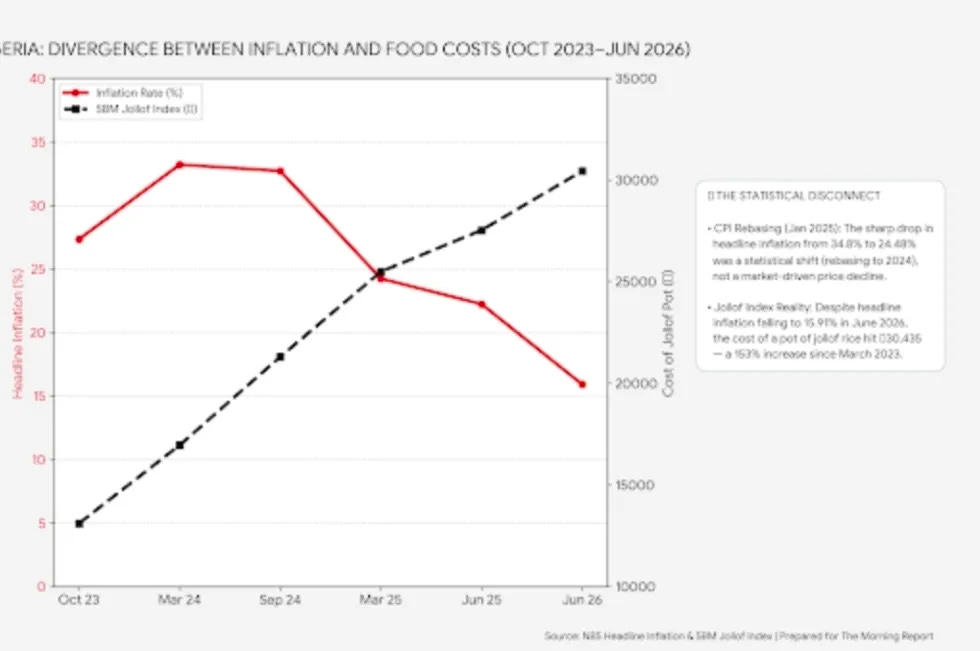
Nigeria’s inflation story is no longer about whether prices are rising or falling. It is increasingly about persistence. Headline inflation eased marginally to 15.91 percent in June from 15.93 percent in May, according to the National Bureau of Statistics. The difference was statistically negligible. The implication is not.
The latest reading suggests Nigeria may have entered a new phase of its inflation cycle. The rapid disinflation that followed last year’s rebasing exercise appears to have stalled. After reaching a low of 15.06 percent in February, inflation rose steadily for three consecutive months before flattening in June. For most of the past year, economists debated whether inflation would continue falling. The June data suggests the debate has changed. Inflation is no longer falling meaningfully. It is settling at around 16 percent.
For the Central Bank of Nigeria, that is both reassuring and uncomfortable. Reassuring because inflation has not reignited despite fresh external shocks. Uncomfortable because neither has it returned to a convincing downward trajectory that would justify aggressive monetary easing.
Between 2023 and early 2025, inflation was dominated by macroeconomic shocks. The removal of fuel subsidies. The liberalisation of the foreign exchange market. The sharp depreciation of the naira. These were large one-off adjustments that rapidly fed through the economy. Those shocks are now fading. What remains are structural pressures that monetary policy cannot easily solve.
Food is becoming the bigger problem again. Food inflation accelerated to 17.52 percent year-on-year, while monthly food inflation climbed sharply to 3.75 percent, up from 2.98 percent in May. That divergence is important. Overall inflation may be stabilising, but food prices are rising faster again. For households, food inflation matters far more than headline inflation. Food accounts for the largest share of household expenditure, particularly among lower-income Nigerians. When food inflation accelerates, consumers rarely feel that inflation is slowing.
Nigeria has experienced one of the most aggressive monetary tightening cycles in its modern history. The Monetary Policy Rate rose from 11.5 percent in 2022 to 27.5 percent before being reduced slightly to 26.5 percent. That tightening appears to have achieved its primary objective. Exchange-rate volatility has moderated. Inflation expectations have become more stable. Capital inflows have strengthened considerably. Foreign reserves have risen. The latest inflation reading suggests monetary policy has largely prevented another inflation spiral.
The challenge now is different. Higher interest rates cannot produce more food. They cannot reduce transport bottlenecks. They cannot solve the insecurity affecting agricultural production. Nor can they lower the electricity costs facing manufacturers. Those are increasingly the forces keeping inflation elevated.
This mirrors the 2014-2015 monetary policy dilemma, when the CBN kept rates high to defend the naira while inflation remained stubbornly elevated. The mechanism then was different, but the result was the same: a central bank caught between the need to control inflation and the limits of monetary policy.
The winners: the CBN, which has stabilised inflation expectations, and savers, who benefit from high interest rates. The losers: businesses, which face high borrowing costs, and Nigerian households, who continue to struggle with rising food prices.
Bottom Line: Inflation is stuck at 16 percent. The CBN has done what it can. The rest is up to the government. Food production, transport, security and electricity. Monetary policy cannot fix any of them.