


Nigeria’s ambition to host the FIFA World Cup has suffered a reality check after Gianni Infantino, president of the Fédération Internationale de Football Association (FIFA), said the country is not currently equipped to stage the global tournament.
Infantino gave the assessment on Monday, November 23, during an interview with Arise News in Abuja. He was responding to a question about whether Nigeria could host football’s biggest competition.
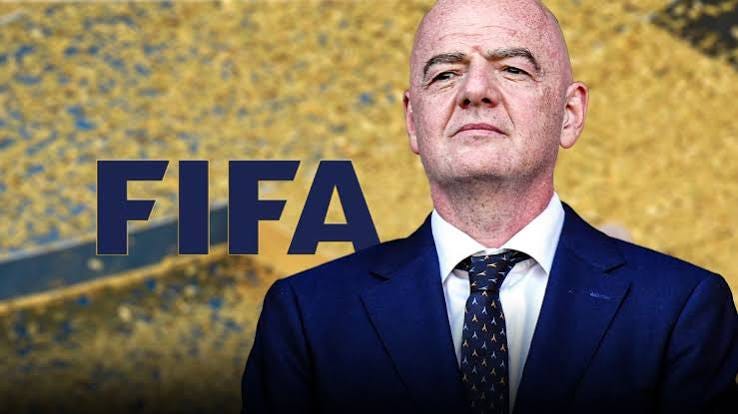
“Today, no. But tomorrow, why not?” he said.
The FIFA president acknowledged Nigeria’s passion for football, resources and determination to develop its sporting infrastructure. However, he explained that hosting the World Cup requires more than a large football following and modern stadiums.
He identified stadiums, hotels, airports and transportation networks as essential facilities that must meet international standards.
“The key for hosting a World Cup is obviously the infrastructure, the stadiums, the airports, transportation, and this is where the best practice is needed,” he said.
Infantino nevertheless expressed optimism about Nigeria’s potential, pointing to ongoing projects in Abuja and Delta State.
He recently inspected the national technical centre under construction at the Moshood Abiola National Stadium in Abuja and the remodelled Warri City Stadium.
The Abuja project, developed in partnership with the Nigeria Football Federation (NFF), received $4.88 million in funding from FIFA’s Forward 3.0 programme. It includes a 68-room players’ hostel and two training pitches.
The Warri City Stadium, which has undergone extensive remodelling, has a capacity of 15,000 spectators. Infantino described the facility positively during his visit to Delta State.
However, these projects represent only a small part of the infrastructure required to host a tournament involving 48 national teams.
NIGERIA’S WORLD CUP HOSTING HISTORY
Nigeria has never hosted the senior men’s FIFA World Cup, despite its long-standing reputation as one of Africa’s major football nations.
The country hosted the FIFA U-20 World Cup in 1999 and the FIFA U-17 World Cup in 2009.
The 2009 tournament remains Nigeria’s most recent FIFA World Cup competition. The Golden Eaglets reached the final but lost 1-0 to Switzerland at the National Stadium in Abuja.
Africa has hosted the senior men’s World Cup only once. South Africa made history in 2010 when it became the first African country to stage the competition.
Morocco will become the second African host when it co-hosts the 2030 edition with Spain and Portugal. Uruguay, Argentina and Paraguay will also host selected matches to mark the tournament’s centenary.
Nigeria previously sought to host the 2027 Africa Cup of Nations (AFCON), but the Confederation of African Football (CAF) awarded the hosting rights to Kenya, Tanzania and Uganda.
That unsuccessful bid further highlights the difficulties Nigeria faces in translating its football reputation into successful hosting arrangements.
INFRASTRUCTURE REMAINS THE BIGGEST OBSTACLE
Hosting the World Cup requires a coordinated national investment programme. Countries must provide stadiums, training facilities, hotels, airports, transportation systems, security arrangements and reliable public services.
The challenge extends beyond constructing football grounds. Supporters must be able to travel between host cities, access accommodation and move safely throughout the competition.
For Nigeria, these requirements expose wider infrastructure weaknesses. Poor road networks, unreliable electricity, inadequate public transportation and inconsistent urban planning could complicate preparations for an event of this scale.
The potential winners from a successful hosting bid would include the tourism industry, hospitality businesses, construction companies and local communities. Such an event could also attract international investment and create employment opportunities.
But taxpayers could become the losers if the government commits enormous resources to stadium construction without addressing the country’s more pressing infrastructure needs.
Infantino’s assessment is therefore not an outright rejection of Nigeria’s ambition. It is a reminder that football passion alone cannot secure hosting rights. Nigeria must demonstrate that it can provide the facilities and organisation required to stage the competition.
Bottom Line: Nigeria has the football culture, population and resources to dream of hosting the World Cup. What it lacks is the infrastructure to make that dream credible. Until the country fixes its stadiums, airports, hotels and transport networks, the ambition will remain more political aspiration than practical possibility.