


Lagos State Deputy Governor Obafemi Hamzat has challenged corporate organisations to invest in research and digital infrastructure, arguing that the state cannot build a competitive digital economy through government spending alone.
Hamzat made the call on Friday, November 20, at a fintech town hall in Lagos organised by MyCard Global in collaboration with the Fintech Association of Nigeria.
The meeting, themed “The Lagos Digital Economy Blueprint: Co-Authoring the Lagos Digital Economy Agenda 2027–2031”, brought together technology companies, financial institutions, investors and government representatives to discuss the state’s digital future.
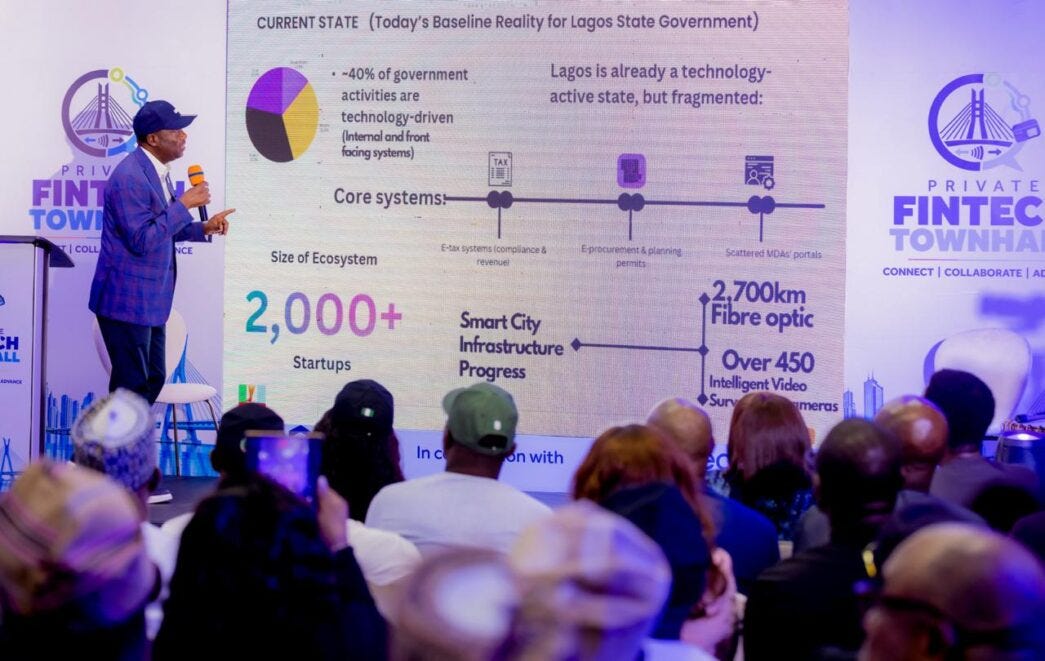
Hamzat identified the weak relationship between research institutions and the private sector as a major obstacle to turning local innovations into commercial products.
He said Lagos had created platforms where young entrepreneurs and researchers could present ideas for possible funding. However, he argued that more deliberate partnerships were needed to connect these innovators with investors and industries.
“We have seen a lot of ideas and young people bringing innovations, but how do we bring them to capital? How do we ensure that we understand the needs of the private sector and connect them to research?” he asked.
The deputy governor urged companies to identify challenges within their industries, partner with universities and research institutions, and fund studies that could produce practical solutions.
His argument highlights a longstanding weakness in Nigeria’s innovation ecosystem. Universities produce research, while businesses spend money acquiring technology and solutions, often without a strong mechanism connecting both sides.
The result is that promising ideas can remain in academic publications or laboratories instead of becoming products that improve productivity, create jobs and generate revenue.
Hamzat said Lagos was working towards an integrated innovation ecosystem that would connect research, incubation, investment, industry and commercialisation.
LAGOS TARGETS 6,000KM FIBRE-OPTIC NETWORK
Beyond research funding, Hamzat identified broadband connectivity as another area requiring stronger private-sector participation.
He said the state was working to expand its fibre-optic network from 2,400 kilometres to approximately 6,000 kilometres through partnerships with telecommunications operators and other private-sector players.
The expansion is expected to improve internet access in schools and public institutions, support technology-driven businesses and reduce the cost of doing business.
The state is also developing an enterprise architecture that will allow ministries, departments and agencies to share information through application programming interfaces (APIs).
Hamzat said standardising government databases would reduce duplication, improve public service delivery and prevent residents from repeatedly submitting the same information to different government agencies.
This is particularly important in a state where residents and businesses interact with several government institutions for permits, registrations, payments and other services.
A more integrated system could reduce administrative delays and help government agencies make decisions using more reliable information.
STARTUPS TO GET 10% OF PUBLIC PROCUREMENT
Hamzat also disclosed that Lagos planned to allocate 10% of public procurement opportunities to emerging businesses.
The initiative is intended to give startups access to government contracts and provide opportunities to expand their operations.
He added that the government was working towards ensuring that participating small businesses received payments within 15 days, a measure designed to improve cash flow and reduce the financial pressure associated with executing public contracts.
Women account for about 54% of startups that have secured work under the initiative, according to the deputy governor.
The proposal could offer emerging businesses an important route into the market. However, its success will depend on transparent procurement processes, timely payments and fair access to government contracts.
At the same event, Gbenga Agboola, co-founder of Flutterwave, called for predictable government policies and better coordination among regulatory agencies.
Agboola said investors needed a stable regulatory environment to plan, commit capital and develop products. He argued that approvals obtained from one regulator should help facilitate requirements from other relevant agencies.
He also warned that duplicated licensing processes and inconsistent regulations could increase operating costs and discourage investment in the fintech sector.
The proposed digital economy agenda presents opportunities for technology companies, research institutions, startups and residents who stand to benefit from better connectivity and more efficient public services. However, businesses will need clear policies, reliable infrastructure and transparent government processes before committing substantial capital.
For Lagos, the challenge is turning these proposals into measurable improvements. Expanding fibre-optic coverage will mean little if connectivity remains expensive or inaccessible. Likewise, allocating procurement opportunities to startups will achieve little if payments are delayed or contracts are distributed without transparency.
Bottom Line: Lagos wants the private sector to help finance its digital transformation. But attracting investment will require more than asking companies to spend. Government must provide the predictable policies, infrastructure and institutional efficiency that make such investments worthwhile.