


At a recent state event, Akwa Ibom Governor Pastor Umo Eno recounted his entrepreneurial journey, revealing that he once made not less than ₦10 million a month from selling “akara burgers” – akara tucked into sliced bread – and running a coffee shop popular with ExxonMobil workers. The governor shared the story as motivation, but the math of his claim quickly became the subject of intense public scrutiny.
The Claim and the Backlash
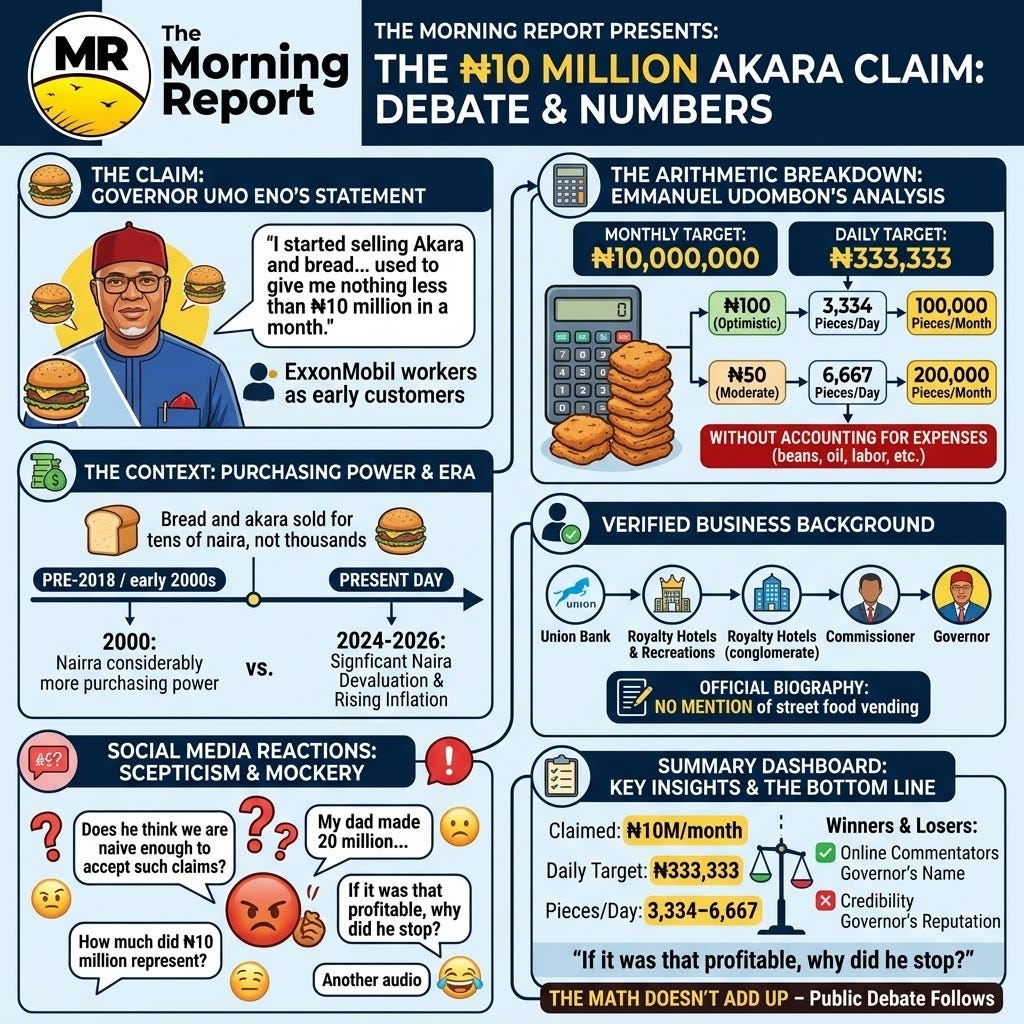
Speaking at the September edition of the state’s monthly covenant prayer service, Eno said: “I started selling Akara and bread. Back then, I was doing Akara Burger — we opened the bread and put Akara inside for you. People going to work at ExxonMobil would buy it in the morning, take coffee. Every month, that akara and bread business used to give me nothing less than ₦10 million in a month.”
The disclosure came months after First Lady Oluremi Tinubu advised Nigerians to consider low-capital businesses such as akara and kulikuli making. Eno’s story appeared to echo her call, but it also triggered a wave of scepticism across social media.
The Arithmetic of Akara
Social critic Emmanuel Udombon broke down the numbers in a Facebook post, arguing that the claim deserves scrutiny rather than blind acceptance. He calculated that if the ₦10 million represented net profit, Eno would have needed to make roughly ₦333,333 in profit every day. Assuming a generous ₦100 profit per piece of akara, he would have needed to sell about 3,334 pieces daily. At ₦50 profit per piece, that number doubles to about 6,667 pieces every day — without accounting for the cost of beans, oil, pepper, onions, firewood, labour and other expenses.
Udombon also questioned the era referenced by the governor, noting that the prices described belong to a period when the naira had considerably more purchasing power, and bread and akara were sold for tens of naira, not thousands . He further questioned whether the figure referred to profit, turnover or income from multiple businesses.
A Tradition of Improbable Wealth Tales
Governor Eno’s claim is far from the first time a Nigerian political figure has offered an eyebrow-raising explanation for their wealth. The tradition is long and colourful.
In a 2022 BBC interview, President Bola Tinubu explained his wealth by stating: “I inherited great real estate and I turned the value around.” He described himself as the “most investigated” politician in Nigeria, denied taking government contracts, and attributed questions about his wealth to “envy”.
Former Abia Governor Orji Uzor Kalu narrated how he borrowed $35 from his mother at age 19 and started trading palm oil, rice and sugar. He later hit it big in the early 1980s when the military government awarded him lucrative contracts to import and supply arms and ammunition.
Former senator Dino Melaye offered one of the most creative explanations in August 2026. He claimed that at age 12, he bought a goat, sold its offspring to pay his school fees, and invested the proceeds in Eurobonds 27 years ago when one euro was exchanged for ₦60 making him one of the earliest adopters of the euro as it came into being exactly 27 years ago. Melaye also claimed to have invested early in Apple, Microsoft, Uber and Zoom shares, with the latter multiplying 400 times during the COVID-19 pandemic.
Atiku Abubakar, presidential candidate of the ADC, has stated that he funded the setting up of the Peoples Democratic Party and amassed his $1.2 billion to $1.5 billion fortune through logistics, real estate, agriculture and education. He has repeatedly dared investigators to probe him.
Social Media Reactions
Online reactions to Eno’s claim ranged from scepticism to outright mockery. One user questioned whether the governor believed his audience was naive enough to accept such claims, while another suggested that if the business was that profitable, he should have kept it going. Others sarcastically compared the claim to other politicians’ rags-to-riches stories.
One user questioned how much ₦10 million represented in that era, another simply asked why he stopped if it was so profitable, while others simply dismissed the story as “another audio”.
The Man and His Background
The governor’s verified background includes a career in banking, hospitality and politics. According to his official biography, he worked with Union Bank and later established Royalty Hotels & Recreations Ltd in 1997, which evolved into a conglomerate with interests in hospitality, manufacturing and catering. He also served as Commissioner for Lands and Water Resources before becoming governor. There is no mention of street food vending in his official biography.
The winners: the online commentators who have engaged in a spirited debate about the numbers and the long tradition of questionable political wealth tales; and the governor, who has kept his name in the headlines. The losers: the credibility of the claim, which has been questioned by many; and the governor’s reputation, which may have been dented by the controversy. The Nigerian public, who are increasingly sceptical of political narratives, also lose as the cycle of improbable wealth explanations continues to erode public trust in political leaders.
Bottom Line: A governor says he made ₦10 million from akara. The internet says the numbers don’t add up. It is just the latest chapter in a long Nigerian tradition of political wealth tales that range from the improbable to the mathematically impossible. The question is whether the public will continue to accept these stories or demand better explanations.