


Global foreign direct investment (FDI) increased by 6% to $1.6 trillion in 2025 from $1.5 trillion in 2024, although the growth remained concentrated in developed and high-income economies. The United Nations Conference on Trade and Development (UNCTAD) made this known in its 2026 World Investment Report.
According to the organisation, developing economies attracted just above $901 billion in FDI during the year, representing a 2% increase from 2024. The global increase, UNCTAD noted, came as investment flows remained volatile and were influenced by one-off transactions, corporate restructurings, conduit flows and other financial movements rather than a broad-based recovery in underlying productive investment.
FDI flows to developed economies increased by 11% to $723 billion, while inflows to high-income economies increased from $1 trillion to more than $1.1 trillion. Inflows to low-income countries increased by 10%, although from a low base. UNCTAD noted that high-income economies drove much of the increase, reflecting higher inflows to developed countries and the continued attractiveness of some high-income developing economies hosting large-scale projects and financial flows.
Hong Kong (China), Singapore and the United Arab Emirates together accounted for more than one-third of FDI inflows to developing economies. Inflows to upper-middle-income economies remained largely unchanged, while FDI flows to lower-middle-income economies declined by 5%. The increase in investment was linked partly to capital- and technology-intensive sectors, including high-technology and digital infrastructure.
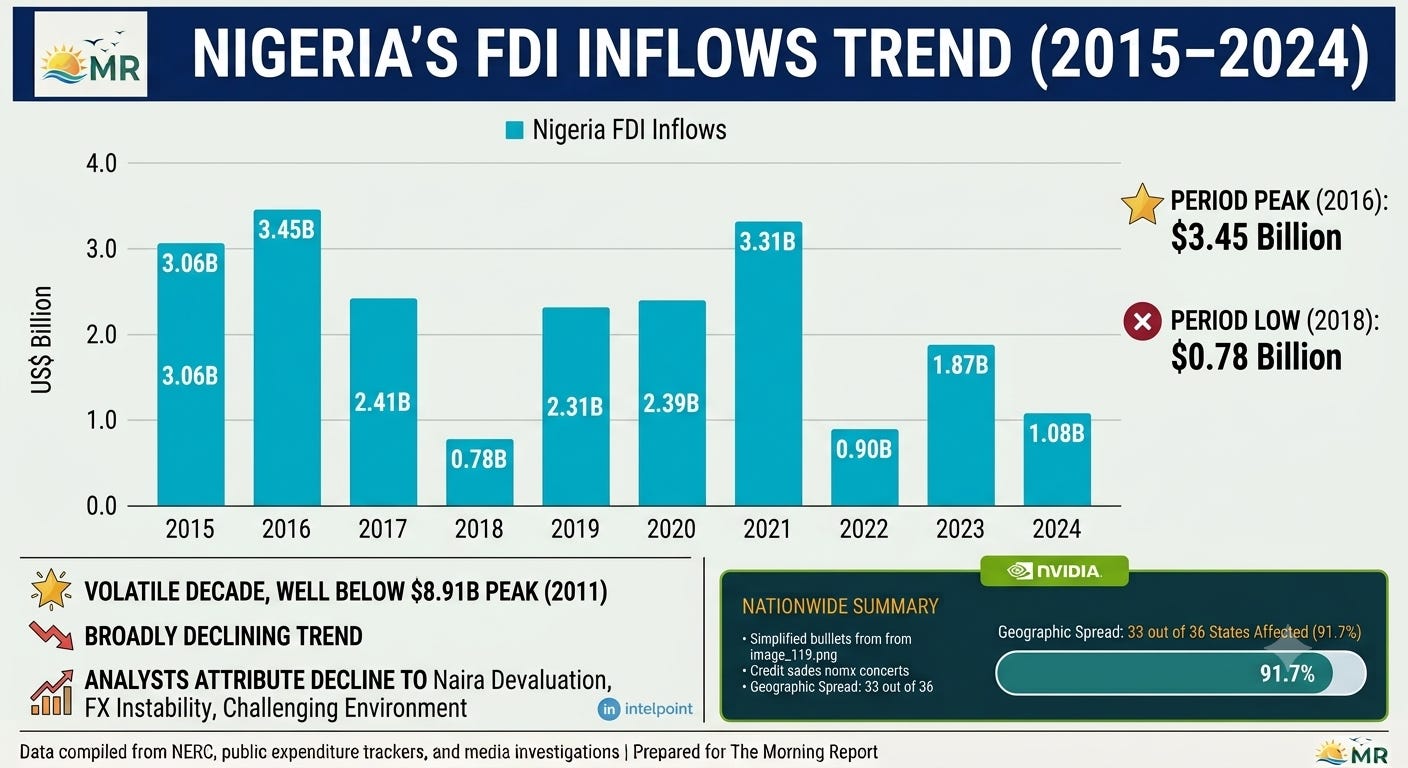
The Nigerian stake is clear. Nigeria’s FDI declined sharply in the first quarter of 2026, falling to $135.08 million from $357.80 million in the fourth quarter of 2025. The decline came as Nigeria attracted total capital inflows of $10.37 billion during the quarter, driven largely by portfolio investments and other short-term financial instruments rather than long-term productive investment.
From a Nigerian vantage point, the global FDI trend highlights the increasing concentration of international investment in economies and sectors capable of attracting large-scale, strategic and technology-intensive capital. Nigeria must improve its investment climate to compete for FDI, particularly in high-technology and digital infrastructure sectors.
This echoes the 2010s FDI trends, which also saw investment concentrated in a few high-performing economies. The mechanism then was different, but the result was the same: a recognition that Nigeria must improve its investment climate to attract FDI.
The winners: economies that attracted FDI, particularly in high-technology sectors; and the Nigerian economy, which could benefit from improved investment. The losers: Nigeria, which saw its FDI decline; and the Nigerian government, which must address the factors driving the decline.
Bottom Line: Global FDI is up 6%. Nigeria’s FDI is down. The world is investing more. Nigeria is investing less. The question is whether the government can reverse the trend.