


The global economy is a notoriously fickle beast. Capital flows tend to follow the path of least resistance and highest yield. The latest data from the United Nations Conference on Trade and Development confirms this timeless truth. Global foreign direct investment climbed by six percent to reach $1.6 trillion in 2025. This ended two consecutive years of decline in cross-border capital movements. On the surface, this looks like a robust recovery. Policymakers in global financial centres might even be tempted to celebrate.
However, the headline figures mask a deeply uneven reality. The spoils of this recovery are highly concentrated in a few privileged regions. Developed economies saw their foreign direct investment inflows surge by 11 percent. They captured a massive $723 billion of the global total. Meanwhile, developing economies recorded a paltry two percent growth. Their total inflows reached $901 billion. This marginal growth in the developing world is barely enough to keep pace with inflation. It certainly falls short of the massive financing needed for infrastructure and job creation.
The situation in Africa is particularly sobering. Overall foreign direct investment into the continent plummeted by 26 percent. Total inflows to Africa dropped from $94 billion in 2024 to just $70 billion in 2025. This steep decline highlights the continent’s vulnerability to global economic shocks. It also underscores a persistent inability to attract sustainable capital outside the extractive sector. Investors clearly prefer the safety and technological maturity of the Global North.
A major driver of this global investment disparity is the artificial intelligence boom. Data centres have emerged as the largest greenfield investment segment globally. Foreign direct investment into data centres reached a staggering $235 billion in 2025. This vastly outstrips investment in traditional sectors like oil and gas. The infrastructure required for the artificial intelligence revolution is highly capital intensive. Unsurprisingly, this capital is flowing overwhelmingly towards North America, Europe, and parts of Asia. Africa is largely standing on the sidelines of this technological gold rush.
Speaking at a technology finance summit in London on 23 July 2026, investment analyst Sarah Jenkins highlighted this shift. She noted that institutional capital is laser-focused on digital infrastructure. Jenkins stated that investors view artificial intelligence readiness as the ultimate metric for future economic viability. This perspective naturally disadvantages regions with unstable power grids and limited broadband penetration. Capital is essentially bypassing the physical economy for the digital one.
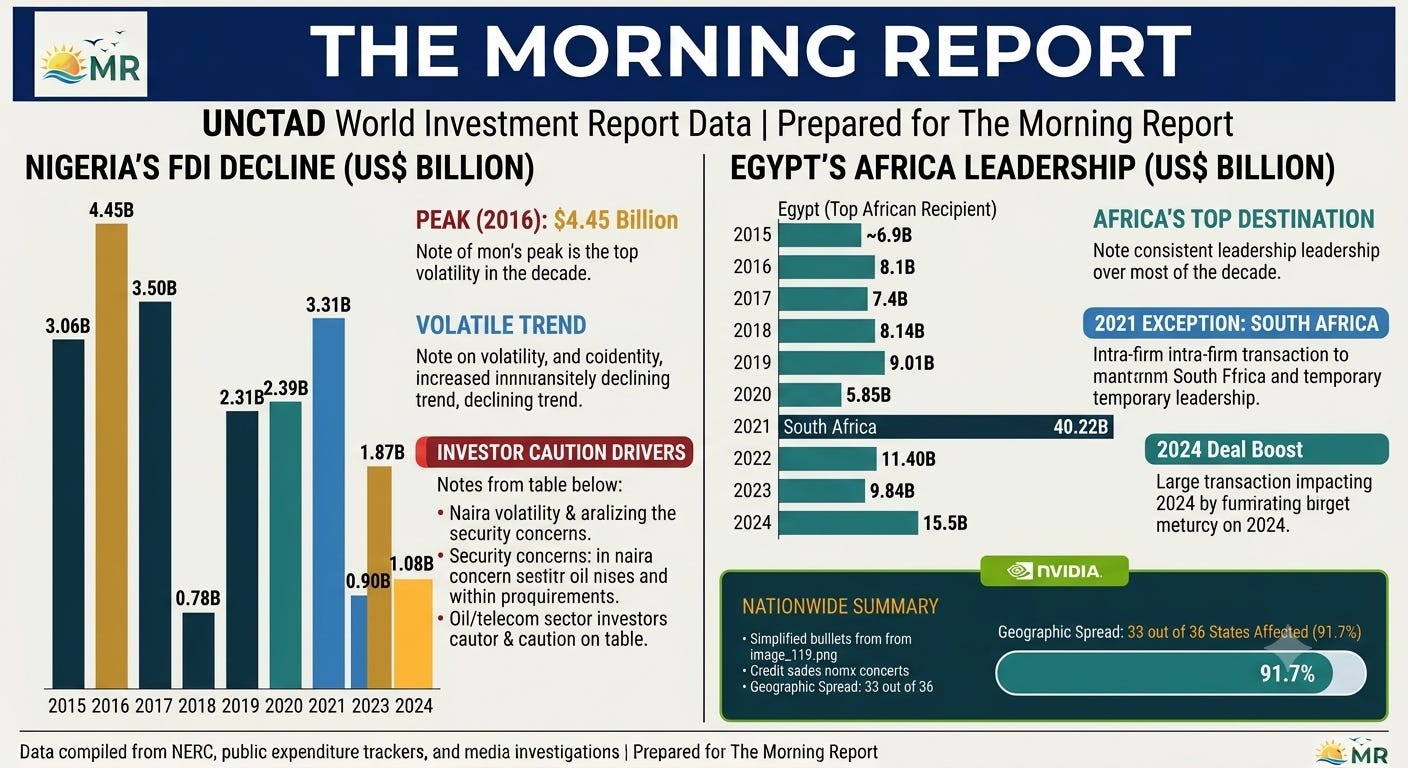
Yet, there are isolated pockets of growth within the African narrative. West Africa saw its foreign direct investment inflows rise by 44 percent to $19.6 billion. This regional surge was almost entirely driven by Nigeria. The continent’s most populous nation saw its inflows double. Nigeria attracted about $4 billion in 2025, compared to $1.6 billion the previous year. For a government desperate for economic validation, these numbers offer a convenient talking point.
Defending the administration’s economic policies at a Lagos trade seminar on 21 July 2026, a senior trade ministry official was visibly upbeat. The official claimed that the doubling of inward investment validates recent macroeconomic reforms. He stated that the removal of bureaucratic bottlenecks is finally restoring investor confidence in Nigeria. He further argued that this $4 billion inflow is just the beginning of a sustained capital influx.
However, a closer examination of this Nigerian windfall reveals a familiar and frustrating pattern. The bulk of this $4 billion did not go into manufacturing or technology. It did not go into agriculture or services that create mass employment. Instead, it was driven by international project finance deals in the oil and gas sector. One single transaction in the fossil fuel sector was valued at about $2 billion. This roughly translates to over ₦3 trillion in local currency. We are essentially celebrating a reliance on the very extractive industries that have long distorted our economy.
This overreliance on hydrocarbon investments drew sharp criticism from local economic watchers. Addressing a policy roundtable in Abuja on 24 July 2026, prominent economist Dr Muda Yusuf offered a blistering assessment. Yusuf argued that celebrating extractive capital is a fundamental misreading of economic development. He stated that oil and gas investments are notoriously poor at creating jobs for the youth. He warned that until capital flows into manufacturing, the broader economy will remain comatose.
Adding to the discourse on regional solutions, trade advocate Chika Onyeama spoke at a policy forum in Accra on 25 July 2026. Onyeama stressed that Africa must stop waiting for Western capital to save its economies. She argued that the African Continental Free Trade Area remains our most viable tool for capital mobilisation. Onyeama insisted that by pooling regional resources, we can fund our own industrialisation. This inward focus may be the only reliable path forward in a fragmented global economy.
Africa has historically served as a mere extraction point for global capital. During the commodity supercycle of the early 2000s, foreign direct investment flooded into the continent. However, this capital was almost entirely focused on digging things out of the ground. Oil, copper, cobalt, and gold were the primary magnets for foreign money. When commodity prices eventually crashed, so did the investment inflows. The continent was left with deep financial craters and very little industrial infrastructure.
Attempts to diversify these investment flows have yielded mixed results over the decades. The mid-2010s saw a brief surge in consumer-focused investments. Global brands attempted to tap into the narrative of a rising African middle class. Retail, telecommunications, and banking saw modest upticks in foreign participation. Yet, currency volatility and structural bottlenecks quickly dampened this enthusiasm. Repatriating profits became a nightmare for foreign companies operating in Nigeria and beyond.
Today, the global investment paradigm has shifted once again. Capital is no longer chasing consumer markets in developing nations with the same vigour. Instead, it is retreating into strategic sectors within secure geopolitical blocs. The rise of supply chain reshoring is devastating for peripheral economies. Western governments are heavily subsidising domestic manufacturing and green energy projects. This leaves very little patient capital available for emerging African markets. The historical failure to industrialise has left Africa uniquely exposed to this new era of strategic protectionism.
The United Nations has repeatedly warned about the dangers of this structural imbalance. Delivering a virtual briefing on 20 July 2026, UNCTAD representative Elena Rostova stressed the urgency of the situation. Rostova noted that the global rebound in capital flows is dangerously narrow. She warned that developing nations are being systematically excluded from high-growth industries like clean energy. She urged international policymakers to deliberately channel infrastructure finance to structurally vulnerable economies.
Unfortunately, international goodwill is rarely a reliable economic strategy. The harsh reality is that capital goes where it feels safe and where returns are predictable. Nigeria’s current business environment remains hostile to patient, long-term capital. High inflation, a volatile Naira, and unpredictable regulatory shifts scare away serious industrial investors. The few who do brave the market demand premium returns to offset the massive risks.
This brings us back to the data centre boom. While the rest of the world builds the infrastructure for artificial intelligence, we are still struggling with basic electrification. A modern data centre requires massive, uninterrupted power and significant cooling capacity. These are resources that remain frustratingly scarce across most of sub-Saharan Africa. Therefore, the $235 billion global investment in data centres bypasses us almost entirely. We remain locked out of the very sector that will define the next century of economic growth.
The tragedy is that our demographic dividend is being wasted. We have a massive, youthful population that is desperate for productive employment. Extractive industries like oil and gas simply do not employ enough people to move the needle. A $2 billion oil platform might create a few hundred highly specialised jobs. A similar investment in light manufacturing could employ tens of thousands of moderately skilled workers. Our foreign direct investment profile is fundamentally misaligned with our demographic reality.
The clear winners in this new investment landscape are the advanced economies of the Global North. The United States and European nations are successfully capturing the lion’s share of strategic investments. They are dominating the influx of capital into artificial intelligence, semiconductors, and green energy. Multinational technology firms and institutional investors are also winning. They are securing high returns in politically stable environments with robust legal frameworks.
The losers are undoubtedly the developing economies of Africa. Despite holding vast human and natural resources, the continent is being starved of transformative capital. The decline from $94 billion to $70 billion in total inflows is a severe blow. The average African youth is a major loser in this equation. They are deprived of the employment opportunities that accompany industrial and technological investments. Finally, the broader Nigerian economy remains a loser, trapped in an endless cycle of oil dependency.
Bottom Line: The latest global foreign direct investment figures should serve as a massive wake-up call. Celebrating a minor uptick driven by a single oil deal is a dangerous delusion. The world is moving rapidly towards a digital and green economic future. Capital is flowing aggressively into the infrastructure required for this new era. Africa is currently being left behind in this critical transition. Until we fix our structural deficits and create a viable environment for industrial capital, we will remain mere spectators. The future belongs to those who build, not just those who extract.