


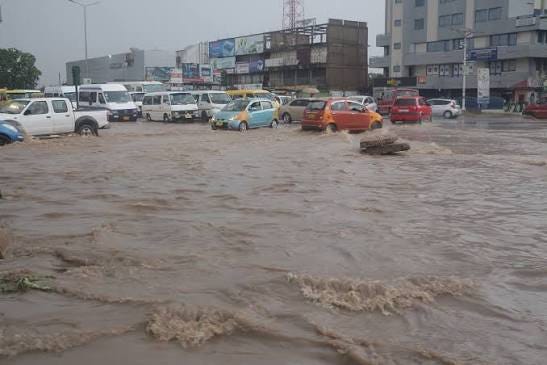
Ghana’s Finance Minister, Dr Cassiel Ato Forson, says President John Dramani Mahama has directed the Ministry of Works, Housing and Water Resources to develop a lasting solution to recurring flooding in Accra and other flood-prone communities. Presenting the 2026 Mid-Year Fiscal Policy Review to Parliament, Forson announced that the government had released additional funds to support ongoing dredging and the construction of critical drainage systems in affected areas.
He said the intervention is aimed at reducing the immediate impact of seasonal floods while work begins on a more comprehensive flood management strategy. According to the minister, funding for the long-term solution will be included in the 2027 national budget and medium-term expenditure framework rather than the current fiscal year. The announcement follows years of devastating floods that have displaced residents, damaged property and claimed lives. Government initiatives such as the Greater Accra Resilient and Integrated Development (GARID) project have sought to improve urban drainage and reduce flood risks.
The Nigerian stake is clear. Accra’s flooding challenges mirror those of Lagos and other Nigerian cities. Both countries face similar problems: rapid urbanisation, inadequate drainage, climate change and poor urban planning. Ghana’s commitment to a long-term solution is a recognition that short-term fixes are not enough.
From a Nigerian vantage point, the Ghanaian initiative is a model and a warning. The model: a government taking a long-term approach to a recurring problem. The warning: Nigeria’s own flood response remains reactive rather than preventive.
This echoes the 2012 Lagos flood response, which also exposed the need for long-term planning. The mechanism then was different, but the result was the same: a recognition that floods require structural solutions, not just emergency responses.
The winners: Ghanaian communities, which may benefit from improved flood management; and the Ghanaian government, which has shown leadership. The losers: the Nigerian government, which has not matched Ghana’s commitment; and Nigerian communities, which face flooding without a comprehensive plan.
Bottom Line: Ghana is developing a lasting solution to Accra’s flooding. Nigeria is still responding to the last flood. The difference is planning. The question is whether Nigeria will learn from Ghana’s example.