


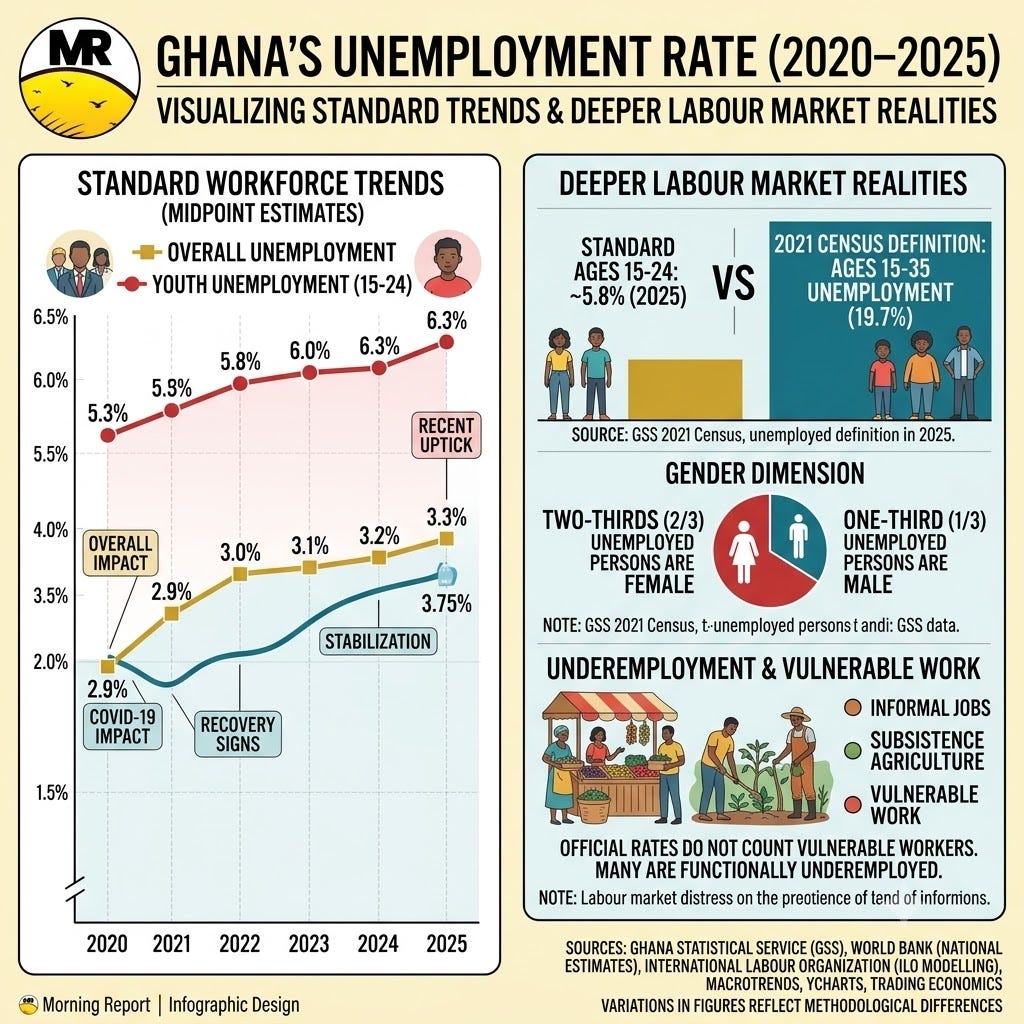
Ghana’s labour market showed signs of weakening in April 2026 as the number of jobs advertised in selected print and online media declined, according to the May 2026 Monetary Policy Report. The report showed that 2,818 job vacancies were advertised in April, representing a 16.8 percent decline from the 3,388 recorded in the same month of 2025. On a month-on-month basis, advertised jobs also fell 5.7 percent from 2,988 vacancies in March.
For the first four months of 2026, total job advertisements dropped 5.4 percent to 12,326, compared with 13,036 during the corresponding period last year, indicating softer labour demand. Despite the decline in advertised vacancies, formal private sector employment remained resilient. The number of contributors to Ghana’s Social Security and National Insurance Trust (SSNIT) increased 5.4 percent year-on-year to 1,135,379 in March 2026, while remaining broadly unchanged from the 1,132,222 recorded in February.
The Nigerian stake is significant. Ghana’s labour market is closely tied to Nigeria’s through trade and migration. Nigerian businesses operating in Ghana may be affected by the weaker demand. Nigerian workers seeking employment in Ghana, a popular destination for skilled professionals, may find fewer opportunities. The decline in job advertisements also signals broader economic weakness in the West African region, which could affect Nigeria’s own economic prospects.
From a Nigerian vantage point, the decline in Ghanaian job advertisements is a reminder of the fragility of West African economies. Ghana has been a regional bright spot, with relatively stable growth and democratic governance. If its labour market is weakening, the region’s economic outlook may be more precarious than it appears.
The winners: none. The losers: Ghanaian job seekers who are finding fewer opportunities, and Nigerian workers who may face increased competition for limited jobs in the region.
Bottom Line: Ghana’s job ads are down. That is not just a Ghana problem. It is a West African problem. And Nigeria is not immune.