

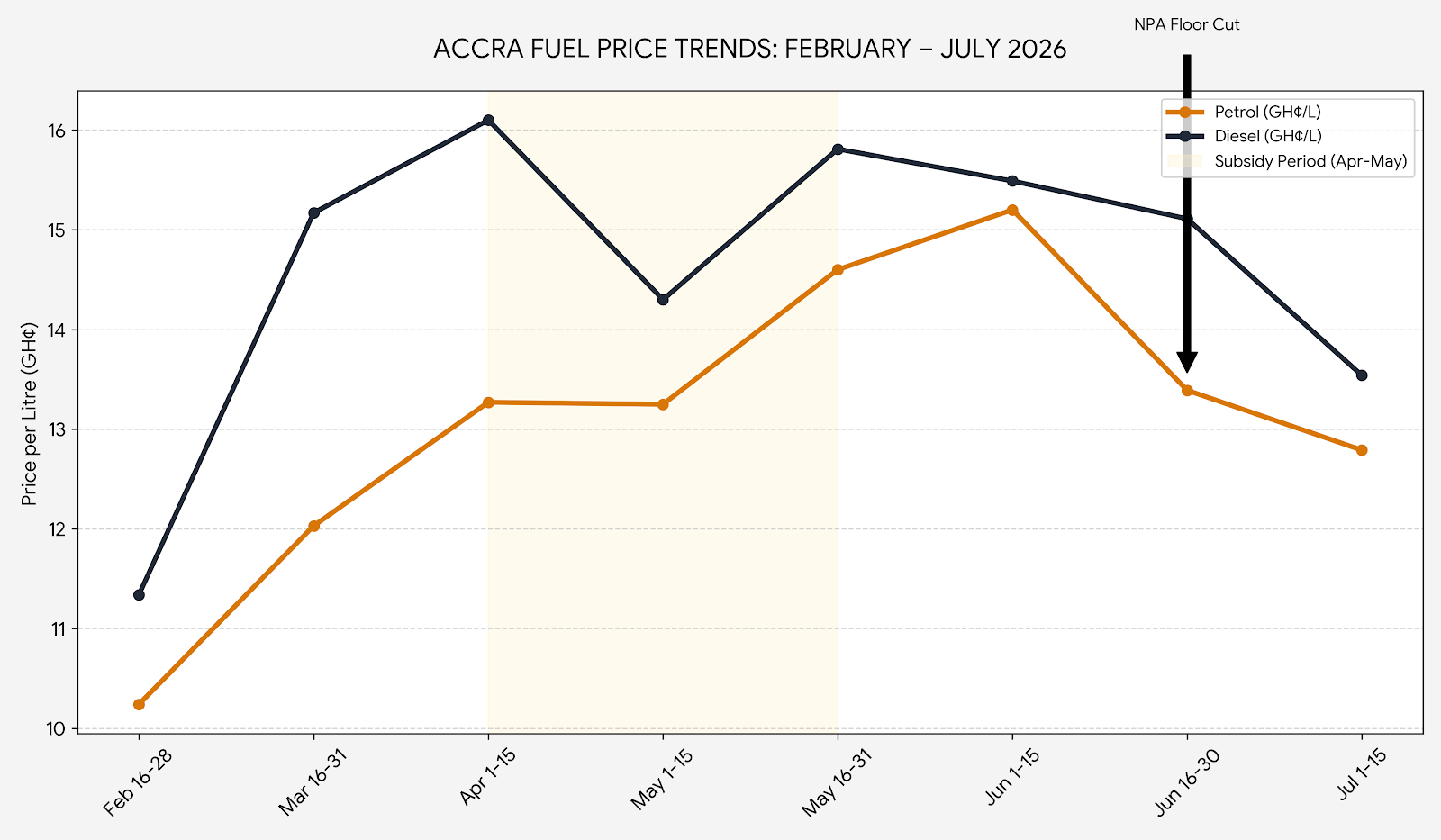
Ghana’s National Petroleum Authority has raised the price floor for petroleum products, with the new rates taking effect from July 16, 2026. Under the revised pricing, the minimum pump price for petrol will increase from GH¢12.79 to GH¢13.28 per litre, while diesel will rise from GH¢13.54 to GH¢14.35 per litre. The adjustment means oil marketing companies and LPG marketers selling below the new thresholds must raise their pump prices.
The increase comes despite earlier projections by the Chamber of Petroleum Consumers that fuel prices would decline, citing the relative stability of the Ghana cedi and modest changes in international fuel prices. The upward adjustment in the price floors comes amid renewed tensions in the Middle East involving the United States and Iran, which have pushed international crude oil prices higher, with Brent crude prices crossing above $80 per barrel.
Introduced in April 2024, the NPA’s price floor policy prevents companies from selling fuel below approved minimum prices to promote market stability, transparency and fair competition. While the Authority says the policy supports a sustainable downstream petroleum sector, some industry stakeholders argue it limits competition and denies consumers the benefits of lower fuel prices.
The Nigerian stake is clear. Ghana’s fuel pricing dynamics are closely watched in Nigeria, as both countries face similar challenges in managing petroleum product pricing amid volatile global oil markets. Nigeria’s own fuel subsidy regime has been a source of contention, with the government struggling to balance consumer welfare with fiscal sustainability.
From a Nigerian vantage point, Ghana’s price floor policy offers a cautionary tale. While the policy provides stability, it also prevents consumers from benefiting from lower international prices. Nigeria’s deregulated market, by contrast, allows prices to move with global trends, but that also means Nigerian consumers bear the full brunt of price increases.
This mirrors the 2015 fuel price debates in Nigeria, when the government struggled to balance deregulation with consumer protection. The mechanism then was different, but the result was the same: a tension between market efficiency and social welfare.
The winners: oil marketing companies, which benefit from guaranteed margins, and the NPA, which maintains market stability. The losers: Ghanaian consumers, who pay higher prices, and the Chamber of Petroleum Consumers, whose projections were proven wrong.
Bottom Line: Ghana’s fuel prices are going up. The government blames global oil prices. The consumers blame the price floor. The debate is familiar. The outcome is predictable.