


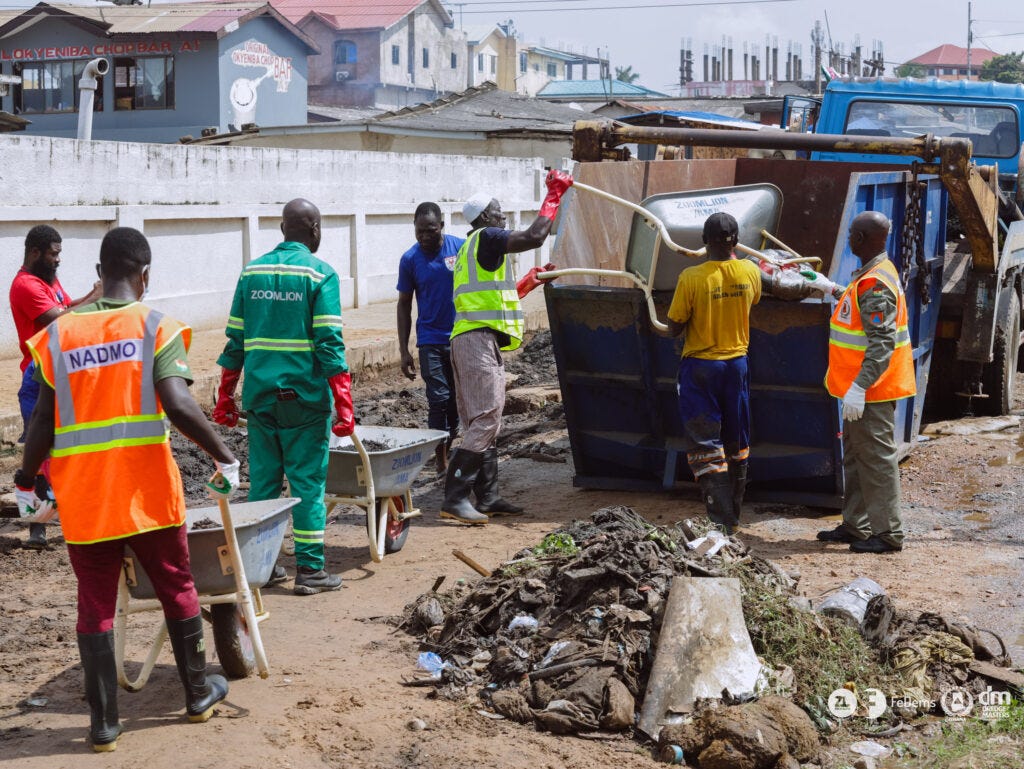
The Ghanaian government has launched a two-day nationwide clean-up exercise across 104 flood-prone and flood-affected locations in the Greater Accra Region to restore communities following recent flooding. The exercise, taking place from July 10 to 11, will run daily from 6:00 am to 1:00 pm.
On the first day, government ministries, agencies, local assemblies, security services, schools, waste management companies and private institutions will lead the exercise, while residents, community groups and volunteers will take over on the second day. Authorities have ordered shops, markets, commercial establishments and other non-essential businesses in affected areas to remain closed during the exercise, while essential and emergency services are exempt.
The clean-up will focus on clearing refuse, desilting choked drains and restoring public spaces across several municipalities, including Ga South, Ga Central, Ga North, Ga East, Tema West, Ledzokuku-Krowor and Ada East and West, among others.
The Nigerian stake is clear. Ghana’s flood response offers lessons for Nigeria, where annual flooding devastates communities with little coordinated response. In 2022, floods in Nigeria claimed more than 600 lives and displaced over 1.4 million people. The pattern is the same in both countries: rapid urbanisation, poor drainage, inadequate disaster preparedness.
From a Nigerian vantage point, the Ghanaian clean-up is a model and a warning. The model: a coordinated government response to a recurring problem. The warning: Nigeria’s own flood response remains reactive rather than preventive.
This mirrors the 2010 floods in Nigeria, which exposed the country’s lack of preparedness for climate-related disasters. The mechanism then was different, but the result was the same: communities left vulnerable and a government response that came too late.
The winners: Ghanaian communities that benefit from the clean-up; the Ghanaian government, which has shown leadership. The losers: the Nigerian government, which has not matched Ghana’s response, and Nigerian communities that face flooding without a coordinated plan.
Bottom Line: Ghana is cleaning up after floods. Nigeria is still waiting for the floods to come. The difference is not luck. It is planning.