


The widespread proliferation of generative artificial intelligence is triggering a profound existential pivot within the field of data science. For over a decade, data scientists were hailed as the undisputed high priests of the modern digital economy. Their value proposition rested primarily on hard technical execution: writing complex Python scripts, constructing bespoke machine learning pipelines, and manually wrangling messy, unstructured datasets. However, the rapid evolution of autonomous AI agents, automated machine learning (AutoML), and Large Language Models (LLMs) has democratised these foundational technical tasks. Today, natural language prompts can generate SQL queries, clean anomalous datasets, and build baseline predictive models in seconds. Consequently, the data science profession in Nigeria and across the Global South is being aggressively forced up the value chain—shifting from technical syntax construction to strategic orchestration, metadata governance, and contextual decision-making.
This technological transition comes at a critical juncture for Africa’s largest digital economy. Nigeria recently emerged as the top-ranked African nation in responsible AI governance, according to the 2026 Global Index on Responsible AI (GIRAI), ranking 38th globally with an overall score of 45.93. Reporting on these findings on 6 August 2026, tech analyst Folake Balogun noted that while Nigeria leads the continent in strategic policy frameworks—such as the National Artificial Intelligence Strategy—a massive “deployment gap” persists between policy paperbacks and real-world industrial execution. Private sector adoption is accelerating in pocketed verticals; financial institutions are leveraging machine learning for credit scoring and fraud detection, while enterprise platforms like Zirro embed AI into SME operating systems. Yet, Nigerian data science teams remain severely bottlenecked by acute infrastructure deficits, including intermittent power, prohibitive cloud computing costs, and scarce access to high-performance Graphics Processing Units (GPUs).
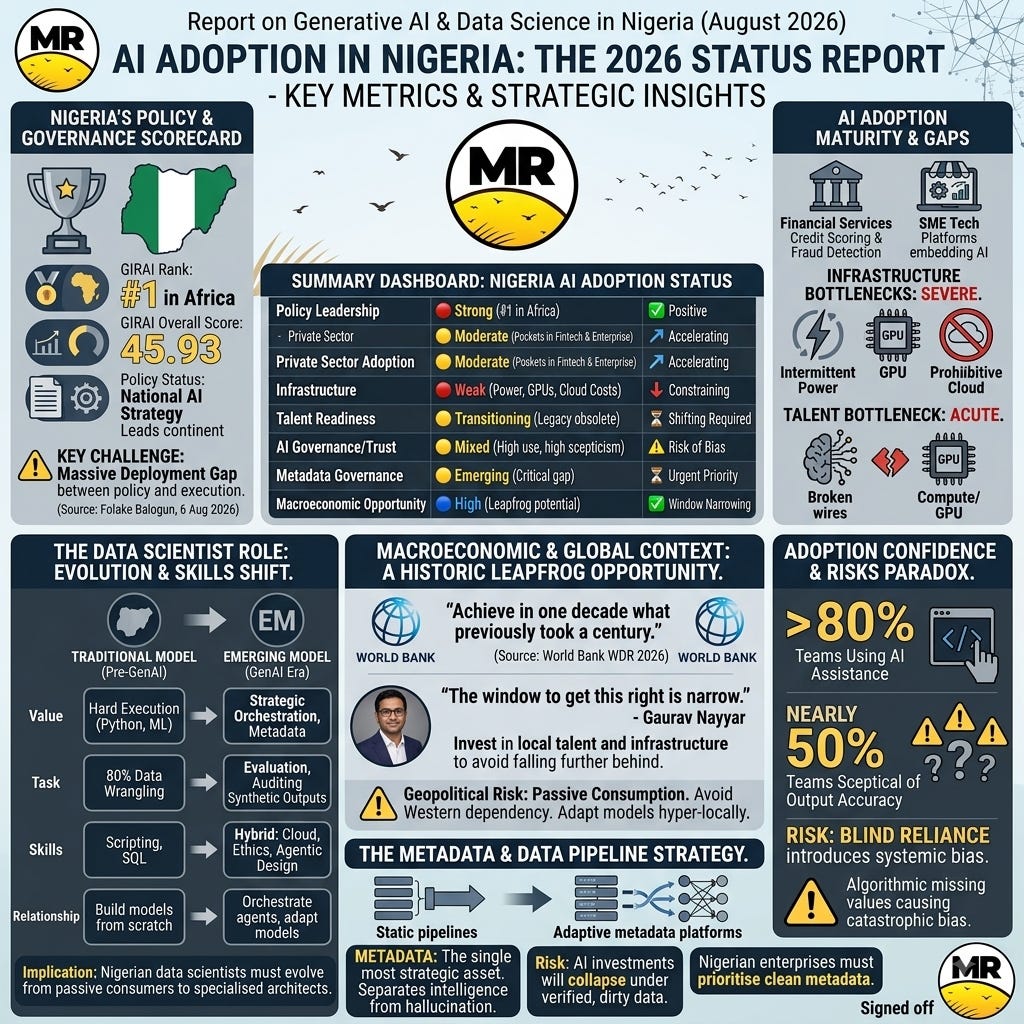

The broader macroeconomic urgency of this transition was recently underscored by international multilateral institutions. Speaking on 10 August 2026 regarding the World Bank’s 2026 World Development Report, Gaurav Nayyar, Director of the report, emphasised that generative AI offers developing economies a historic opportunity to leapfrog traditional development stages. Nayyar stated bluntly that AI can help developing countries achieve in a single decade what previously required a century of incremental industrial progress. However, he cautioned that “the window to get this right is narrow.” For Nigeria to capitalise on this compressed timeline, domestic data science talent cannot simply remain passive consumers of Western frontier models. They must evolve into specialised architects who can adapt global foundational models to resolve complex, hyper-local operational realities.
The core disruption altering the daily workflow of data scientists lies in the complete automation of routine data engineering and cleaning. Historically, data professionals spent upwards of 80 percent of their time on laborious data preprocessing—handling missing values, deduplicating records, and normalising data schemas. Modern generative tools and agentic AI systems now execute these workflows autonomously, dynamically learning validation rules and identifying anomalies before they pollute downstream systems. Yet, experts warn against blind reliance on automated outputs. Recent developer surveys reveal a striking paradox: while over 80 percent of technical teams now utilise AI assistance in their workflows, nearly half express deep scepticism regarding the accuracy of synthetic outputs. In high-stakes environments like credit risk assessment, clinical diagnostics, or public policy formulation, an algorithmically imputed missing value can introduce catastrophic systemic bias. Thus, the human data scientist’s primary role evolves from data cleaner to contextual evaluator—possessing the domain expertise to question, validate, and audit synthetic outputs.
Furthermore, the rise of generative AI is elevating metadata—the contextual data describing the origin, ownership, and transformation of information—into the single most strategic enterprise asset. In an era where foundation models consume vast oceans of structured and unstructured data, clean metadata serves as the essential boundary layer separating reliable business intelligence from hallucinated noise. Data science leaders are increasingly moving away from building static, rigid data pipelines toward designing adaptive metadata-driven platforms. These platforms provide the necessary governance, lineage tracking, and compliance frameworks required under evolving international standards like the EU AI Act. Organisations that master metadata architecture will successfully deploy autonomous AI agents that reason and execute complex workflows safely; those that ignore it will find their AI investments collapsing under the weight of unverified, dirty data.
This structural evolution fundamentally reshapes the required talent profile for the next generation of Nigerian tech professionals. The era of securing high-paying data science roles merely by memorising Scikit-Learn libraries or writing basic SQL queries is officially over. The data scientist of the generative era must possess a hybrid skill set: deep technical fluency in cloud architecture and distributed systems, paired with sharp business acumen, ethical literacy, and domain-specific knowledge. Local educational institutions and tech bootcamps must urgently overhaul their curricula, moving beyond surface-level coding instruction to focus on model evaluation, prompt engineering, agentic workflow design, and data governance.
Ultimately, generative AI does not spell the demise of the data scientist; rather, it elevates the discipline to its original, intended promise. By stripping away the repetitive manual labour of coding syntax and pipeline maintenance, generative tools liberate data professionals to focus on the hardest problems in business and governance: asking the right questions, establishing ethical guardrails, and extracting actionable truth from noisy global data ecosystems. Nigeria’s ability to transition from a policy leader in responsible AI to a global hub for high-value data orchestration will determine whether the nation truly harnesses this technological wave or remains stranded on the wrong side of the digital divide.
Winners: Strategic data architects, metadata specialists, and domain-literate analysts who leverage generative AI to multiply their output and solve complex business problems.
Losers: Junior code-writers, manual data entry clerks, and traditional data coders who fail to move beyond basic syntax scripting and pipeline maintenance.
Bottom Line: Generative AI is not replacing data scientists, but data scientists who master generative tools, metadata architecture, and contextual evaluation will rapidly replace those who do not.