


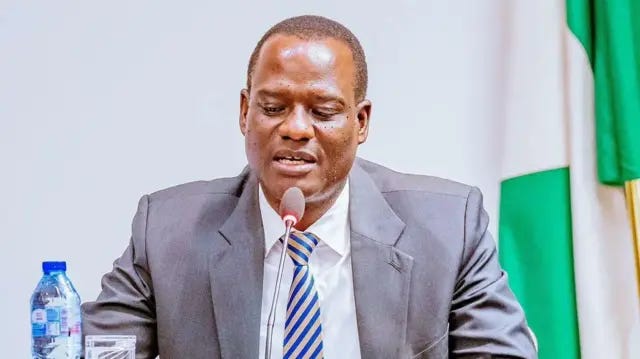
The Federal Government has dismissed claims that it spent more than ₦8 trillion outside the approved budget. The Minister of Finance and Coordinating Minister of the Economy, Taiwo Oyedele, insisted that the government does not operate a “shadow budget” and that all public expenditures are carried out within the framework of the Constitution and relevant laws.
In a statement on Sunday, Oyedele described recent commentary suggesting that about two percent of Nigeria’s GDP was spent without legislative approval as inaccurate and misleading. He said the claims, linked to references made by the International Monetary Fund’s 2026 Article IV Consultation Report, created a false impression about the government’s financial management practices.
“For the avoidance of doubt, the Federal Government does not operate a ‘shadow budget’ or expend public funds outside the constitutional and statutory framework established for public finance,” Oyedele stated.
He explained that under Sections 80 to 83 and 162 of the 1999 Constitution, public funds may be withdrawn and spent only in accordance with constitutional provisions and laws enacted by the National Assembly. Federal expenditures are undertaken through duly enacted Appropriation Acts, Supplementary Appropriation Acts and other statutory authorisations approved by lawmakers.
The minister also noted that multi-year capital projects, which often extend beyond a single fiscal year, are implemented under existing legal provisions, including approved capital rollovers. He argued that such arrangements are standard features of public financial management and should not be interpreted as spending outside the budget.
Oyedele challenged those making the allegations to provide evidence of specific projects executed without appropriation or legal authorisation. He said the IMF’s observations were largely focused on improving the comprehensiveness, timing and presentation of fiscal reporting rather than questioning the legality of government spending.
This is not the first time Nigeria’s budget has faced scrutiny. The IMF’s 2025 Article IV consultation estimated a fiscal “statistical discrepancy” of 2.7% of GDP and raised concerns about opaque financial arrangements. The minister’s defence is constitutional. The concern is that the constitution can be interpreted broadly enough to accommodate almost any spending.
The winners: the Finance Minister, who has contained the immediate political damage. The losers: the Nigerian public, which still does not have a clear answer on where 2% of GDP went.
Bottom Line: The minister says there is no shadow budget. The IMF says 2% of GDP is missing. Someone is not telling the whole story.