


The Federal Government has called for public memoranda on the proposed National Policing Bill, even as a new report paints a grim picture of escalating violence across the country. The Presidential Working Group on the National Policing Bill has unveiled a seven-week, milestone-driven exercise running from 27 July to 14 September 2026, with the draft Executive Bill scheduled for presentation to President Bola Tinubu on 3 September.
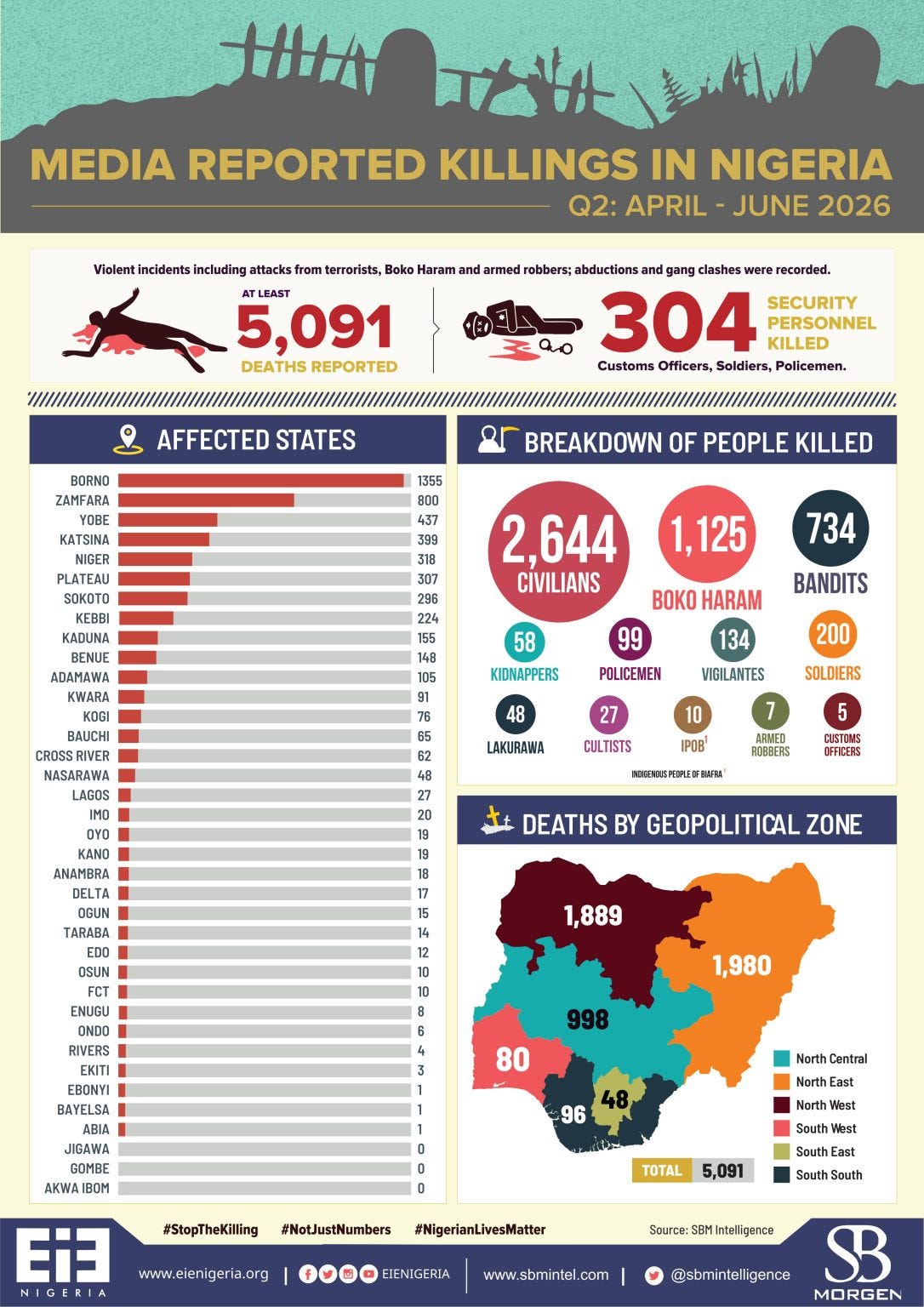
The urgency is not without cause. A new report released by SBM Intelligence yesterday recorded 5,091 deaths in the second quarter of 2026 from violent incidents involving terrorists, bandits and armed robbers. Borno State led the pack with 1,355 deaths out of the 5,091 victims. The report also documented 304 security personnel killed within the same period. Another report by EONS Intelligence showed that July 2026 alone recorded 264 deaths in 417 incidents.
The Working Group has therefore called on the public for memoranda, position papers and practical proposals from various stakeholders. Chief of Staff to the President, Femi Gbajabiamila, said the national consultation will allow Nigerians to engage with the actual clauses, safeguards, funding proposals and transition arrangements.
Gbajabiamila also dismissed suggestions that the Federal Government intends to retain control over state policing through the proposed National Policing Bill. “There is a misconception that what we are doing amounts to the Federal Government micro-managing what should ordinarily be a state responsibility,” he said. According to him, the bill will address critical issues arising from the transition to a multi-layer policing system.
The Sharia Council has warned against a rushed amendment, urging caution in the legislative process. The Attorney-General of the Federation, however, has assured that abuse of the new framework will be checked. State governors have backed the draft ahead of its September presentation to the President.
Gbajabiamila defended the timeline, stating: “The timetable is demanding, but it is not a shortcut”. He stressed that state police must not be an instrument of oppression. The proposed State Police Service must demonstrate credible arrangements for recruitment, vetting, training, pay, pensions, equipment, custody, complaints, discipline, data, firearms control, independent oversight and financial sustainability before it begins policing.
The SBM Intelligence report provides the grim backdrop against which this debate is unfolding. Over 5,000 Nigerians killed in a single quarter. The equivalent of more than 55 deaths every day. In Borno alone, the death toll exceeded the combined fatalities of several states. The fact that 304 security personnel were also killed underscores the scale of the challenge facing the country’s security forces.
The push for state police is a response to this reality. The Senate approved the State Police constitutional proposal on 24 June 2026, and the House of Representatives passed the Executive State Police Bill on 23 July 2026. Now, the President is expected to take the next major step when the draft national policing bill is presented to him for approval on 3 September.
This echoes the decades-long debate over decentralising Nigeria’s policing structure, which has been a recurring theme since the return to democracy in 1999. The difference now is the urgency. With 5,091 deaths in three months, the argument that the status quo is unsustainable is no longer theoretical.
The winners: state governors, who will gain control over policing in their states; and the Nigerian public, who may benefit from more responsive security. The losers: the Nigeria Police Force, which will lose its monopoly; and states that lack the resources to fund their own police services.
Bottom Line: Over 5,000 Nigerians were killed in the second quarter of 2026. The government is rushing a state police bill as the answer. The question is whether the cure will be faster than the disease.