


After years of delays and repeated promises, the Federal Government has finally commenced the ₦1.45 trillion modernisation of Apapa and Tin Can Island ports in Lagos.
The Minister of Marine and Blue Economy, Adegboyega Oyetola, flagged off the project on Wednesday, November 25, describing it as a major intervention to restore Nigeria’s competitiveness in international maritime trade.
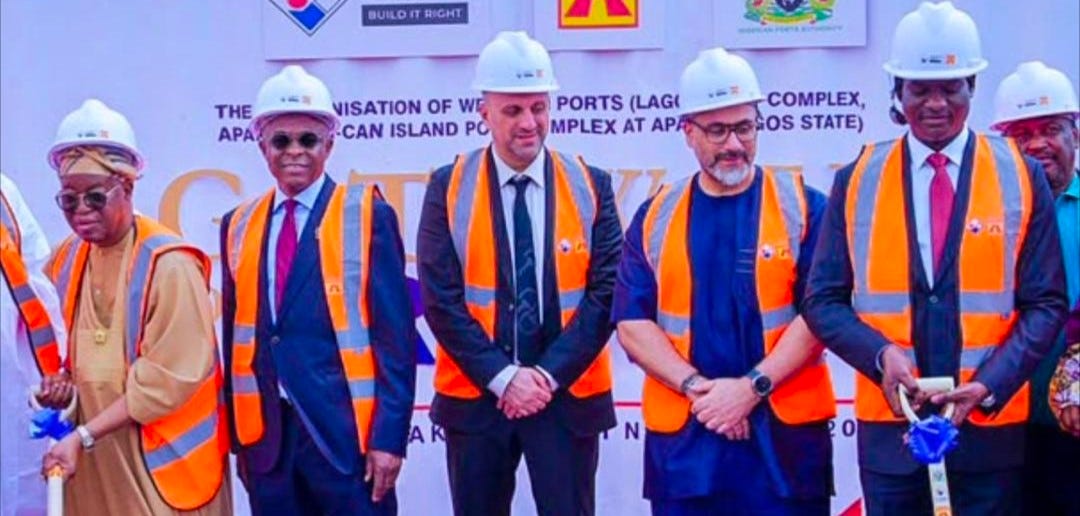
The project, valued at £746 million, is expected to create at least 20,000 direct and indirect jobs across construction, engineering, dredging, transportation, logistics and port operations.
But the bigger promise is economic. The government wants to reduce cargo clearance time, lower the cost of doing business and attract international shipping companies that increasingly favour more efficient ports in neighbouring countries.
Nigeria’s busiest ports have struggled with ageing infrastructure and congestion for decades. Apapa Port, established in 1913, is more than a century old, while Tin Can Island Port began operations in 1977.
When Tin Can was commissioned, Nigeria recorded annual cargo throughput of about 8.11 million metric tonnes. That figure has since increased to 129.3 million metric tonnes, while annual merchandise trade has grown beyond $100 billion.
The infrastructure, however, has not expanded at the same pace.
Oyetola said cargo dwell time at Nigerian ports historically ranges between 10 and 18 days, compared with three to five days at leading international ports.
These delays increase demurrage, storage charges and transportation costs for importers and exporters. The minister estimated that port inefficiencies cost the Nigerian economy as much as $4 billion annually.
The modernisation will cover the rehabilitation of quay walls and berths, dredging of navigation channels, improved access facilities, new cargo-handling equipment and digitally enabled operational systems.
The government also hopes to attract more direct calls by international shipping lines, retain Nigerian-bound cargo and expand transshipment opportunities.
This is important because Nigeria continues to lose maritime business to countries that have invested heavily in modern port infrastructure. Neighbouring ports have become attractive alternatives for shipping companies seeking faster cargo handling and lower operating costs.
The consequences extend beyond the maritime industry. Delays at ports increase the cost of imported goods, affect manufacturers that depend on raw materials and weaken the competitiveness of Nigerian exports.
For farmers and exporters, inefficient cargo movement can mean missed delivery schedules and additional costs. For manufacturers, it can disrupt production and increase the price of finished products.
FINANCING AND IMPLEMENTATION
Finance Minister Taiwo Oyedele described the financing arrangement as Nigeria’s largest sovereign export credit transaction since 2009. He also said it was the first Nigerian project involving Poland’s Export Credit Insurance Corporation, KUKE.
The project follows a £746 million financing arrangement backed by international export credit support.
However, the commencement comes after earlier timelines were missed. The government had initially indicated that construction would begin in the second quarter of 2026. Another projection placed contractor mobilisation in the third quarter.
Neither timeline was met.
The Nigerian Ports Authority (NPA) has previously indicated that the construction period would last 48 months, suggesting completion around the end of 2030.
Oyetola said an inter-ministerial committee had been approved to coordinate construction and prevent major disruptions to port activities. The committee will oversee vessel scheduling, cargo evacuation, truck traffic and the use of alternative ports and transport routes.
NPA Managing Director Abubakar Dantsoho also pledged that the project would follow approved engineering standards, contractual timelines and safety requirements.
The immediate beneficiaries could include construction workers, logistics companies, manufacturers, exporters and businesses that depend on imported goods. Nigerian consumers could also benefit if lower port costs eventually translate into cheaper products.
But taxpayers and the federal government carry the financial responsibility for the investment. The government must therefore ensure that the financing delivers measurable economic returns rather than another expensive infrastructure project plagued by delays.
The Lagos upgrade is also part of a wider maritime programme covering Onne Port in Rivers State, Delta Port and Calabar Port.
Bottom Line: Nigeria has finally started rebuilding two ports that have struggled to support the country’s expanding trade. But a ₦1.45 trillion investment will only be worthwhile if it reduces cargo delays, lowers business costs and makes Nigerian ports competitive with their regional counterparts.