


The European Union Support to Democratic Governance in Nigeria (EU-SDGN) Election Observation Hub has released its report on the Ekiti and Osun off-cycle governorship elections. It describes vote trading as rampant. Voters received up to ₦50,000 for their ballots. The report was presented in Abuja on Tuesday. The Hub comprises the Kukah Centre, TAF Africa, the Nigerian Women Trust Fund, Yiaga Africa, the International Press Centre, and the Centre for Media and Society (CEMESO).
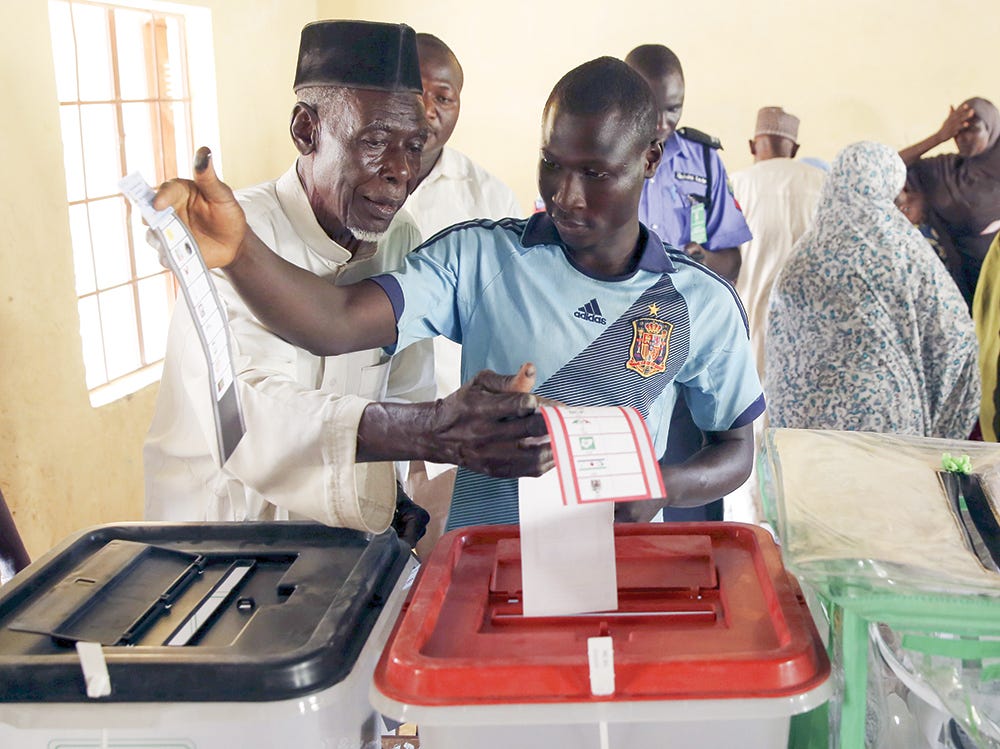
Vote-buying is not new in Nigeria. In 2018, the Ekiti governorship election was described as a cash-for-votes carnival. In 2022, the Osun election saw similar allegations. The practice has evolved. It is now organised and standardised. Party agents are the primary actors. In 2022, the National Assembly amended the Electoral Act to criminalise vote-buying. Enforcement has been weak. The 2026 elections confirmed the gap between law and practice.
Professor Bolade Eyinla, reading the Hub’s findings, said vote trading has become a pandemic. “If we don’t do anything about it, the sanctity of the vote and freedom of choice is beginning to come under severe threat and pressure,” he said. He described the method. A voter marks the ballot, then shows it to party agents. Once the agent confirms compliance, payment follows. “Originally, I was thinking payment was within the range of ₦10,000 or thereabouts, but the report from Osun even told me that people got ₦50,000.” He emphasised the scale. “If you divide ₦50,000 by the number of voters in Osun, how much that will amount to in terms of the volume of money involved.”
The data is stark. 77% of the 84 verified incidents were vote trading. Party agents were the main actors in at least 90% of those cases. In Osun, the figure was 69%. Eyinla lamented that offenders remain unpunished. “Maybe the IG will tell us if they are arrested. And the result of that is that everybody has assumed a sense of impunity.” He called for ward-level result uploads, noting that most irregularities occur at that level.
The Hub deployed 598 observers across all 16 LGAs in Ekiti on 20 June and 823 observers across all 30 LGAs in Osun on 15 August. Dr Akin Akingbulu of CEMESO said more than 1,400 trained Nigerians watched, counted and verified. The Hub commended INEC for a near-perfect election and security agencies for ensuring peaceful polls. But it warned that the integrity of the vote is under threat.
Winners: Political parties with the deepest pockets. Party agents, who orchestrated the transactions. Candidates who benefited from purchased votes. Losers: Voters who sold their consciences for ₦50,000. The electoral process, which was corrupted. INEC, whose credibility suffers despite its logistical success. The police, whose failure to arrest anyone signals impunity. Nigeria’s democracy, which is being hollowed out from within.
Bottom Line: Votes sold for ₦50,000. No arrests. No prosecutions. The Electoral Act criminalises vote-buying, but the law is not enforced. Until offenders face consequences, vote trading will remain a pandemic. The 2027 general election is the next test.