


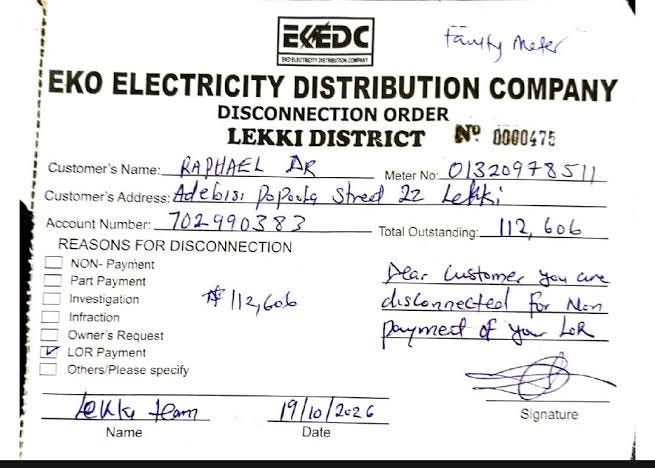
Eko Power has cancelled a loss-of-revenue charge issued to a customer who installed a solar system. The charge was ₦112,606. The company also withdrew a disconnection notice. The customer was never disconnected. The company said it supports customers who invest in alternative energy. The company issued the statement on Friday in Lagos.
Nigerian electricity customers have faced billing disputes for decades. Estimated billing was the norm. Prepaid meters reduced some friction. They created new disputes. Low consumption can trigger suspicion of meter bypass. Customers who install solar reduce their grid purchases. That reduces revenue for distribution companies. Companies must balance cost recovery with customer choice. Regulators set rules on disconnection and back-billing. Enforcement is uneven. Customers often cannot prove their meters are faulty. The burden falls on them.
Raphael Awoseyin installed an 18-kilowatt solar power system. He relied on solar during the day. He used Eko Power as backup at night. He last purchased tokens in July 2026. He still had units remaining. Eko Power personnel inspected his prepaid meter. They suspected a bypass. They issued a disconnection notice. They demanded ₦112,606 as a loss-of-revenue charge.
Awoseyin offered to have the meter tested. He said the company needed to recover the amount. He said he briefly switched to the company’s supply to show that the meter could record consumption. The meter recorded it. The personnel returned the next day with the disconnection notice.
Eko Power's General Manager of Corporate Communication, Abiola Aloba, responded. He said the charge had been fully cancelled. “It should not have been made, and the customer doesn’t owe us,” he said. He said the company withdrew the disconnection notice. The customer was never disconnected. He said the prepaid meter had been in service for many years. Testing found it to be faulty. The company replaced it at no cost. He said there would be no back-billing or reconciliation charges. He said low electricity consumption is not a reason to disconnect anyone.
Winners: Awoseyin, who avoids the charge and gains a new meter. Solar users, who gain reassurance. Eko Power, which limits reputational damage. The regulator, if its rules are followed. Losers: Eko Power, whose staff issued a wrongful demand. The company’s revenue, which falls as solar adoption grows. Customers who lack the confidence to challenge similar charges. DisCos facing falling grid purchases.
Bottom Line: A solar customer was billed for using less power. The company cancelled the charge. The meter was faulty. The customer was right. Solar adoption will grow. DisCos must adapt. Penalising customers for reducing consumption is not a revenue strategy. It is a complaint waiting to happen.